





Definition and Importance of North Carolina Communicable Disease Reporting
The North Carolina communicable disease reporting system is a structured approach to monitor and control infectious diseases within the state. This reporting process is crucial for public health officials to identify outbreaks, allocate resources effectively, and implement control measures to protect the community. A communicable disease is defined as an illness caused by a specific infectious agent or its toxic products, which can spread from one person to another.
Reporting is mandatory for healthcare providers in North Carolina, and timely submission is vital for the protection of public health. When cases are reported promptly, outbreaks can be swiftly managed, ultimately reducing the spread of diseases such as influenza, tuberculosis, or sexually transmitted infections.
- Purpose: The primary aim is to ensure that significant public health risks are identified promptly, and appropriate actions are taken.
- Legal Requirement: North Carolina laws mandate the reporting of specific communicable diseases to relevant health departments, making compliance essential for healthcare providers.
Steps to Complete the North Carolina Communicable Disease Reporting Form
Completing the North Carolina communicable disease reporting form involves several critical steps, which ensure accurate and comprehensive reporting. Healthcare providers must adhere to the guidelines set forth by the North Carolina Department of Health and Human Services.
- Identify the Disease: Determine if the condition is on the list of reportable communicable diseases in North Carolina. This list is updated regularly and can be accessed through state health department resources.
- Gather Patient Information: Collect detailed patient information, including demographics, clinical findings, and laboratory results. Ensure that the data is accurate and complete.
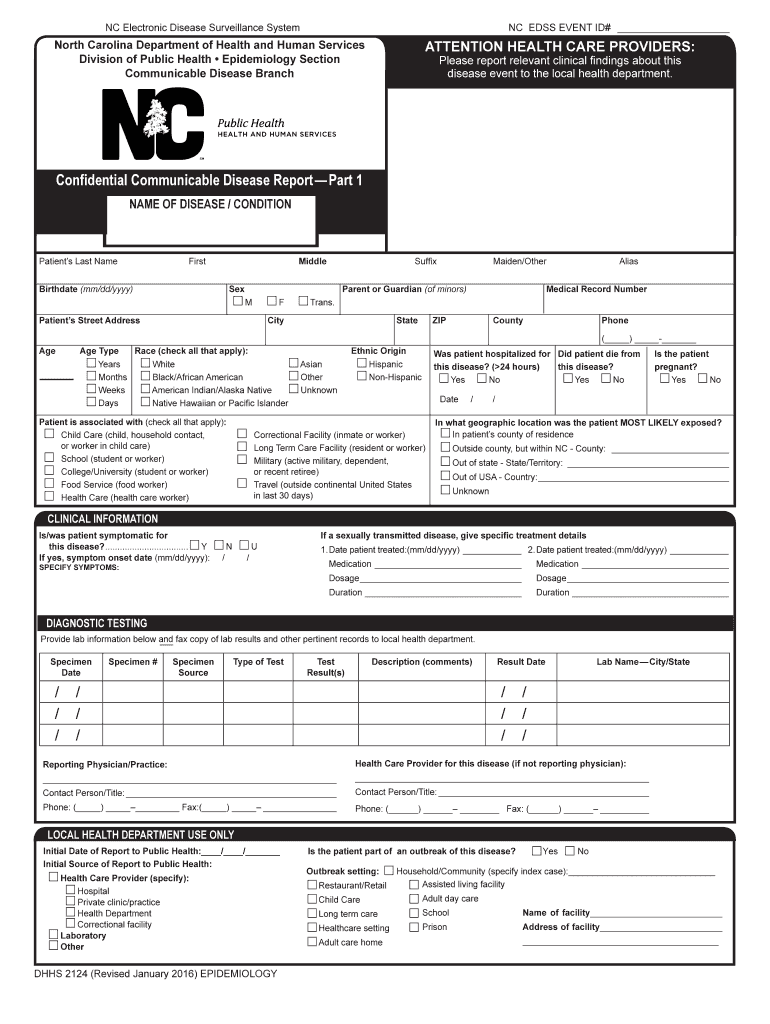
- Complete the Form: Fill out the NC communicable disease reporting form thoroughly. Each section of the form must be completed, including details about the suspected or confirmed diagnosis and any outbreak associations.
- Submit the Form: Depending on the guidelines, submit the form electronically through the NC Electronic Disease Surveillance System (EDSS) or as a hard copy to the appropriate local health department. Ensure adherence to submission timelines to facilitate swift public health responses.
- Follow Up: After submission, healthcare providers should confirm that the report has been received and processed by the health department.
Key Elements of the North Carolina Communicable Disease Reporting Form
The North Carolina communicable disease reporting form is designed with several key elements that facilitate effective data collection and disease monitoring. Understanding these elements is vital for accurate reporting.
- Patient Information: This section captures essential demographic data such as name, age, gender, and contact information. Correct and complete information assists in tracking disease trends within populations.
- Clinical Description: Healthcare providers must provide specific details about the illness, including symptom onset date, diagnosis, and treatment given. This helps public health officials assess the severity and spread of the disease.
- Laboratory Results: Documentation of lab tests, including type, date of testing, and results, is crucial. These results help verify the diagnosis and inform epidemiological investigations.
- Outbreak Association: If the case is tied to an outbreak, the form requires the reporting of potential exposure sources, such as travel history or contacts with infected individuals, to aid in outbreak management.
Important Terms Related to North Carolina Communicable Disease
Understanding the terminology associated with the North Carolina communicable disease reporting form enhances compliance and accuracy in submissions.
- Reportable Diseases: A categorized list of diseases that healthcare providers must report to public health authorities, including sexually transmitted infections and vaccine-preventable illnesses.
- Confidentiality: Legal protections are in place to ensure patient privacy when reports are submitted, emphasizing the importance of secure handling of sensitive information.
- Public Health Surveillance: The continuous, systematic collection and analysis of health data which informs public health responses and policy-making.
- Epidemiology: The study of how diseases spread among populations, which is directly supported by data collected through these reports.
Legal Use and Obligations for Reporting Communicable Diseases in North Carolina
Healthcare providers have binding legal obligations when it comes to reporting communicable diseases in North Carolina. Failure to comply can result in serious repercussions, including fines and legal penalties.
- Mandated Reporting: Healthcare providers are required by law to report specified communicable diseases within a set timeframe. These deadlines may vary depending on the disease and are critical for community health safety.
- Penalties for Non-Compliance: Not submitting a report, or failing to do so in a timely manner, can lead to disciplinary actions against providers, highlighting the importance of adherence to these legal requirements.
- Anonymity and Protection: Information reported is often anonymized to protect patient identity, but providers must be aware that they still need to comply with regulations regarding patient data security and confidentiality.
Examples of Using the North Carolina Communicable Disease Reporting Form
Real-world scenarios illustrate how healthcare providers utilize the North Carolina communicable disease reporting form effectively.
- Outbreak Situations: During an outbreak of a communicable disease, such as mumps, a healthcare provider identifies multiple cases among the same community. They use the form to report cluster cases, which prompts public health intervention and vaccination campaigns.
- New Infections: A laboratory confirms a new case of tuberculosis in a patient. The healthcare provider completes the reporting form to notify public health officials, who follow up with contact tracing and further epidemiological investigation.
- Regular Reporting: Routine reporting of sexually transmitted infections by clinics ensures that public health officials have updated data to address prevention efforts and resource allocation effectively.
Summary of Submission Methods for the North Carolina Communicable Disease Reporting Form
Submitting the North Carolina communicable disease reporting form can be carried out through various methods, with electronic submission being the most streamlined.
- Online Submission: Healthcare providers can submit forms directly through the NC Electronic Disease Surveillance System (EDSS), which allows for efficient processing and easy tracking of submissions.
- Mail Options: For providers who prefer or require hard copies, completed forms can be sent via mail to local health departments. It's crucial to ensure accurate addressing to avoid delays in processing.
- In-Person Delivery: Providers may also choose to deliver forms directly to health department offices, facilitating immediate confirmation of submission receipt and any required follow-up discussions.
Understanding these processes ensures that healthcare providers can effectively fulfill their reporting obligations while supporting public health initiatives in North Carolina.