Type text, add images, blackout confidential details, add comments, highlights and more.
02. Sign it in a few clicks
Draw your signature, type it, upload its image, or use your mobile device as a signature pad.
03. Share your form with others
Send it via email, link, or fax. You can also download it, export it or print it out.
How to use or fill out close estate with our platform
Ease of Setup
DocHub User Ratings on G2
Ease of Use
DocHub User Ratings on G2
Click ‘Get Form’ to open the close estate document in the editor.
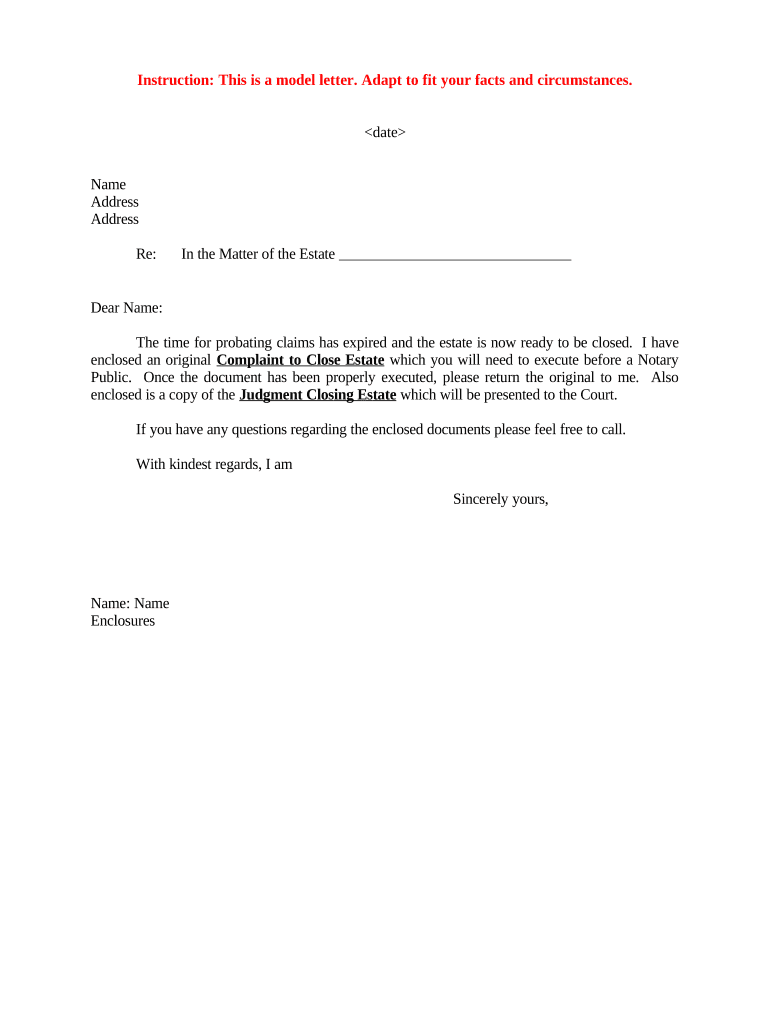
Begin by filling in the date at the top of the form. This is essential for record-keeping and legal purposes.
Next, enter your name and address in the designated fields. Ensure that all information is accurate to avoid any delays.
In the section labeled 'In the Matter of the Estate', clearly state the name of the estate you are closing. This identifies which estate is being referenced.
Review any enclosed documents, such as the original Complaint to Close Estate, and ensure you understand what needs to be executed before a Notary Public.
Once completed, save your changes and prepare to print or share your document for notarization as required.
After notarization, return the original document as instructed. Keep a copy for your records.
Start using our platform today to streamline your close estate process for free!
Waiting to see if the Will is challenged By waiting ten months, the executor has the chance to see whether anyone is going to raise an objection. There are six months from the date of the Grant of Probate in which to commence a claim under the Inheritance (Provision for Family and Dependants) Act 1975.
How long can an estate remain open?
Most estates in California are closed within 9 to 18 months, but there are complications that may delay the process. Executors are encouraged to close the estate quickly to prevent legal issues and further expenses. For probate guidance and assistance, contact Angelique Friend for expert advice and assistance.
How do I close off an estate?
Key steps Organize the funeral. Obtain the required documents. Take inventory of the estate. Draft a notice of closure of inventory. Notify the beneficiaries. Notify organizations and service providers (phone and internet services, etc.) Open an estate account. Ensure assets are secure.
How long should an executor take to settle an estate?
While an executor is generally expected to settle an estate within 12 months, there are reasons that the executor may file for an extension that allows for additional time to address complex issues related to the probate case.
How long do you have to wait to close an estate?
Timeline for Settling Estates in California The courts take steps to move the process along, and the executor of an estate generally has 12 months to complete the probate process and pay heirs or beneficiaries from the estate. This payout can only happen once all debts have been paid.
Related Searches
How does an executor close an estateFailure to close estateDo you need a lawyer to close an estateHow long do you have to close an estateWhat do I need to close an estate bank accountWhat happens when you close an estate accountEstate closing letter to beneficiariesHow to close an estate in NJ
Security and compliance
At DocHub, your data security is our priority. We follow HIPAA, SOC2, GDPR, and other standards, so you can work on your documents with confidence.
Closing an estate means that the executor has carried out all of their duties and that theres nothing left to do to manage the estate other than distributing assets.
What does notice to close estate mean?
Though you hear the term consistently, there is no such thing as Closing an Estate. Probate instructions never tell you how to Close the Estate, because it never actually happens. The term refers to the distribution of the estates final assets, which typically means that the Executor has run out of things to do.
What is the 3-year rule for a deceased estate?
The deceased estate 3-year rule provides specific tax concessions for the administration of the estate within the first three income years after the date of death. Heres how it works: Main Residence CGT Exemption: Generally, the sale of assets within a deceased estate triggers a capital gain or loss.
Related links
25 CFR 11.712 - Closing estate. - Legal Information Institute
(a) Upon finding that the estate has been fully administered and is in a condition to be closed, the court shall enter an order closing the estate and
notice of intent to close estate - Michigan Courts
The court will close the administration of this estate and terminate the personal representatives authority within 63 days of this notice unless any of the
Cookie consent notice
This site uses cookies to enhance site navigation and personalize your experience.
By using this site you agree to our use of cookies as described in our Privacy Notice.
You can modify your selections by visiting our Cookie and Advertising Notice.