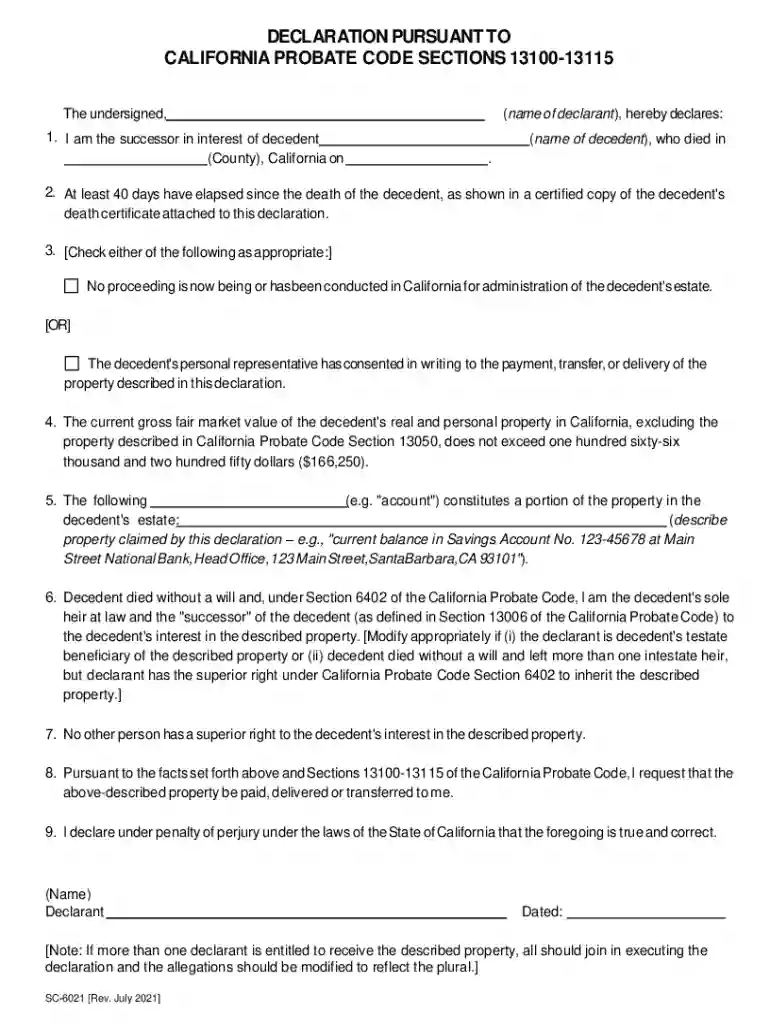
SC-6021-2026

Get Form
SC-6021 Preview on Page 1

Here's how it works

01. Edit your form online
Type text, add images, blackout confidential details, add comments, highlights and more.

02. Sign it in a few clicks
Draw your signature, type it, upload its image, or use your mobile device as a signature pad.

03. Share your form with others
Send it via email, link, or fax. You can also download it, export it or print it out.

Definition and Meaning of SC-6021

Form SC-6021 is a legally recognized document referenced under California Probate Code Sections 135, designed for use by successors in interest of a deceased person's estate. This form facilitates the claim of property by heirs or beneficiaries without undergoing full estate administration, making it an efficient solution in specific probate scenarios. It serves as a declaration form that allows the successor to assert their right to the decedent's property, contingent on meeting specific legal conditions.

Steps to Complete the SC-6021

  1. Identify Eligibility: Confirm you are a successor in interest by determining your legal relationship to the decedent.

  2. Verify Required Conditions: Ensure conditions such as a specific time lapse since death and the absence of ongoing estate administration are met.

  3. Complete the Declaration: Fill the form accurately, stating your right to claim property under penalty of perjury.

  4. Gather Necessary Documentation: Collect documents that support your claim, including death certificates and property records.

  5. Submit the Form: File the completed form with the appropriate county office or court handling the decedent’s estate.

Key Elements of the SC-6021

  • Declarant’s Identification: Direct details of the person claiming the property, including contact information and legal standing.
  • Decedent’s Information: Necessary details about the deceased, such as full legal name and date of death.
  • Property Description: Detailed listing of the property being claimed, including estimated value.
  • Affirmation of Conditions: Statements confirming the procedural conditions, like the timeline since death and the absence of estate proceedings, are satisfied.

Who Typically Uses the SC-6021

Successors in interest typically utilize SC-6021, including:

  • Immediate Family Members: Such as children, spouses, and siblings, especially when they are direct heirs.
  • Designated Beneficiaries: Individuals named in a will or trust document as beneficiaries, eligible to bypass traditional probate processes.
  • Sole Heirs: In cases where the successor is the only eligible recipient of the remaining estate.
decoration image ratings of Dochub

Legal Use of the SC-6021

The form is used under legal provisions within California to streamline the property transfer process from decedent estates without administrative probate. It is legally binding when properly executed and verified, enabling successors to assert rights to assets swiftly. The declarant must affirm the veracity of their claims under penalty of perjury, reinforcing the form's legal weight.

Important Terms Related to SC-6021

  • Successor in Interest: An individual with the right to inherit property from the deceased estate.
  • Probate Code Sections 135: Legal framework guiding the use of SC-6021.
  • Declarant: The person making a formal statement on the form to claim property.
  • Estate Administration: The formal process of managing and distributing a deceased person’s assets.

Required Documents for SC-6021

  • Death Certificate: Proof of the decedent’s death.
  • Proof of Relationship: Documents verifying the legal relationship with the decedent, such as birth or marriage certificates.
  • Property Documentation: Evidence of property ownership, value, and location to substantiate the claim.
  • Affidavits or Statements: Where applicable, additional declarations may be needed to affirm compliance with California Probate Code requirements.

Software Compatibility

While the SC-6021 is primarily a legal document manually completed and submitted, digital facilitation tools like DocHub can streamline form management:

  • Document Editing Platforms: These platforms allow users to fill out PDF forms digitally, aiding accuracy and efficiency.
  • Cloud Integration: Tools compatible with cloud storage support accessible sharing and secure storage of completed forms.
  • Legal Software: Certain legal management applications may offer templates or assistance aligned with state-specific forms such as SC-6021.

Penalties for Non-Compliance

Failing to adhere to the conditions and requirements of the SC-6021 could result in:

  • Legal Actions: Misrepresentation or omission in the declaration may lead to legal penalties or prosecution.
  • Property Claim Denial: Courts may dismiss claims if the form is incorrectly completed or submitted without proper documentation.
  • Delays in Inheritance Processing: Non-compliance can significantly delay property transfers, complicating estate settlement.

By understanding these facets of the SC-6021, users in California can ensure proper inheritance processing through informed and compliant form utilization.

See more SC-6021 versions

We've got more versions of the SC-6021 form. Select the right SC-6021 version from the list and start editing it straight away!
Versions Form popularity Fillable & printable
2021 4.4 Satisfied (22 Votes)
2012 4 Satisfied (32 Votes)
be ready to get more

Complete this form in 5 minutes or less

Get form

Got questions?

We have answers to the most popular questions from our customers. If you can't find an answer to your question, please contact us.
Contact us

eSignatures are an excellent alternative to traditional signing, as they save time, effort, and money people spend on printing, scanning, and paper delivery. You can eSign your SC-6021 utilizing a reliable and powerful online document processing services like DocHub. It complies with main eSignature regulations (ESIGN and UETA), so all forms approved there are legally binding and have the same validity as physically signed ones.

When you edit your SC-6021 with DocHub, you will not need to look for other applications or solutions to sign it. An electronic signature is a component of DocHub’s comprehensive editing toolset, which enables you to implement changes in your form without switching between websites. Simply complete your form, double-check the correctness of the information and place your electronic signature at the end to make it submission-ready in minutes.

Deceased died with a Will If you are named as an heir, you may have to prove to the estate trustee that you are the person named. This can be done by showing the estate trustee identification or providing an affidavit.
Probate Code 13100 13115 provide for a summary procedure to transfer the personal property of a decedent without going through a probate action if the decedents estate is valued at less than $150,000 and at least forty (40) days have elapsed since the death of the decedent.
Usually, you have to fill out court forms and appear in court to: Prove to the Court that the Will is valid (this is usually routine), Appoint a legal representative with authority to act on behalf of the decedent, Identify and inventory the decedents property, and have that property appraised, Pay debts and taxes, and.

Security and compliance

At DocHub, your data security is our priority. We follow HIPAA, SOC2, GDPR, and other standards, so you can work on your documents with confidence.

Learn more
ccpa2
pci-dss
gdpr-compliance
hipaa
soc-compliance
be ready to get more

Complete this form in 5 minutes or less

Get form

People also ask

To establish heir status in California, you may file an affidavit of heirship in the Superior Court of the county where your deceased family members property is located. California family code states that the petition must include the heirs basic information including a description of the property you are claiming,
The potential heir petitions the appropriate court to issue a decree of determination of heirship at a future hearing. If granted, it establishes the petitioner as an heir to the estate and that their claim to property is valid.
What is an Affidavit of Heirship? An affidavit of heirship is exactly what it sounds like a document meant to prove your relationship with the decedent and determine the right to inherit. The point of an affidavit of heirship, however, is to aid in skipping the probate process.

Related links