






Definition and Meaning
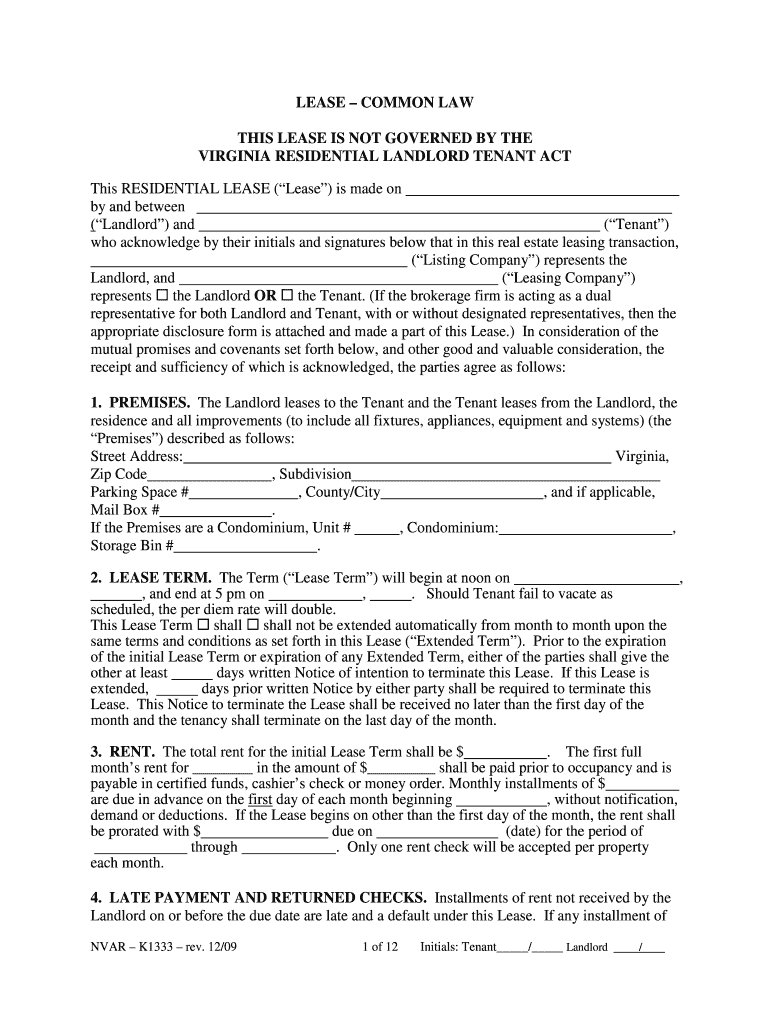
The "lease common law 2009 form" is a legal document used primarily in leasing arrangements governed by the common law framework as opposed to statutory rules. This form delineates the responsibilities and rights of both the landlord and the tenant in a leasing contract. By emphasizing a common law approach, this form avoids the statutory constraints that certain residential tenants might encounter under acts like the Virginia Residential Landlord Tenant Act. This allows for greater flexibility in drafting terms specific to the agreement.
How to Use the Lease Common Law 2009 Form
To effectively use the lease common law 2009 form, an understanding of its sections is critical. Begin by reviewing the preamble, which will outline the parties involved and the general premises. Key components include:
- Lease Terms and Duration: Specifies the start and end dates.
- Rental Payment Details: Details on how often rent is paid and what methods are acceptable.
- Tenant and Landlord Obligations: Describes responsibilities such as maintenance and repair duties.
- Termination Conditions: Protocols for ending the lease prematurely.
Proper completion involves filling out each section accurately and ensuring both parties agree on all terms before signing.
Steps to Complete the Lease Common Law 2009 Form
- Gather Information: Collect information about the landlord, tenant, and premises.
- Fill Out Lease Details: Input lease term, rent amount, and payment schedule.
- Outline Responsibilities: Clearly designate maintenance, utility payments, and insurance obligations.
- Review and Agree: Both parties review terms to ensure mutual understanding.
- Sign and Date: Once all parties agree, sign and date the form to make it binding.
Legal Use of the Lease Common Law 2009 Form
The lease common law 2009 form is utilized to formalize agreements in states with a predominant reliance on common law principles. It is essential for legal compliance that the terms do not violate state-specific common law precedents or override statutory necessities in cases where statutory law cannot be entirely excluded. The form must also comply with broader legal requirements of contract validity, including legality, capacity, and mutual consent.
Key Elements of the Lease Common Law 2009 Form
- Parties Involved: Identification of both landlord and tenant.
- Lease Agreement Details: Commencement and termination dates of the lease.
- Rent Specification: Amount, payment method, and due dates.
- Maintenance Terms: Responsibilities for property maintenance.
- Dispute Resolution: Outlines preferred methods for resolving disagreements, such as mediation or arbitration.
- Governing Law: Clauses regarding applicable state laws.
Important Terms Related to Lease Common Law 2009 Form
- Consideration: The exchange of value, usually rent, offered for the lease.
- Premises: The property being leased.
- Default: Situations under which the lease might be terminated due to unmet obligations.
- Security Deposit: Monies held by the landlord to cover potential damages or issues with the lease terms.
- Subletting: Whether the tenant has the right to lease the property to another party.
Who Typically Uses the Lease Common Law 2009 Form
This form is commonly used by landlords and tenants entering residential or small-scale commercial leases. It is especially prevalent among those seeking more bespoke arrangements that might not conform neatly to statutory frameworks, such as leases in certain states not governed by tenant-specific statutory provisions. It can also attract landlords managing properties in multiple states who prefer a single form adaptable to the common law.


State-Specific Rules for the Lease Common Law 2009 Form
Though the lease common law 2009 form follows general legal principles, some states may impose additional requirements such as:
- Security Deposit Limits: Some states regulate the amount a landlord can demand.
- Disclosure Requirements: Information that must be provided, like potential lead paint risks in older buildings.
- Termination Norms: States may have specific rules about notice periods or eviction proceedings irrespective of common law.
Penalties for Non-Compliance
Failure to comply with state-specific regulations or omissions of required disclosures could render the lease unenforceable and might result in legal penalties or disputes. An improperly executed form could also lead to damages or reimbursement claims, emphasizing the importance of complying with all applicable laws and ensuring clarity and thoroughness in documentation preparation.
Examples of Using the Lease Common Law 2009 Form
For instance, a California landlord might use this form to lease property in a manner flexible enough to tailor responsibilities not fully covered under statutory protections. Another example includes a Virginia landlord avoiding the Virginia Residential Landlord Tenant Act to create a more customized residential lease agreement that specifies unique maintenance processes not typically covered by statute.