Warranty Deed from Individual to Corporation - South Carolina 2026

Get Form
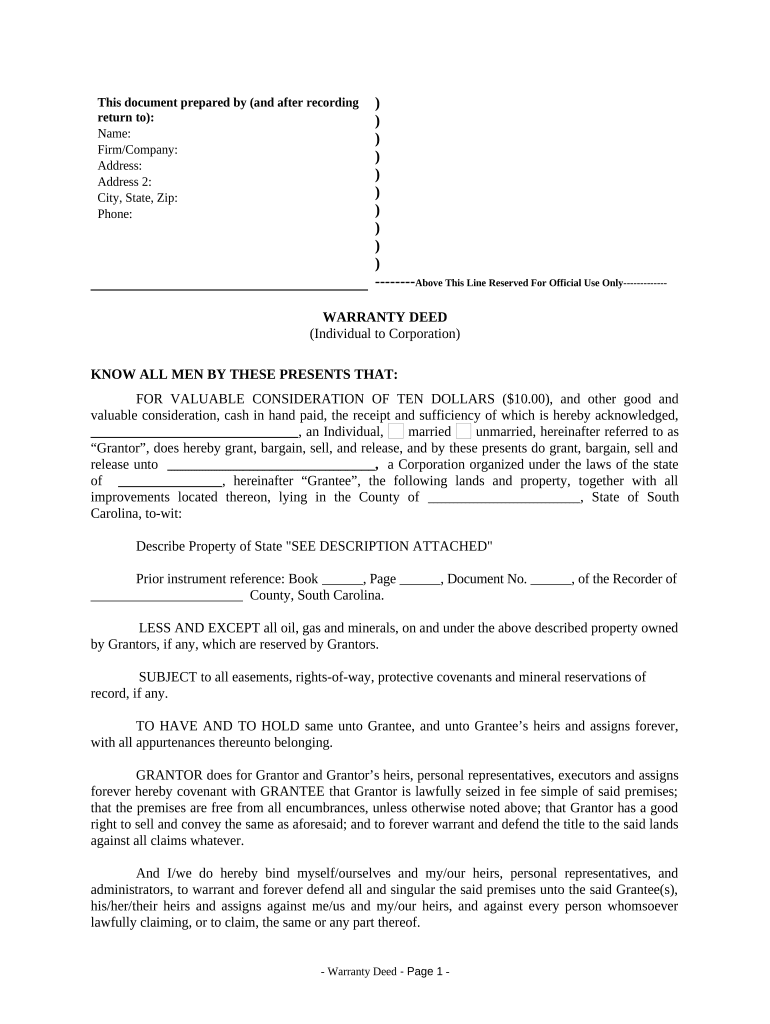
south carolina warranty deed Preview on Page 1

Here's how it works

01. Edit your south carolina warranty deed online
Type text, add images, blackout confidential details, add comments, highlights and more.
02. Sign it in a few clicks
Draw your signature, type it, upload its image, or use your mobile device as a signature pad.
03. Share your form with others
Send it via email, link, or fax. You can also download it, export it or print it out.

How to use or fill out Warranty Deed from Individual to Corporation - South Carolina

Form edit decoration
9.5
Ease of Setup
DocHub User Ratings on G2
9.0
Ease of Use
DocHub User Ratings on G2
  1. Click ‘Get Form’ to open it in the editor.
  2. Begin by entering the Grantor's name, marital status, and contact information in the designated fields. Ensure accuracy as this identifies the individual transferring the property.
  3. Next, input the Grantee's name and corporation details. This section confirms who will receive ownership of the property.
  4. Describe the property being transferred in detail. If necessary, attach a separate description document and reference it accordingly.
  5. Fill in any prior instrument references if applicable, including book and page numbers for record purposes.
  6. Complete the sections regarding easements and mineral rights, ensuring all exceptions are noted clearly.
  7. Finally, have the Grantor sign in front of a witness and notary public. Ensure all signatures are properly executed to validate the deed.

Start using our platform today to streamline your document editing and signing process for free!

be ready to get more

Complete this form in 5 minutes or less

Get form

Got questions?

We have answers to the most popular questions from our customers. If you can't find an answer to your question, please contact us.
Contact us
The process of transferring a warranty to the new homeowner can vary among providers. Some may require a transfer fee, while others may have specific steps you need to follow. Make sure you understand the transfer process and associated costs.
Warranty deeds must be signed by the grantor and acknowledged before a notary public and two witnesses, one of which can be the notary.
- a corporation can convey real estate only by the authority defined in its by lsws or on the basis of a resolution passed by its board of directors. A deed conveying corporation-owned real estate can be signed only by an authorized officer.
Special Warranty Deed Risks: The limited protection may expose buyers to title issues that arose before the sellers ownership period. This can be risky, especially for older properties or those with a complicated title history.
What Is a Corporate Warranty Deed? As mentioned above, a warranty deed is an instrument conveying real estate between two parties. When one of those parties is a corporation, a corporate warranty deed is an appropriate form for recording the transaction.

Security and compliance

At DocHub, your data security is our priority. We follow HIPAA, SOC2, GDPR, and other standards, so you can work on your documents with confidence.

Learn more
ccpa2
pci-dss
gdpr-compliance
hipaa
soc-compliance

People also ask

A deed is the legal document that transfers legal title from one person to another. A warranty deedalso known as a general warranty deedis a specific type of deed that guarantees that the owner of the property owns it free and clear, and is able to transfer the property to the seller.
You may not need to involve an attorney to create a particular deed if you already have all the information. This is especially true if you are transferring property between family members or into or out of a trust. We provide several real estate forms that can help you transfer property validly in your state.
A warranty deed is a legal document used when a piece of real estate is sold and the ownership is transferred from the grantor (seller) to the grantee (buyer). The form usually includes a description of the property and discloses all known encumbrances like easements, outstanding liens or judgments.

Related links