Letter from Landlord to Tenant as Notice of Default on Commercial Lease - District of Columbia 2026

Get Form
Letter from Landlord to Tenant as Notice of Default on Commercial Lease - District of Columbia Preview on Page 1

Here's how it works

01. Edit your form online
Type text, add images, blackout confidential details, add comments, highlights and more.
02. Sign it in a few clicks
Draw your signature, type it, upload its image, or use your mobile device as a signature pad.
03. Share your form with others
Send it via email, link, or fax. You can also download it, export it or print it out.

How to use or fill out Letter from Landlord to Tenant as Notice of Default on Commercial Lease - District of Columbia

Form edit decoration
9.5
Ease of Setup
DocHub User Ratings on G2
9.0
Ease of Use
DocHub User Ratings on G2
  1. Click ‘Get Form’ to open it in the editor.
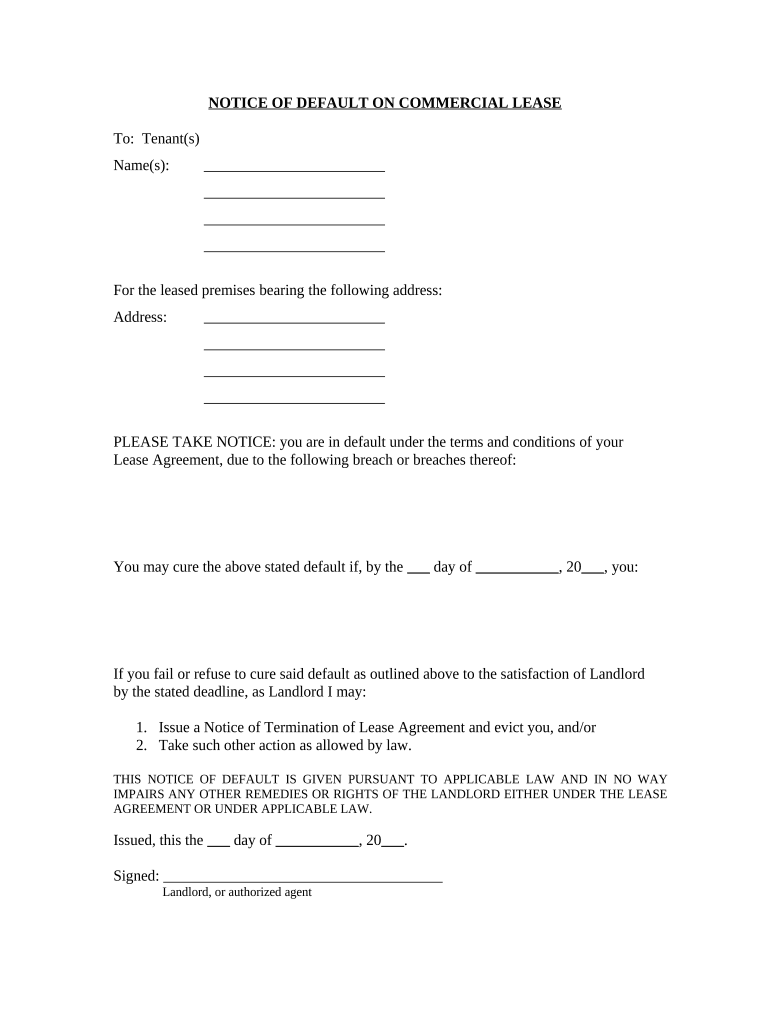
  2. Begin by entering the tenant's name(s) in the designated field at the top of the document. This ensures that the notice is addressed correctly.
  3. Next, fill in the address of the leased premises where the tenant resides. Accurate information here is crucial for clarity.
  4. In the section detailing breaches, specify the reasons for default under the Lease Agreement. Be clear and concise to avoid misunderstandings.
  5. Indicate a deadline by which the tenant must cure the default. Fill in both day and year to provide a complete date.
  6. Finally, sign and date the document at the bottom, ensuring that it is completed properly before sending it to your tenant.

Start using our platform today for free to streamline your document editing and signing process!

be ready to get more

Complete this form in 5 minutes or less

Get form

Got questions?

We have answers to the most popular questions from our customers. If you can't find an answer to your question, please contact us.
Contact us
Some of the basic rights usually afforded to commercial tenants in New Jersey include quiet enjoyment, habitable premises, repair and maintenance, security deposit return, notice of entry, non-discrimination, and eviction protection.
Dear {TENANT NAME}, You are hereby notified to vacate the premises at {RENTAL PROPERTY ADDRESS} by {DATE} and {TIME}. The reason for this eviction notice letter is: {STATE THE REASON} which is in direct violation of your rental agreement, as noted below: {INSERT THE LEASE AGREEMENT}.
Tenants can work with a trusted real estate advisor to draft their exercise letter. The exercise letter needs to reference the commercial lease, establish the effective date of the early termination, the penalty due, the circumstances of payment, and the condition of the premises upon vacation.
In California, tenants typically need to give 30 days notice, while landlords must provide either 30 or 60 days notice, depending on how long the tenant has occupied the space.
In most cases, a 30-day notice is required, but in some types of cases, a landlord is required to give the tenant as much as 90, 120, or 180-days notice before an eviction lawsuit can be filed.

Security and compliance

At DocHub, your data security is our priority. We follow HIPAA, SOC2, GDPR, and other standards, so you can work on your documents with confidence.

Learn more
ccpa2
pci-dss
gdpr-compliance
hipaa
soc-compliance

People also ask

Written notice should be given to the tenant three months before the lease term expires or before the landlord would like the tenant to vacate the property. It should state any final rental payments due and the conditions against which any deposit paid at the start of the tenancy will be returned.
Usually, the tenant can only leave at the end of a period (before the next payment of rent is due), but must give at least the amount of notice required in the lease (3 months if not contracted out).

Related links