01. Edit your sample deposition questions for defendant online
Type text, add images, blackout confidential details, add comments, highlights and more.
02. Sign it in a few clicks
Draw your signature, type it, upload its image, or use your mobile device as a signature pad.
03. Share your form with others
Send sample deposition questions for defendant car accident via email, link, or fax. You can also download it, export it or print it out.
How to use or fill out Interrogatories to Defendant for Motor Vehicle Accident - Connecticut
Ease of Setup
DocHub User Ratings on G2
Ease of Use
DocHub User Ratings on G2
Click ‘Get Form’ to open it in the editor.
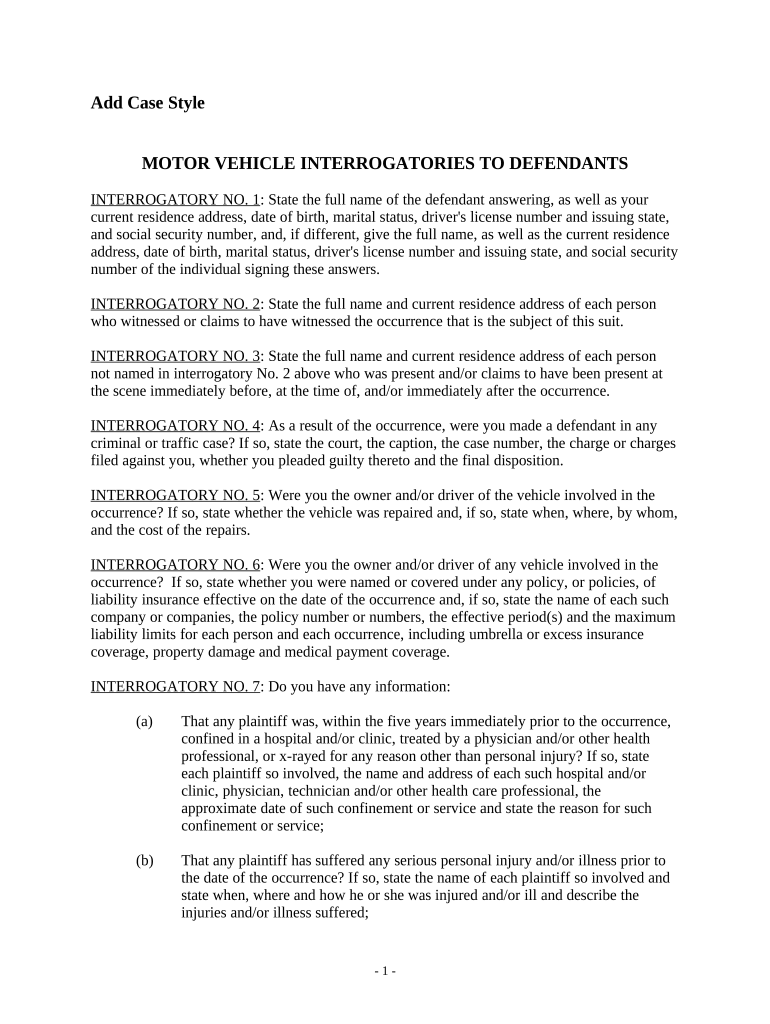
Begin with INTERROGATORY NO. 1, providing your full name, current residence address, date of birth, marital status, driver's license number and issuing state, and social security number. If someone else is signing the answers, include their details as well.
Proceed to INTERROGATORY NO. 2 by listing all witnesses who saw the incident. Ensure you provide their full names and current addresses.
For INTERROGATORY NO. 3, identify any additional individuals present at the scene before, during, or after the accident.
Continue through each interrogatory systematically, ensuring that you answer questions regarding prior injuries (INTERROGATORY NO. 7), vehicle ownership (INTERROGATORY NO. 5), and any relevant conversations (INTERROGATORY NO. 9).
Once completed, review your responses for accuracy before signing at the end of the document.
Start using our platform today to fill out your Interrogatories efficiently and for free!
Fill out Interrogatories to Defendant for Motor Vehicle Accident - Connecticut online It's free
Sample interrogatories to Defendant car accidentCar accident Interrogatories to DefendantSample answers to Interrogatories auto accidentGeneral personal injury Negligence interrogatories to defendantPremises liability Interrogatories to DefendantSample interrogatory questions to PlaintiffSample interrogatory questions to DefendantWrongful death interrogatories to defendant
Security and compliance
At DocHub, your data security is our priority. We follow HIPAA, SOC2, GDPR, and other standards, so you can work on your documents with confidence.
This guide links to advance release opinions on the Connecticut Judicial Branch website and to case law hosted on Google Scholar and Harvards Case Law AccessRead more
Pre-Trial Discovery of Insurance Coverage and Limits
by JN Fournier 1959 Cited by 46 A DEFENDANT is sued for bDocHub of contract. In advance of trial, is plaintiff entitled to discover the defendants financial ability to respond in damages?Read more
Cookie consent notice
This site uses cookies to enhance site navigation and personalize your experience.
By using this site you agree to our use of cookies as described in our Privacy Notice.
You can modify your selections by visiting our Cookie and Advertising Notice.