Type text, add images, blackout confidential details, add comments, highlights and more.
02. Sign it in a few clicks
Draw your signature, type it, upload its image, or use your mobile device as a signature pad.
03. Share your form with others
Send it via email, link, or fax. You can also download it, export it or print it out.
How to use or fill out Warranty Deed from Husband to Himself and Wife - Connecticut with our platform
Ease of Setup
DocHub User Ratings on G2
Ease of Use
DocHub User Ratings on G2
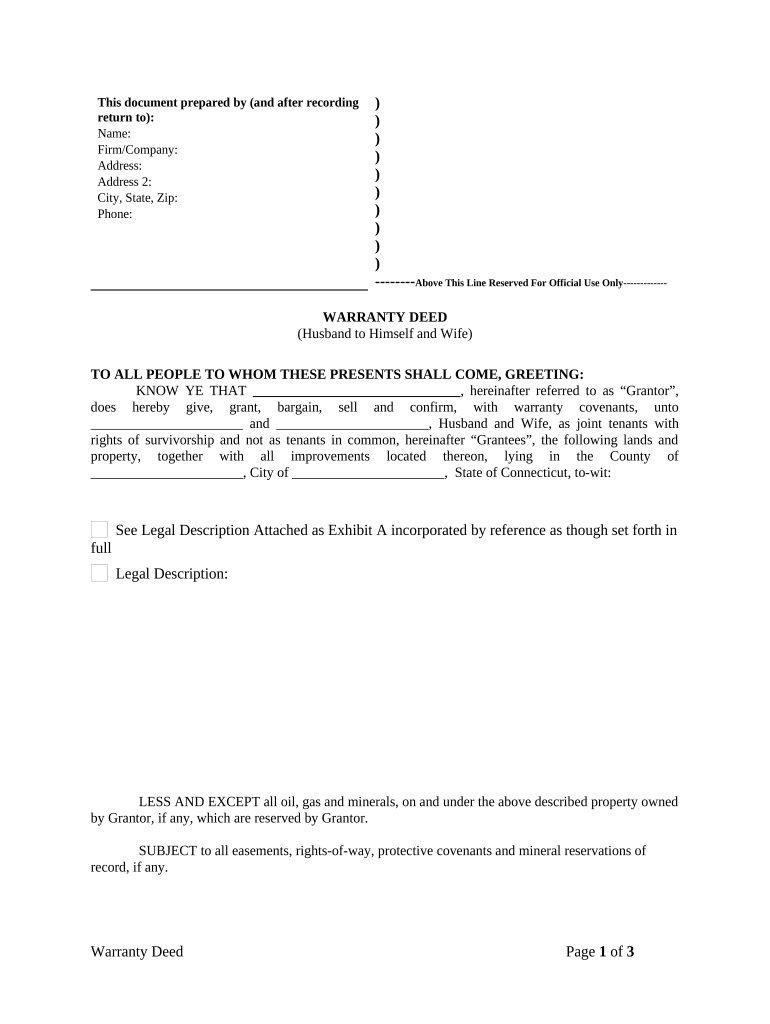
Click ‘Get Form’ to open the Warranty Deed in the editor.
Begin by entering the Grantor's name, which is the husband, in the designated field. This identifies who is transferring the property.
Next, fill in the names of both Grantees (the husband and wife) as joint tenants. Ensure you include their full names for clarity.
In the section for property description, provide a detailed legal description of the property being transferred. If you have an Exhibit A, attach it accordingly.
Complete any exceptions or reservations regarding oil, gas, and minerals if applicable. This ensures transparency about what is included in the transfer.
Sign and date the document where indicated. Make sure to have witnesses sign as well to validate the deed.
Finally, ensure that a notary public acknowledges your signatures to finalize the document legally.
Start using our platform today to easily complete your Warranty Deed online for free!
Fill out Warranty Deed from Husband to Himself and Wife - Connecticut online It's free
Estates by the Entirety: Creation Between Husband and Wife
by GH de Carion 1948 Cited by 1 An estate by the entirety may be created by the spouse holding fee simple title conveying to the other by a deed in which the purpose to create such estate is.Read more
When donee in tail liable upon covenants in a deed of warranty. 23 C. 349 Whenever a husband and wife are joint tenants in the same real estateRead more
Cookie consent notice
This site uses cookies to enhance site navigation and personalize your experience.
By using this site you agree to our use of cookies as described in our Privacy Notice.
You can modify your selections by visiting our Cookie and Advertising Notice.