Warranty Deed from Corporation to Corporation - Connecticut 2026

Get Form
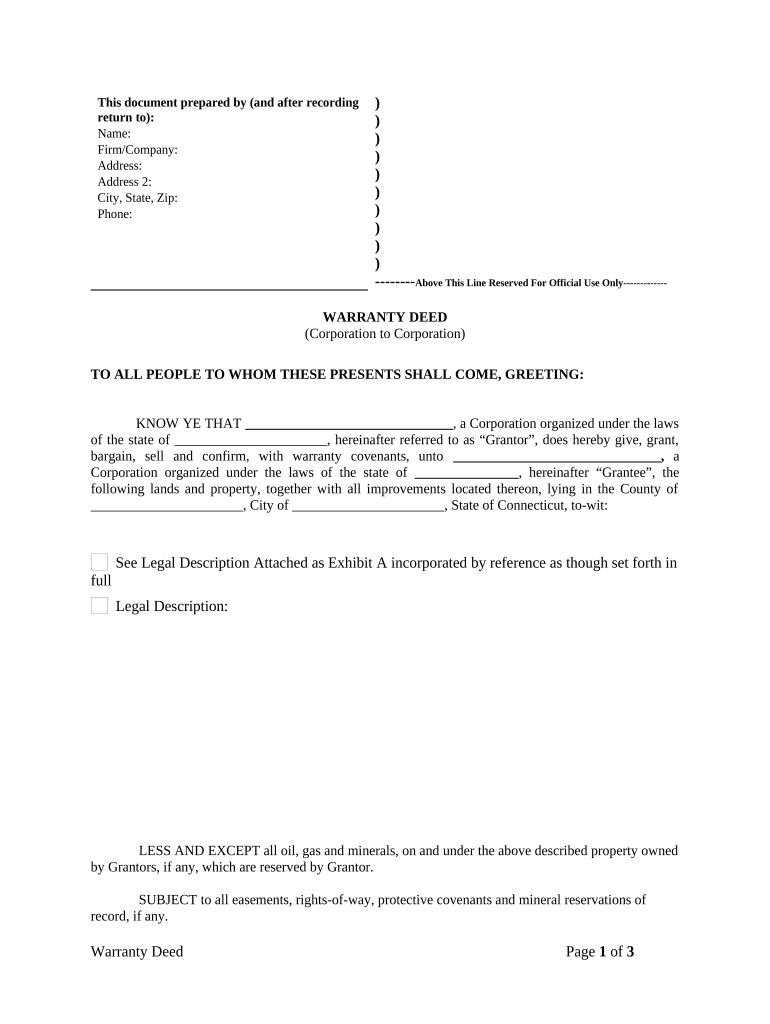
Warranty Deed from Corporation to Corporation - Connecticut Preview on Page 1

Here's how it works

01. Edit your form online
Type text, add images, blackout confidential details, add comments, highlights and more.
02. Sign it in a few clicks
Draw your signature, type it, upload its image, or use your mobile device as a signature pad.
03. Share your form with others
Send it via email, link, or fax. You can also download it, export it or print it out.

How to use or fill out Warranty Deed from Corporation to Corporation - Connecticut with our platform

Form edit decoration
9.5
Ease of Setup
DocHub User Ratings on G2
9.0
Ease of Use
DocHub User Ratings on G2
  1. Click ‘Get Form’ to open the Warranty Deed in the editor.
  2. Begin by filling in the 'Prepared by' section at the top. Enter the name, firm/company, address, city, state, zip, and phone number of the preparer.
  3. In the main body of the deed, specify the names of both the Grantor and Grantee corporations along with their respective states of incorporation.
  4. Provide a detailed legal description of the property being transferred. This may be attached as Exhibit A; ensure it is referenced correctly.
  5. Fill in any exceptions or reservations regarding oil, gas, and minerals under the property if applicable.
  6. Complete the execution section by entering the date and having authorized representatives sign and print their names along with their titles.
  7. Finally, ensure that a notary public acknowledges the signatures for legal validity.

Start using our platform today to streamline your document editing and signing process for free!

be ready to get more

Complete this form in 5 minutes or less

Get form

Got questions?

We have answers to the most popular questions from our customers. If you can't find an answer to your question, please contact us.
Contact us
A warranty deed holds the seller, or grantor, responsible for any breach after the title search, even if the breach occurred without their knowledge or during a period before the grantor owned the property. It ensures that the buyer will not be responsible for any past title defects or encumbrances.
Involuntary conveyance is the transfer of real property without the owners consent. This can take place in cases of condemnation due to neglect or natural disaster, failure to pay taxes, or the death of a property owner with no direct heirs.
There are several different essentials to a valid deed: 1. It must be in writing; 2. The parties must be properly described; 3. The parties must be competent to convey and capable of receiving the grant of the property; 4.
For a deed to legal in Pennsylvania, it must meet the following basic requirements: It must be in writing, State the name of the current owner, Include the legal description for the real estate being transferred, and.
0:18 2:05 It proves ownership and gets updated when property changes hands when a corporation transfersMoreIt proves ownership and gets updated when property changes hands when a corporation transfers property. They sign a deed this deed needs to be as official as a referees whistle.

Security and compliance

At DocHub, your data security is our priority. We follow HIPAA, SOC2, GDPR, and other standards, so you can work on your documents with confidence.

Learn more
ccpa2
pci-dss
gdpr-compliance
hipaa
soc-compliance
be ready to get more

Complete this form in 5 minutes or less

Get form

People also ask

Use a bargain and sale deed for property transactions included in foreclosure, tax, or estate settlement processes. With a bargain and sale deed, the grantee receives assurance that the grantor has clear ownership of the property, however, the grantee assumes the risk of any debts, burdens, or defects in the title.

Related links