Colorado trust 2026

Get Form
colorado trust Preview on Page 1

Here's how it works

01. Edit your form online
Type text, add images, blackout confidential details, add comments, highlights and more.
02. Sign it in a few clicks
Draw your signature, type it, upload its image, or use your mobile device as a signature pad.
03. Share your form with others
Send it via email, link, or fax. You can also download it, export it or print it out.

How to use or fill out Colorado Trust with our platform

Form edit decoration
9.5
Ease of Setup
DocHub User Ratings on G2
9.0
Ease of Use
DocHub User Ratings on G2
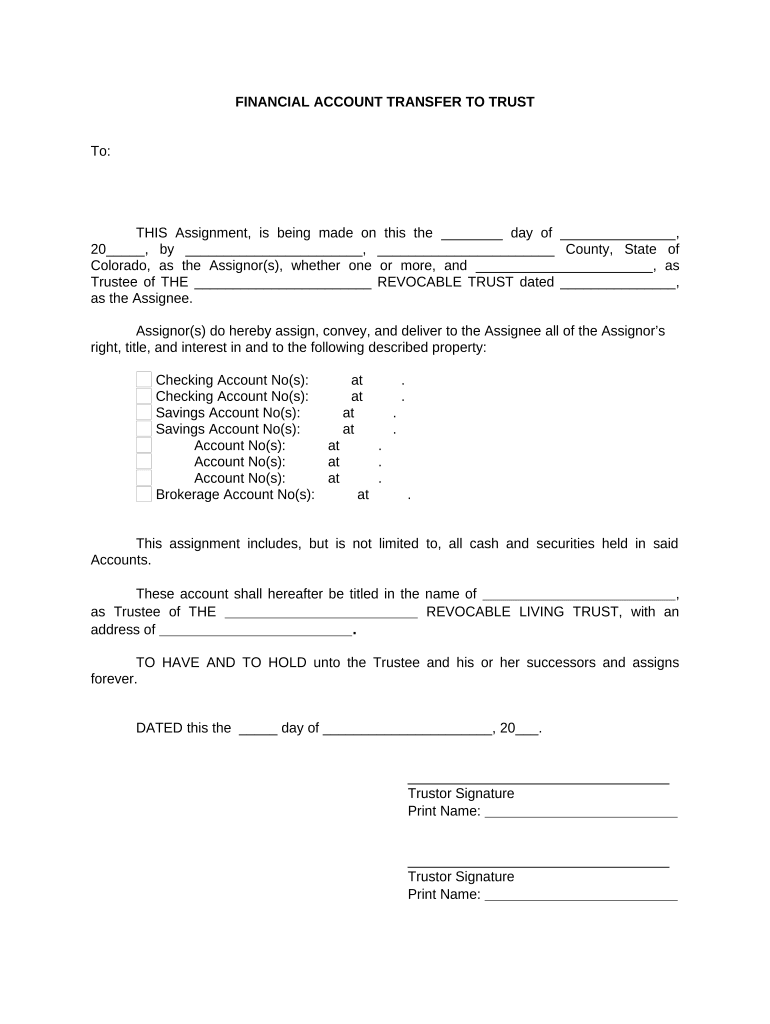
  1. Click ‘Get Form’ to open the Colorado Trust document in the editor.
  2. Begin by entering the date of the assignment in the format 'day of month, year' on the first line.
  3. Fill in your name as the Assignor(s) along with your county and state of residence.
  4. Specify the name of the Trustee and the title of the trust on the designated lines.
  5. List all relevant account numbers under 'Checking Account No(s)' and 'Savings Account No(s)', ensuring accuracy for each entry.
  6. Complete any additional account information as required, including brokerage accounts if applicable.
  7. Sign and print your name as Trustor at the bottom of the form, ensuring all signatures are completed.
  8. If necessary, have a notary public acknowledge your signature by filling out their section at the end of the document.

Start using our platform today to easily complete your Colorado Trust form online for free!

be ready to get more

Complete this form in 5 minutes or less

Get form

Got questions?

We have answers to the most popular questions from our customers. If you can't find an answer to your question, please contact us.
Contact us
Trusts are used to avoid paying estate taxes in some situations. But more often, trusts are used to control how money will be distributed out to minor children or children with drug and/or alcohol abuse problems. If you do not have minor children, a will may be all you need.
Trust is the best way. It avoids taxes since the trust is the legal owner and the trust does not die, thus no inheritance taxes. You can pass a trust to someone without any tax liabilities, and the trust goes with everything it owns.
Unlike a will, a trust doesnt have to die with you. Assets can stay in your trust, managed by the person or corporate trustee you have chosen until your beneficiaries (including minor children) reach the age(s) you want them to inherit, or to provide for a loved one with special needs.
Every resident estate and resident trust with Colorado-source income must file a Colorado Fiduciary Income Tax Return if it is required to file a federal income tax return, or if a resident estate or trust has a Colorado tax liability.
The first, and most often used reason to have a trust is to avoid the probate process needed for a will. A living trust can avoid probate. A living trust can also help with passing assets on to your loved ones with greater ease of transfer. And a living trust can allow you to control assets after you die.

Security and compliance

At DocHub, your data security is our priority. We follow HIPAA, SOC2, GDPR, and other standards, so you can work on your documents with confidence.

Learn more
ccpa2
pci-dss
gdpr-compliance
hipaa
soc-compliance