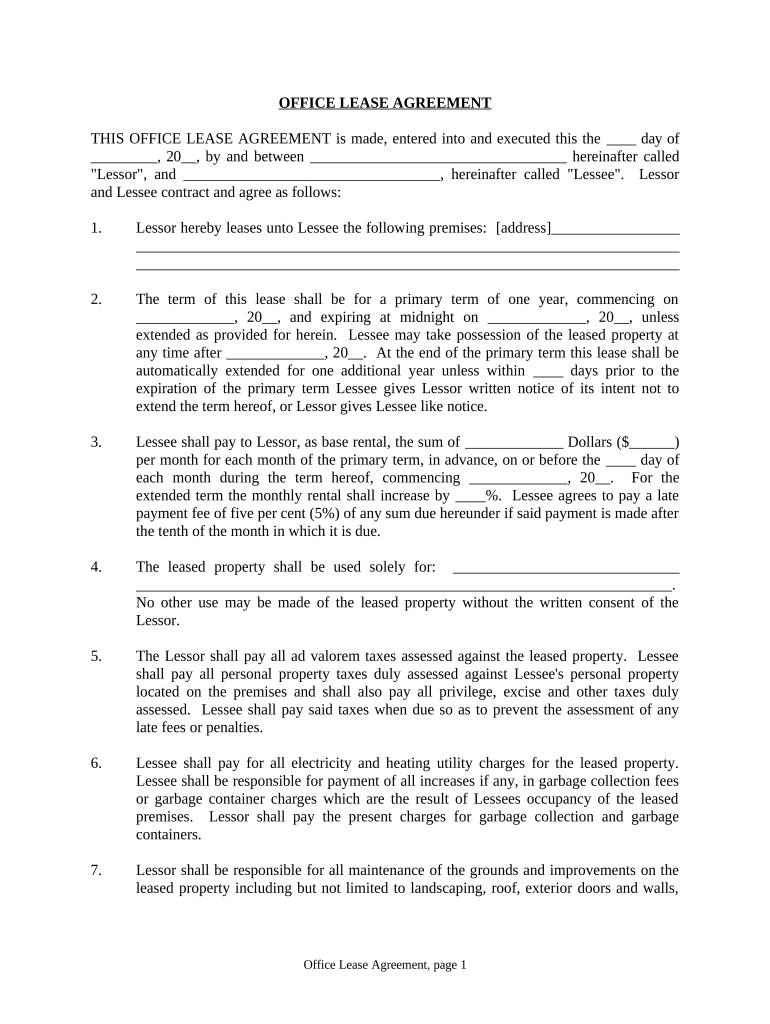
Office Lease Agreement - Colorado 2026

Get Form
office lease agreement template Preview on Page 1

Here's how it works

01. Edit your office lease agreement template online
Type text, add images, blackout confidential details, add comments, highlights and more.
02. Sign it in a few clicks
Draw your signature, type it, upload its image, or use your mobile device as a signature pad.
03. Share your form with others
Send it via email, link, or fax. You can also download it, export it or print it out.

How to use or fill out Office Lease Agreement - Colorado with our platform

Form edit decoration
9.5
Ease of Setup
DocHub User Ratings on G2
9.0
Ease of Use
DocHub User Ratings on G2
  1. Click ‘Get Form’ to open the Office Lease Agreement - Colorado in the editor.
  2. Begin by filling in the date at the top of the document, followed by the names of both Lessor and Lessee. Ensure that all parties are clearly identified.
  3. In Section 1, provide the complete address of the leased premises. This is crucial for legal clarity.
  4. For Section 2, specify the lease term start and end dates. Note any conditions for automatic renewal or termination.
  5. In Section 3, enter the monthly rental amount and payment due date. Be aware of late fees as outlined.
  6. Section 4 requires you to state the intended use of the leased property. Ensure this aligns with your business needs.
  7. Complete Sections 5 through 10 by detailing tax responsibilities, utility payments, maintenance obligations, and insurance requirements.
  8. Finally, review Sections 11 through 18 for any special provisions or additional agreements before signing at the bottom.

Start using our platform today to easily fill out your Office Lease Agreement - Colorado for free!

be ready to get more

Complete this form in 5 minutes or less

Get form

Got questions?

We have answers to the most popular questions from our customers. If you can't find an answer to your question, please contact us.
Contact us
Oral leases for a term of one year or less are binding and enforceable. Oral agreements must be treated as a written lease once a tenant has moved in or the exchange and acceptance of payment have been made. Oral leases are more complicated to prove, but they will stand up in a court of law.
Compare Commercial Lease Agreements Gross leases tend to benefit the tenant, whereas net leases are more landlord friendly. In a gross lease, the tenant has more control over how much is spent on such expenses as janitorial services and utilities.
Distinction Between NNN and Other Lease Agreements A Triple Net Lease (NNN) places the responsibility for property expenses on the tenant. This includes common area maintenance (CAM), property taxes, and insurance. In contrast, a Gross Lease includes these costs in a single rent payment, making it simpler for tenants.
A Colorado standard residential lease agreement is a contract between a landlord and tenant that defines the terms and conditions of renting residential real estate. The parties are typically bound to the agreement for a period of one year and have the option to negotiate an extension or renewal at the lease term.
The most common types include Full Repairing and Insuring Lease (FRI) lease, Gross Lease, Net Lease and Percentage Lease.

Security and compliance

At DocHub, your data security is our priority. We follow HIPAA, SOC2, GDPR, and other standards, so you can work on your documents with confidence.

Learn more
ccpa2
pci-dss
gdpr-compliance
hipaa
soc-compliance
be ready to get more

Complete this form in 5 minutes or less

Get form

People also ask

If youre wondering what is the most common type of residential lease, the answer is the fixed-term lease. This lease type locks in tenants for a set period, typically 12 months, giving landlords predictable rental income and financial security.
Gross Lease Gross leases are most common for commercial properties such as offices and retail space. The tenant pays a single, flat amount that includes rent, taxes, utilities, and insurance. The landlord is responsible for paying taxes, utilities, and insurance from the rent fees.
The Colorado General Assembly passed a law, which went into effect in April 2024, which docHubly impacts the legal landscape for landlords considering not to renew a residential lease. Under the new law landlords must now have a valid reason, or cause, to evict tenants.

Related links