Type text, add images, blackout confidential details, add comments, highlights and more.
02. Sign it in a few clicks
Draw your signature, type it, upload its image, or use your mobile device as a signature pad.
03. Share your form with others
Send it via email, link, or fax. You can also download it, export it or print it out.
How to use or fill out Alabama deposition with our platform
Ease of Setup
DocHub User Ratings on G2
Ease of Use
DocHub User Ratings on G2
Click ‘Get Form’ to open the Alabama deposition in the editor.
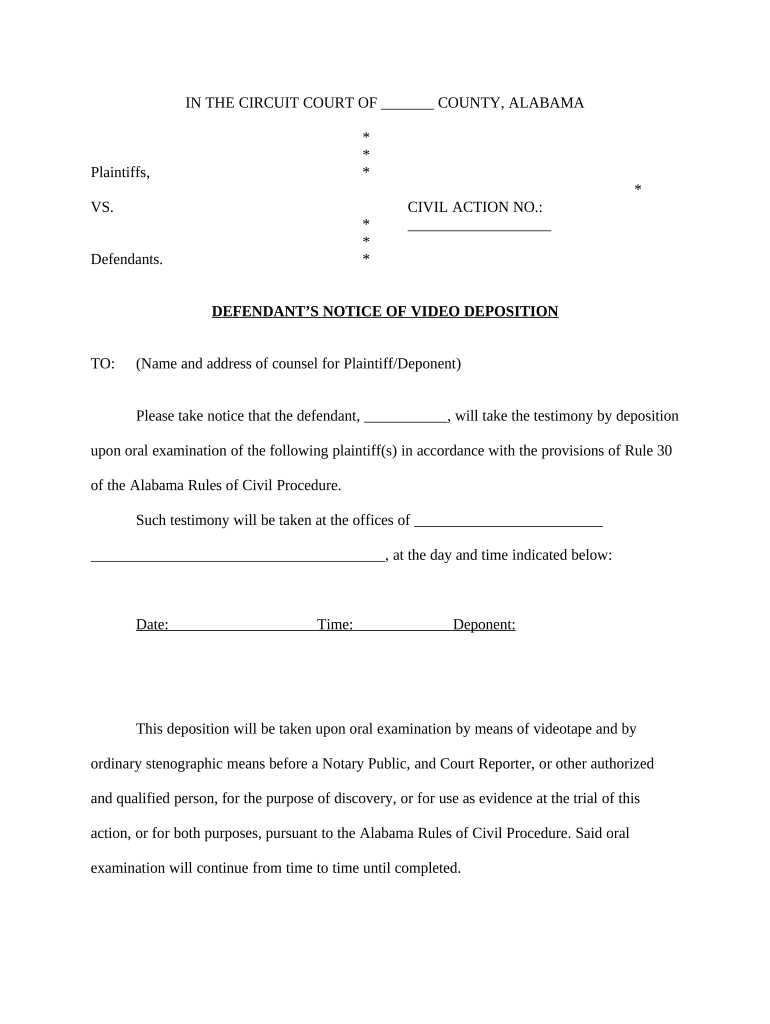
Begin by filling in the 'CIVIL ACTION NO.' section with the appropriate case number. This is crucial for identifying your case.
In the 'Defendant’s Notice of Video Deposition' section, enter the name and address of the counsel for the Plaintiff/Deponent. Ensure accuracy to avoid any legal complications.
Specify the date and time of the deposition in their respective fields. This information is essential for scheduling purposes.
Identify the deponent by entering their name in the designated field. This ensures clarity on who will be providing testimony.
Review and complete any additional sections, such as Exhibit A, which may require you to list documents that need to be produced during the deposition.
Finally, ensure all fields are filled out correctly before saving or exporting your completed document for distribution.
Start using our platform today to streamline your Alabama deposition process for free!
The 3 steps of deposition are Preparation, Deposition Itself and Follow-ups. Preparation: Review documents and practice key questions with the attorney. The Deposition: Answer questions under oath during a recorded session. Review and Follow-up: Check the transcripts accuracy and discuss next steps.
What are the three main types of deposition?
There are four main ways to conduct a pretrial deposition in modern law practice: the deposition by written question, the in-person deposition, the remote deposition, and the hybrid deposition. Each has its strengths and limitations, and each can be appropriate in the right circumstances.
Is a deposition a big deal?
Your oppositions can figure out key information about the case from the deposition process. since they will be going through the questioning process, they will also come across any hitherto unknown facts. Depending on the nature of the case, that can be a very big problem.
What usually happens during deposition?
Depositions often take a long time, occur in an attorneys office, and allow for all parties to ask questions. The testimony is then used to formulate a strategy by both sides and can decide whether the case gets settled or goes to trial.
What are three types of deposition?
Deposition is defined as a witness sworn out-of-court testimony that is reduced to writing, usually by a court reporter, for later use in court or for discovery purposes.[1] This module will discuss the different types of depositions: oral,[2] written,[3] discovery,[4] to preserve testimony,[5] and to perpetuate
Related Searches
Motion of discovery AlabamaAlabama Civil ProcedureAlabama Rules of CourtAlabama local RulesJudicial Alabama govAlabama rule 35Alabama Rules of Civil Procedure 33Alabama Rule of civil procedure 41
Security and compliance
At DocHub, your data security is our priority. We follow HIPAA, SOC2, GDPR, and other standards, so you can work on your documents with confidence.
JD Supra posted a blog on June 13 that describes the four types of depositions: written question, in-person, remote, and hybrid.
What are three examples of deposition?
Wind Gravity Deposition Sand dunes, landslides, and mudflows are also formed and/or caused by the process of deposition. A sand dune is the result of large amounts of sand moved by wind over time.
What not to say during deposition?
3 attorney answers 1. The question has already been asked and answered 2. Harassing the Witness 3. Calls for speculation 4. Overbroad 5. Vague 6. Not warranted by existing law 7. Improper purpose (to harass witness) 8. Irrelevant inquiry
Related links
Rule 30. Depositions by Oral Examination - Law.Cornell.Edu
A party may, by oral questions, depose any person, including a party, without leave of court except as provided in Rule 30(a)(2).Read more
I make this statement for the purpose of securing a WARRANT/SUMMONS against the named of accused. I understand that I am instituting a criminal.Read more
Cookie consent notice
This site uses cookies to enhance site navigation and personalize your experience.
By using this site you agree to our use of cookies as described in our Privacy Notice.
You can modify your selections by visiting our Cookie and Advertising Notice.