Fiduciary Deed for use by Executors, Trustees, Trustors, Administrators and other Fiduciaries - Kansas 2026

Get Form
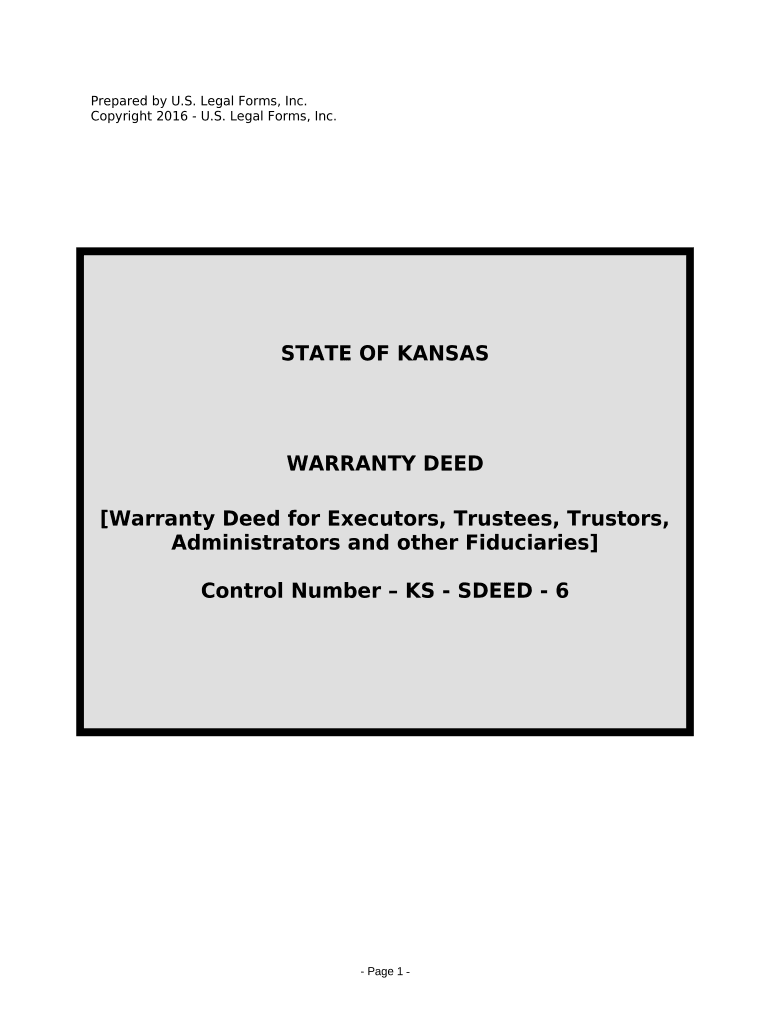
Fiduciary Deed for use by Executors, Trustees, Trustors, Administrators and other Fiduciaries - Kansas Preview on Page 1

Here's how it works

01. Edit your form online
Type text, add images, blackout confidential details, add comments, highlights and more.
02. Sign it in a few clicks
Draw your signature, type it, upload its image, or use your mobile device as a signature pad.
03. Share your form with others
Send it via email, link, or fax. You can also download it, export it or print it out.

How to use or fill out Fiduciary Deed for use by Executors, Trustees, Trustors, Administrators and other Fiduciaries - Kansas

Form edit decoration
9.5
Ease of Setup
DocHub User Ratings on G2
9.0
Ease of Use
DocHub User Ratings on G2
  1. Click ‘Get Form’ to open it in the editor.
  2. Begin by entering the Grantor's name and county in the designated fields. This identifies who is transferring the property.
  3. Specify the type of fiduciary role (executor, trustee, etc.) and provide details about the estate or trust involved.
  4. In the Grantee section, enter the names of individuals or entities receiving the property. Ensure correct spelling and titles.
  5. Describe the property being conveyed. If there is a detailed description attached, reference it appropriately.
  6. Complete any additional required fields such as prior instrument references and notary information at the end of the document.
  7. Review all entered information for accuracy before saving your changes. Use our platform’s features to navigate easily between fields.

Start using our platform today to streamline your Fiduciary Deed completion process for free!

be ready to get more

Complete this form in 5 minutes or less

Get form

Got questions?

We have answers to the most popular questions from our customers. If you can't find an answer to your question, please contact us.
Contact us
In general terms, a fiduciary is a person who owes a duty of care and trust to another and must act primarily for the benefit of the other in a particular activity.
A fiduciary deed is used to transfer property when the executor is acting in his official capacity. A fiduciary deed warrants that the fiduciary is acting in the scope of his appointed authority but it does not guarantee title of the property.
A warranty deed offers the strongest protection. It protects the party receiving the property title in case there turns out to be any issues with the title.
A deed is a written document which is executed with the necessary formality (that is, more than a simple signature), and by which an interest, right or property passes or is confirmed, or an obligation binding on some person is created or confirmed. Deeds are generally enforceable despite any lack of consideration.
A warranty deed describes the amount of the interest that the owner has in the property and guarantees that the title can be transferred without any unknown liens or other claims to block it. Fiduciary deeds are one of several types of deeds that may be used to transfer ownership of real estate or other property.

Security and compliance

At DocHub, your data security is our priority. We follow HIPAA, SOC2, GDPR, and other standards, so you can work on your documents with confidence.

Learn more
ccpa2
pci-dss
gdpr-compliance
hipaa
soc-compliance

People also ask

A Fiduciary Deed, also known as a trustees deed or personal representatives deed, is a legal document used to convey real property from one party (the grantor) to another (the grantee). A fiduciary is a person or entity entrusted with the responsibility to manage and act in the best interests of another party.

Related links