Scdmv form 400 2026

Get Form
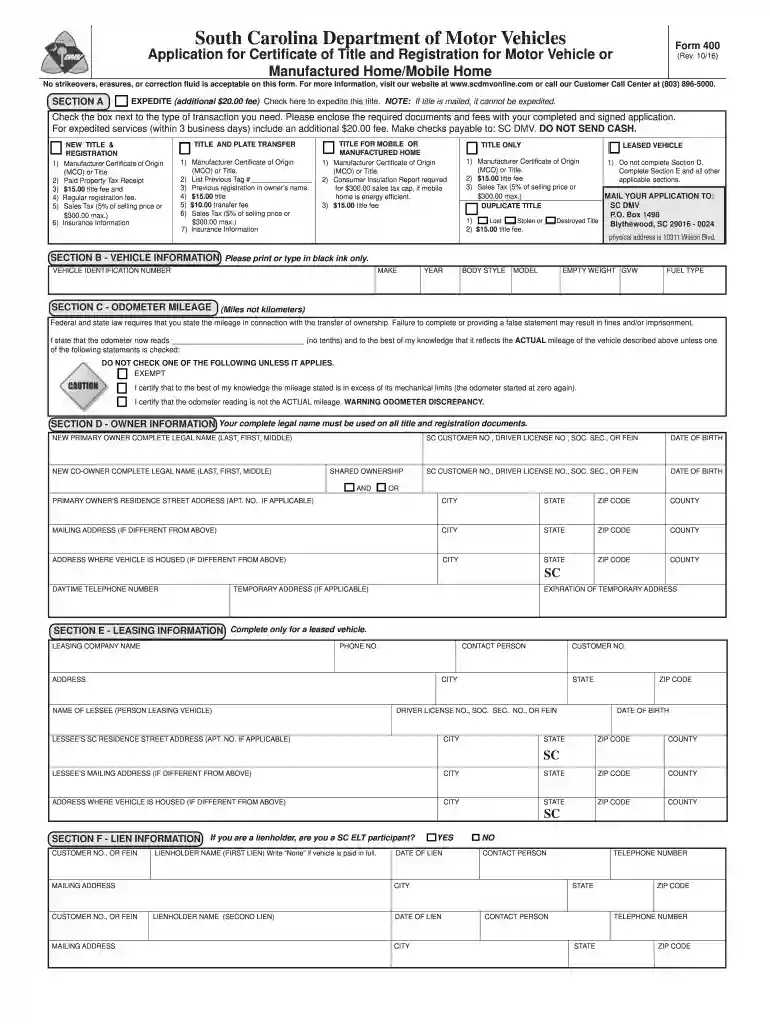
scdmv form 400 Preview on Page 1

Here's how it works

01. Edit your scdmv form 400 online
Type text, add images, blackout confidential details, add comments, highlights and more.

02. Sign it in a few clicks
Draw your signature, type it, upload its image, or use your mobile device as a signature pad.

03. Share your form with others
Send sc form 400 via email, link, or fax. You can also download it, export it or print it out.

Definition and Purpose of SCDMV Form 400

The SCDMV Form 400 is a crucial document issued by the South Carolina Department of Motor Vehicles for individuals and businesses seeking to obtain or transfer the title and registration for motor vehicles or manufactured homes. This form outlines various transaction types, including new registrations, title transfers, and duplicate title requests. It is essential for ensuring compliance with state laws regarding vehicle registration and ownership documentation.

Key Uses of Form 400

  • Vehicle Ownership Transfer: Allows the transfer of vehicle ownership from one party to another.
  • Title Application: Used to apply for a new vehicle title after purchasing a vehicle.
  • Registration Renewal: Serves as the application for renewing the registration of a vehicle.
  • Duplicate Title Requests: Applicable for obtaining a replacement title if the original is lost or damaged.

Legal Significance

The completion and submission of Form 400 is legally significant, as it verifies ownership and ensures that the vehicle is properly registered with the state. Incorrectly filing this form can lead to legal issues, including penalties or delays in obtaining a title.

How to Obtain the SCDMV Form 400

Obtaining the SCDMV Form 400 is straightforward. There are multiple methods available for individuals to access this essential document.

Sources to Access the Form

  1. SCDMV Website: The most efficient way to obtain a copy is by downloading it directly from the official South Carolina DMV website. A PDF version is often available for printing.
  2. Local DMV Offices: The form can also be acquired in person at any South Carolina DMV office, where staff can provide assistance if needed.
  3. Authorized Third-Party Services: Some third-party services may offer access to the form online along with additional support in completing it.

Printable Formats

The SCDMV Form 400 is typically available in a printable PDF format. Users can print this form at home or at local print shops to complete it by hand.

Steps to Complete the SCDMV Form 400

Filling out the SCDMV Form 400 requires attention to detail and an understanding of the required information.

General Steps for Completion

  1. Personal Information: Fill in the owner's name, address, and contact information accurately.
  2. Vehicle Information:
    • Include details such as the Vehicle Identification Number (VIN), make, model, year, and color of the vehicle.
  3. Transaction Type: Indicate the type of transaction for which you are filing the form (e.g., title transfer, new registration).
  4. Lien Information: If applicable, complete the section for lien holders and their information.
  5. Signatures and Certifications: Ensure that all required signatures are obtained and any necessary certifications regarding sales tax exemptions are completed.

Special Considerations

  • Accuracy is Key: Double-check all information for accuracy to avoid delays.
  • Required Documents: Collect and attach supporting documents, such as proof of identity, sales contract, and any previous title if applicable.

Important Terms Related to SCDMV Form 400

Understanding the terminology associated with the SCDMV Form 400 can help clarify the process and requirements.

Commonly Used Terms

  • Lien: A legal claim on the vehicle by a lender until the loan is paid off.
  • Title: The legal document that confirms ownership of the vehicle.
  • VIN: The unique identifier for a vehicle, crucial for registration and title purposes.
  • Sales Tax Exemption: Conditions under which a buyer may not need to pay sales tax on the purchase of a vehicle.

Relevance of Terms

Familiarity with these terms enhances the ability to accurately complete the form and understand the implications of the application process.

Submission Methods for the SCDMV Form 400

Once the SCDMV Form 400 is completed, submitting it can be done through various channels.

Available Submission Options

  • Online Submission: Certain qualifying applications can be submitted electronically through the SCDMV online portal. Users must create an account to access this option.
  • Mail: Completed forms can be mailed to the designated SCDMV address. Users are advised to use a secure mailing method.
  • In-Person Submission: Individuals can visit a local DMV office to submit the form directly and receive immediate assistance.

Deadlines and Timing

It is important to be aware of any deadlines associated with vehicle registration or title transfer to avoid potential penalties.

Examples of Using the SCDMV Form 400 in Real Scenarios

The practical applications of the SCDMV Form 400 extend across various scenarios, showcasing its importance for different users.

Real-World Use Cases

  • Private Sale: An individual purchases a used vehicle from a private seller and completes Form 400 to transfer the title into their name.
  • Dealer Transactions: A car dealership needs to register a new vehicle for a customer, using Form 400 to document the sale and title application.
  • Inherited Vehicle: Family members handling the estate of a deceased relative use Form 400 to transfer ownership of the inherited vehicle to the new owner.

Case Study Illustrations

  • Case of a Duplicate Title: If a title is lost, the owner can complete Form 400 for a duplicate title, providing necessary identification and any lien holder information to be issued a new title.

By understanding and utilizing the SCDMV Form 400 correctly, individuals can navigate the vehicle registration and title processes with confidence, ensuring legal compliance and smooth transitions of ownership.

See more scdmv form 400 versions

We've got more versions of the scdmv form 400 form. Select the right scdmv form 400 version from the list and start editing it straight away!
Versions Form popularity Fillable & printable
2023 4.2 Satisfied (46 Votes)
2022 4.8 Satisfied (101 Votes)
2020 4.8 Satisfied (48 Votes)
2010 4.1 Satisfied (65 Votes)
2005 4 Satisfied (25 Votes)
be ready to get more

Complete this form in 5 minutes or less

Get form

Got questions?

We have answers to the most popular questions from our customers. If you can't find an answer to your question, please contact us.
Contact us
Titling a Vehicle A transfer is processed the same as any transfer of ownership (buying or selling). Only if you do not have an SC drivers license or ID. The price and odometer reading at the time of sale must be included on the back of the title. If it is not there, you will need the Bill of Sale.
SCDMV Form 400 is the official Title Application for the South Carolina Department of Motor Vehicles, used to apply for a new title, transfer an existing title, register a vehicle, or get a duplicate title for cars, trucks, and mobile homes, requiring detailed vehicle, owner, and lienholder information, and must be filled out in black ink without errors for various ownership and leasing transactions. What its used for: New Title Registration: For vehicles purchased or brought into South Carolina. Title Transfer: Changing ownership after a sale or gift. Duplicate Titles: Requesting a replacement for a lost title. Leased Vehicles: Titling vehicles leased from a company. Mobile Homes: Applying for titles for manufactured/mobile homes. Key Information Required: Vehicle Details: VIN, Make, Model, Year, Odometer Reading. Owner/Lessee Info: Name, DOB, SC Customer Number, Drivers License/SSN/FEIN. Lienholder Info: If applicable. Sales Tax/Fees: Details for sales tax or applicable exemptions. Important Rules: No Errors: Strikeovers, erasures, correction fluid, or tape are not allowed, especially on the VIN or odometer, notes FormsPal. Black Ink: Complete the form using black ink. Supporting Docs: Youll need a signed Bill of Sale (with price and odometer reading) and potentially other documents like the sellers signed title, according to Oreate AI and Oreate AI. You can find the official form and more details on the SCDMV website, says Oreate AI. AI can make mistakes, so double-check responsesSouth Carolina Department of Motor Vehicles - SCDMVPage 1. South Carolina Department of Motor Vehicles. Title and/or Registration Application. No *strikeovers, *erasures (*VIN / OdoSouth Carolina State Government (.gov)Title Application (SCDMV Form 400)IMF/SALES TAX Vehicles purchased from individuals and titled in South Carolina are subject to IMF or sales tax unless exempt. The South Carolina State Government (.gov)
Even though no money changes hands, South Carolina still requires a Bill of Sale or a Title Assignment that clearly states the vehicle is a gift. Write gift in the section that would normally list the sale price. This clarifies the intent and protects both parties from future tax or ownership issues.Jun 24, 2025
a $15
If you lost your title, you may get a replacement. If there is a lien on your vehicle, a duplicate title will be sent to the lien holder. Before purchasing a replacement title, please verify your address on file. If changes need to be made, you can update them here.

Security and compliance

At DocHub, your data security is our priority. We follow HIPAA, SOC2, GDPR, and other standards, so you can work on your documents with confidence.

Learn more
ccpa2
pci-dss
gdpr-compliance
hipaa
soc-compliance

People also ask

The best way to transfer a car title to a family member involves the original owner signing the title (often as a gift), completing any necessary state forms (like a gift affidavit or bill of sale), and the recipient taking these documents, proof of insurance, ID, and fees to the local DMV to register it in their name, usually with sales tax exemptions available for family, but always check your states specific DMV rules first. Step-by-Step Transfer Process Check DMV Requirements First: Visit your states DMV website (or equivalent) to get exact forms and rules, as they vary by location. Clear Liens Get the Title: Ensure the car has no outstanding loans (liens) and you have the original title. Complete the Title: The current owner signs the title, indicating its a gift or sale (using gift or $0 for price to potentially avoid sales tax). Fill Out Gift/Affidavit Forms: Complete any required gift affidavits or bills of sale, which might need notarization, to claim tax exemptions. Recipient Gets Insurance: The new owner must get auto insurance for the vehicle. Go to the DMV: The recipient goes to the DMV with: Signed title gift/sale forms Proof of insurance Their valid ID/drivers license Funds for fees (registration, plates, potential taxes) Finalize: The DMV processes the paperwork, issues a new title in the recipients name, and provides registration/plates. Key Considerations Sales Tax: Many states exempt family transfers (spouses, parents, children, siblings) from sales tax, but you must use the correct forms. Notarization: Some states (like Texas) require notarization for gift affidavits, say Reddit users, so check locally. Location Matters: Rules for vehicle registration, insurance, and taxes are state-specific. AI can make mistakes, so double-check responsesHow to Transfer a Car Title to a Family Member - Mazda USA7. Complete the transfer at a DMV (or local equivalent) In most states, the giftee can finalize the vehicle transaction on their oMazda USAFrequently Asked Questions - Florida Department of Highway Safety and Motor VehiclesFlorida Highway Safety and Motor Vehicles (.gov)
No, typically only the seller must be physically present with the notary to sign and have their signature DocHubd; the buyer usually doesnt need to be there for the notarization itself but must have their information printed on the title beforehand, while they sign separately (often at the DMV) to avoid illegal open titles. However, requirements vary by state, and for jointly-owned titles, both owners usually must sign or provide a Power of Attorney. Key Points for the Seller: Personal Appearance: The seller must appear before the notary and sign in their presence. Buyers Info: The buyers full name and address must be filled in on the title before the seller signs and the notary DocHubs (no blank spaces/open titles). Multiple Owners: If there are joint owners on the title, both must sign, but not necessarily at the same time; they can get DocHubd separately. Key Points for the Buyer: Not Present for Notarization: The buyers signature isnt usually DocHubd at this stage; they sign the title later, often at the DMV when applying for their new title. State Variations: Some states might have specific procedures, so checking with your local DMV is crucial. In Summary: The notary witnesses the sellers signature to verify their identity and intent. The buyers information is required to complete the title assignment, but their signature on the buyers section typically happens later and isnt DocHubd as part of the sellers transaction. AI can make mistakes, so double-check responsesVehicle Titles - Ohio BMVImportant Information to Remember. For dual ownership, both parties must be present, unless a power of attorney is provided. SociaOhio BMV (.gov)Common Documents Requiring Caution! - OhioNotaries.orgEnsure the name on the front of the title matches that of the ID presented; Joseph Smith is NOT the same person as Joseph Smith JrOhioNotaries.org
Finalize Ownership Transfer with the South Carolina DMV The Certificate of Title, signed over to you by the previous vehicle owner. A completed Application for Certificate of Title and Registration for Motor Vehicle (Form 400). Completed bill of sale. Odometer disclosure statement. Proof of lien release (if applicable). Jun 22, 2025

scdmv form 400 pdf