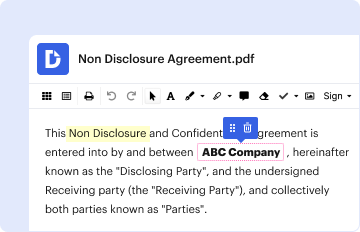
Type text, add images, blackout confidential details, add comments, highlights and more.
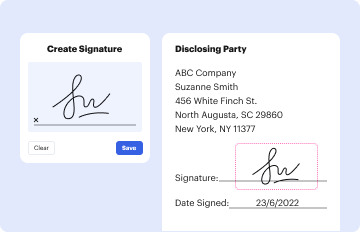
02. Sign it in a few clicks
Draw your signature, type it, upload its image, or use your mobile device as a signature pad.
03. Share your form with others
Send it via email, link, or fax. You can also download it, export it or print it out.
How to use or fill out Fiduciary Deed for use by Executors, Trustees, Trustors, Administrators and other Fiduciaries - Wyoming
Ease of Setup
DocHub User Ratings on G2
Ease of Use
DocHub User Ratings on G2
Click ‘Get Form’ to open it in the editor.
Begin by entering the Grantor's name and title in the designated fields. This should reflect your official capacity, such as 'Executor' or 'Trustee'.
Next, specify the Grantees' names and their relationship (e.g., individuals or joint tenants). Ensure you include all necessary details as outlined in the form.
Fill in the legal description of the property being conveyed. If there is an attached Exhibit A, ensure it is referenced correctly.
Complete any additional sections regarding easements or covenants that may apply to the property.
Finally, sign and date the document where indicated. Make sure to have it notarized if required.
Start using our platform today to easily complete your Fiduciary Deed for free!
Fill out Fiduciary Deed for use by Executors, Trustees, Trustors, Administrators and other Fiduciaries - Wyoming online It's free
What is the difference between a fiduciary deed and an executor deed?
A Fiduciary refers to any individual acting on behalf of another, and in Estate Planning this often means in a legal capacity. An Executor, on the other hand, is a much more narrow responsibility. Executors can only act on the terms laid out in a Will.
What are the professional duties of fiduciaries, trustees, financial planners, and executors?
Professional fiduciaries provide critical services to seniors, persons with disabilities, and children. They manage matters for clients including daily care, housing and medical needs, and also offer financial management services ranging from basic bill paying to estate and investment management.
What is a fiduciary deed?
A fiduciary deed is used to transfer property when the executor is acting in his official capacity. A fiduciary deed warrants that the fiduciary is acting in the scope of his appointed authority but it does not guarantee title of the property.
What is the difference between a warranty deed and a fiduciary deed?
A warranty deed describes the amount of the interest that the owner has in the property and guarantees that the title can be transferred without any unknown liens or other claims to block it. Fiduciary deeds are one of several types of deeds that may be used to transfer ownership of real estate or other property.
Whats the difference between a fiduciary and an executor?
While the duties of a fiduciary and an executor are similar, each role has unique legal obligations: Fiduciary Duty: Extends beyond death and may involve managing assets for years if serving as a trustee. Executor Duty: Ends once the estate is fully administered and closed.
Related Searches
Wyoming trust Codewyoming statute § 4-10-813wyoming statute 34-1-142Wyoming asset protection trust costWyoming rule against perpetuitiesWyoming Secretary of Stateinvoluntary alienation can be carried out by:Wyoming Statement of Consideration
Security and compliance
At DocHub, your data security is our priority. We follow HIPAA, SOC2, GDPR, and other standards, so you can work on your documents with confidence.
General Warranty Deeds A general warranty deed, sometimes called a full covenant and warranty deed is a deed containing the strongest and broadest form of guarantee of title. With this sort of deed, certain covenants or warranties legally bind the grantor.
Related links
Some Problems With the Uniform Trustees Powers Act
by PG Haskell 1967 Cited by 12 The impact of the Act upon fiduciary administration may not be as great as appears at first blush. The common law position has been that the trustee has only
Title 34 Property, Conveyances and Security Transactions
Every letter of attorney, or other instrument, containing a power to convey lands as agent or attorney for the owner of such lands, and every executory contract
Cookie consent notice
This site uses cookies to enhance site navigation and personalize your experience.
By using this site you agree to our use of cookies as described in our Privacy Notice.
You can modify your selections by visiting our Cookie and Advertising Notice.