




01. Edit your t7 bill of sale online
Type text, add images, blackout confidential details, add comments, highlights and more.

Type text, add images, blackout confidential details, add comments, highlights and more.

Draw your signature, type it, upload its image, or use your mobile device as a signature pad.

Send can a bill of sale be handwritten in georgia via email, link, or fax. You can also download it, export it or print it out.
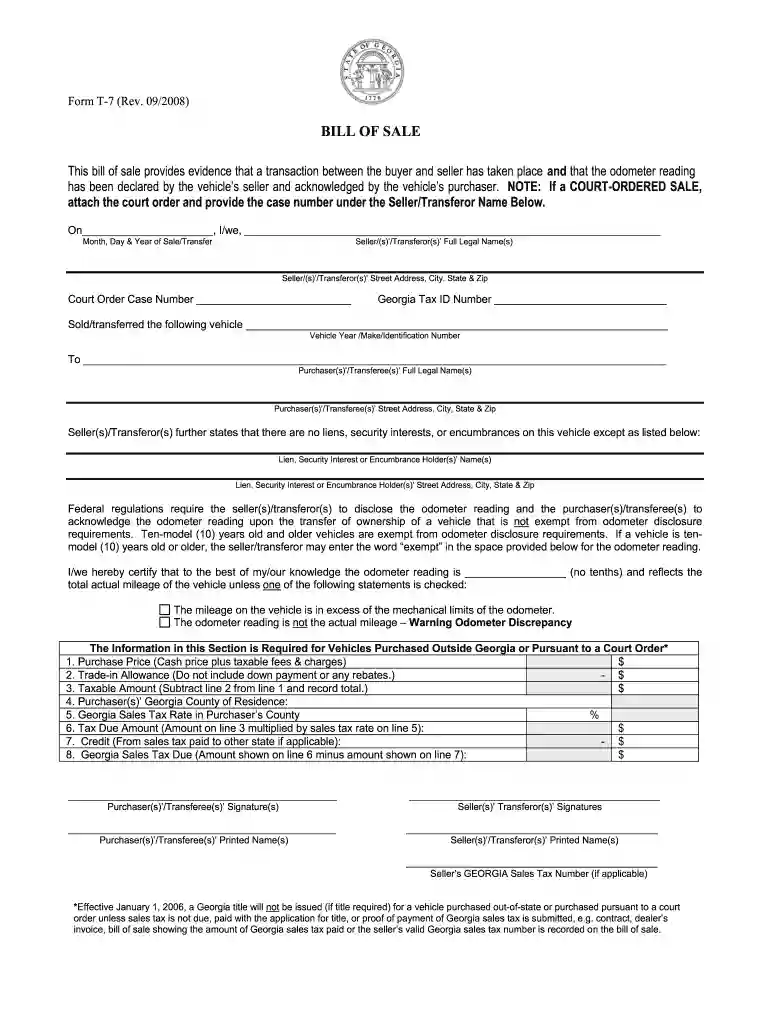
A Georgia Bill of Sale (Form T-7) is a legal document that records a transaction between a buyer and a seller for a vehicle exchange. It acts as proof of purchase and contains critical details about the buyer, seller, and vehicle, including the sale date, purchase price, vehicle identification number (VIN), make, model, and year. Its primary function is to protect both parties by providing a documented history of vehicle ownership.
Gather Information: Ensure you have all necessary details, including identification for both parties, vehicle information, sale price, and sale date.
Fill in Seller Information: Enter the name, address, and contact details of the seller.
Enter Buyer Details: Provide the buyer's name, address, and contact information.
Complete Vehicle Details: Include the vehicle make, model, year, VIN, and current odometer reading.
Confirm Sale Price and Terms: Clearly state the agreed purchase price and any conditions of the sale.
Sign and Date: Both parties must sign and date the form to validate the transaction.
Witness or Notarization: It's recommended, though not mandatory, to have the document witnessed or notarized for added legal protection.
The Georgia Bill of Sale can be downloaded directly from the Georgia Department of Revenue's website or obtained from any county tax commissioner's office. It is crucial to use the official Form T-7 to ensure compliance with state requirements. Alternatively, third-party platforms like DocHub can offer templates, allowing users to fill out the form online for convenience.
The Georgia Bill of Sale serves multiple legal purposes. It is essential for registering the vehicle in the buyer's name and for transferring the vehicle title. Additionally, it can be used in resolving disputes about ownership or sale conditions. The document protects both parties by establishing a legal record of the transaction.
In Georgia, specific regulations must be followed when using the Bill of Sale. Notably, the Bill of Sale is particularly important in private vehicle sales than in dealer transactions. Additionally, the document is needed to establish ownership transfer before the new owner can register the vehicle.
While the Georgia Bill of Sale is quite straightforward, other states may have different requirements, such as mandatory notarization or additional documentation for title transfer. It is essential to understand that every state has its regulations for vehicle transactions, which may influence the procedure and form requirements.
We've got more versions of the t7 bill of sale form. Select the right t7 bill of sale version from the list and start editing it straight away!
At DocHub, your data security is our priority. We follow HIPAA, SOC2, GDPR, and other standards, so you can work on your documents with confidence.




A Georgia certificate of title is required if the vehicle being sold/transferred is a 1986 or newer model year motor vehicle, motorcycle, camper, travel trailerRead more
To buy an automobile, you must sign a car bill of sale. This contract makes sure the dealership is legally required to sell you the vehicle and maintainsRead more


