Lead based disclosure 2026

Get Form
lead based disclosure Preview on Page 1

Here's how it works

01. Edit your form online
Type text, add images, blackout confidential details, add comments, highlights and more.
02. Sign it in a few clicks
Draw your signature, type it, upload its image, or use your mobile device as a signature pad.
03. Share your form with others
Send it via email, link, or fax. You can also download it, export it or print it out.

How to use or fill out lead based disclosure with our platform

Form edit decoration
9.5
Ease of Setup
DocHub User Ratings on G2
9.0
Ease of Use
DocHub User Ratings on G2
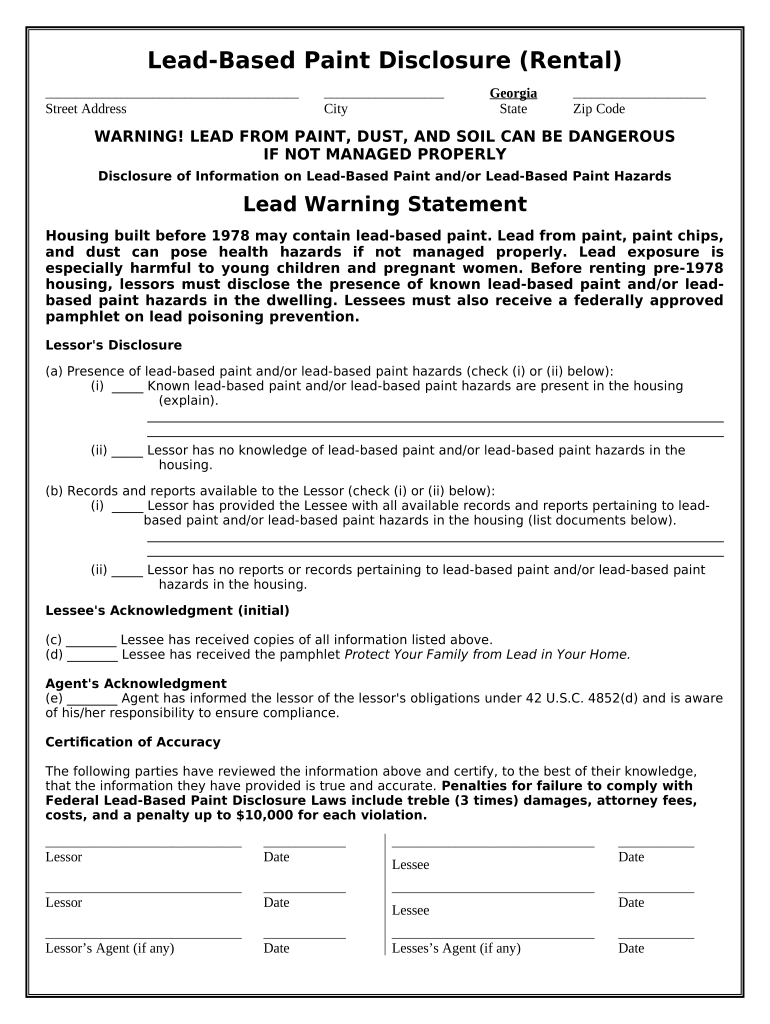
  1. Click ‘Get Form’ to open the Lead-Based Paint Disclosure in the editor.
  2. Begin by entering the street address, city, state, and zip code of the property at the top of the form.
  3. In the Lessor's Disclosure section, check either (i) or (ii) to indicate whether known lead-based paint hazards are present. If applicable, provide an explanation in the space provided.
  4. Next, indicate if you have provided all available records and reports regarding lead-based paint hazards by checking (i) or (ii). List any documents if you checked (i).
  5. The Lessee must initial to acknowledge receipt of all information listed above and confirm they received the pamphlet 'Protect Your Family from Lead in Your Home.'
  6. Ensure that both lessor and lessee sign and date the form at the bottom to certify accuracy.

Start using our platform today for free to complete your Lead-Based Paint Disclosure efficiently!

be ready to get more

Complete this form in 5 minutes or less

Get form

Got questions?

We have answers to the most popular questions from our customers. If you can't find an answer to your question, please contact us.
Contact us
What Can I Do If I Have Lead Paint in the House? Immediately clean up any paint chips you find. Keep play areas clean. Dont let children chew on painted surfaces. Clean dust off of window sills and other surfaces on a regular basis, using a sponge, mop, or paper towels with warm water.
It is designed to help people make more informed choices based on the information they receive. The Lead-Based Paint Disclosure Rule applies to most pre-1978 private housing, public housing, federally owned housing, and housing receiving federal assistance.
Answer: Approximately three-quarters of the nations housing built before 1978 contains some lead-based paint. This paint, if properly managed and maintained, poses little risk. If allowed to deteriorate, lead from paint can threaten the health of occupants, especially children under six years old.
Home sellers who fail to comply with federal disclosure responsibilities may be sued by the buyer for damages suffered. These can be quite hefty, especially if young children have developed a lead-related health problem (over $10,000, depending on the violation). Other penalties can also be imposed.
Though lead-based paint for use in homes was banned in the U.S. in 1978, it is still present in millions of homes. Lead-based paint is usually not a hazard if it is in good condition. However, deteriorating (peeling, chipping, chalking, ing, or damaged) lead-based paint is a hazard and needs prompt attention.

Security and compliance

At DocHub, your data security is our priority. We follow HIPAA, SOC2, GDPR, and other standards, so you can work on your documents with confidence.

Learn more
ccpa2
pci-dss
gdpr-compliance
hipaa
soc-compliance

People also ask

Lead-based paint disclosure exemptions In addition to houses built in or after 1978, the following also qualify for an exemption from the disclosure rules: Dwelling units with no bedrooms, such as a studio apartment. Dwelling units that are leased for 100 days or fewer, such as short-term rentals.

Related links