

Mutual Wills package with Last Wills and Testaments for Married Couple with No Children - District of Columbia 2026

Get Form
Mutual Wills package with Last Wills and Testaments for Married Couple with No Children - District of Columbia Preview on Page 1

Here's how it works

01. Edit your form online
Type text, add images, blackout confidential details, add comments, highlights and more.
02. Sign it in a few clicks
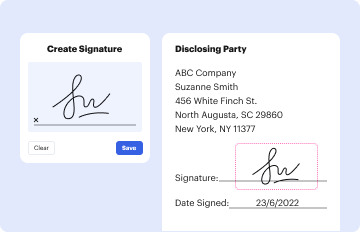
Draw your signature, type it, upload its image, or use your mobile device as a signature pad.
03. Share your form with others
Send it via email, link, or fax. You can also download it, export it or print it out.

How to use or fill out Mutual Wills package with Last Wills and Testaments for Married Couple with No Children - District of Columbia

Form edit decoration
9.5
Ease of Setup
DocHub User Ratings on G2
9.0
Ease of Use
DocHub User Ratings on G2
  1. Click ‘Get Form’ to open it in the editor.
  2. Begin by entering your name in Field [1] and your spouse's name in Field [4]. This establishes the primary parties involved.
  3. In Article Three, specify any specific property you wish to bequeath. If none, simply type 'none' in the designated fields.
  4. For Article Four, if applicable, enter your spouse's name as the recipient of your homestead or primary residence.
  5. Proceed to Article Five to designate your spouse as the recipient of all remaining property. Ensure accuracy in Fields [24] and [29].
  6. In Article Six, indicate alternate beneficiaries should your spouse predecease you. Check the appropriate box for distribution preferences.
  7. Complete Articles Seven through Eleven by filling in personal representative details and any optional provisions you wish to adopt.
  8. Once all fields are filled, review for accuracy before printing. Remember that signatures must be witnessed by two individuals not related to you.

Start using our platform today to effortlessly complete your Mutual Wills package online for free!

be ready to get more

Complete this form in 5 minutes or less

Get form

Got questions?

We have answers to the most popular questions from our customers. If you can't find an answer to your question, please contact us.
Contact us
However, mutual wills are rare, for good reason. This is partly because their legal impact is unclear. For example, it is agreed that the effect of a mutual will is to bind the conscience of the surviving testator, but what is the scope of the obligation on the surviving testator?
Mutual Wills is a term that refers to two Wills created by two individuals, most commonly spouses or civil partners, with the agreement that neither party can alter or revoke their Will without the consent of the other, even after the first partys demise.
Your relationship with your spouse: If you and your spouse have similar estate planning goals, a simple will or mirror will may suffice. If theres potential for disagreement or changes in the future, a mutual or trust will may provide more security.
Mutual wills are based on the agreement of both partners that the surviving partner wont change their will after the other dies.
In separate wills or mirror wills, each spouse can have identical provisions if they want, but after the first spouse dies, the surviving spouse can amend their will to reflect any changes in their lives, such as having new grandchildren, a new spouse, and new stepchildren.

Security and compliance

At DocHub, your data security is our priority. We follow HIPAA, SOC2, GDPR, and other standards, so you can work on your documents with confidence.

Learn more
ccpa2
pci-dss
gdpr-compliance
hipaa
soc-compliance

People also ask

Joint Wills vs Mutual Wills: Understanding The Difference While a Joint Will is a single document that combines the testamentary wishes of multiple parties, a Mutual Will consists of separate Wills created by the individuals, wherein they leave their assets to each other.
Disadvantages of mutual wills It could be considered unfair, particularly in the case of younger couples, that the surviving partner cannot alter their Will to reflect changing circumstances such as growing more distant from their children or starting a new family.

Related links