Mutual Wills or Last Will and Testaments for Unmarried Persons living together with Minor Children - Idaho 2026

Get Form
Mutual Wills or Last Will and Testaments for Unmarried Persons living together with Minor Children - Idaho Preview on Page 1

Here's how it works

01. Edit your form online
Type text, add images, blackout confidential details, add comments, highlights and more.
02. Sign it in a few clicks
Draw your signature, type it, upload its image, or use your mobile device as a signature pad.
03. Share your form with others
Send it via email, link, or fax. You can also download it, export it or print it out.

How to use or fill out Mutual Wills or Last Will and Testaments for Unmarried Persons living together with Minor Children - Idaho

Form edit decoration
9.5
Ease of Setup
DocHub User Ratings on G2
9.0
Ease of Use
DocHub User Ratings on G2
  1. Click ‘Get Form’ to open it in the editor.
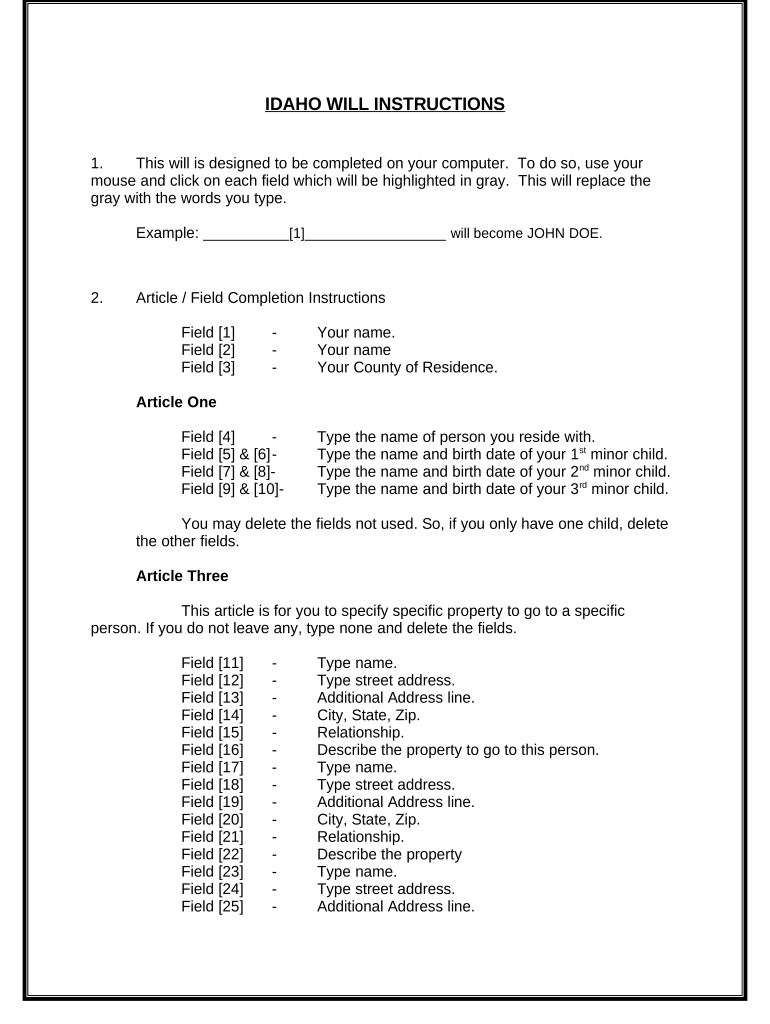
  2. Begin by entering your name in Field [1] and your county of residence in Field [3].
  3. In Article One, specify the name of the person you reside with in Field [4] and list the names and birth dates of your minor children in Fields [5]-[10]. You can delete unused fields if necessary.
  4. For Article Three, detail any specific property bequests. Fill out Fields [11]-[26] with names, addresses, relationships, and descriptions of property. If no property is to be left, type 'none'.
  5. In Article Four, indicate who will receive your homestead by filling out Field [29] or selecting your children in Field [30].
  6. Complete Articles Five through Eleven by specifying remaining property distribution, appointing a trustee, guardian for minor children, and personal representatives as needed.
  7. Review all entries for accuracy before printing. Ensure to sign the document in front of two witnesses.

Start using our platform today to easily complete your Mutual Wills or Last Will and Testament for free!

be ready to get more

Complete this form in 5 minutes or less

Get form

Got questions?

We have answers to the most popular questions from our customers. If you can't find an answer to your question, please contact us.
Contact us
When You can Avoid Probate in Idaho Small Estate and no Real Property. The first circumstance that exists in Idaho where a probate can be avoided is when there is a small estate. Using a Trust While You are Alive. Beneficiary or Payable Upon Death Designations. Enlist an Idaho Estate Planning Attorney to Help You.
(6) For the purposes of this section only, next of kin means the closest living blood relative, including spouse, adult child, parents, siblings, grandparents, aunts and uncles, and cousins. History: [49-245, added 2024, ch. 118, sec.
Yes. In Idaho, a handwritten (holographic) will is valid, so long as all the important provisions are in your handwriting. You must also sign the will. If you have a complex or large estate (over $200,000) or if you have any doubts about how to write a holographic will see an attorney.
Assets inherited by one partner in a marriage can be considered separate and owned only by that partner. However, inheritances can be ruled as marital property jointly owned by both partners and, therefore, subject to division along more or less equal lines in the event of a divorce.
A direct heir (also known as an heir apparent or lineal heir) is who would be considered the decedents next of kin, and they are first in line to inherit through intestate succession. If the decedent had been married when they died, their direct heir most likely would be their surviving spouse.

Security and compliance

At DocHub, your data security is our priority. We follow HIPAA, SOC2, GDPR, and other standards, so you can work on your documents with confidence.

Learn more
ccpa2
pci-dss
gdpr-compliance
hipaa
soc-compliance

People also ask

When evidence exists that undue influence was applied in order to get the Will created or signed, then that Will is invalid. A court hearing this evidence will simply declare the Will to be invalid. A final way that a Will may be invalid is if it was revoked by the person who created it.
If you have descendants and a surviving spouse, the surviving spouse will inherit all of your community property and half of your separate property. Your descendants will then inherit the rest of the separate property.

Related links