




01. Edit your free health care proxy form massachusetts online
Type text, add images, blackout confidential details, add comments, highlights and more.

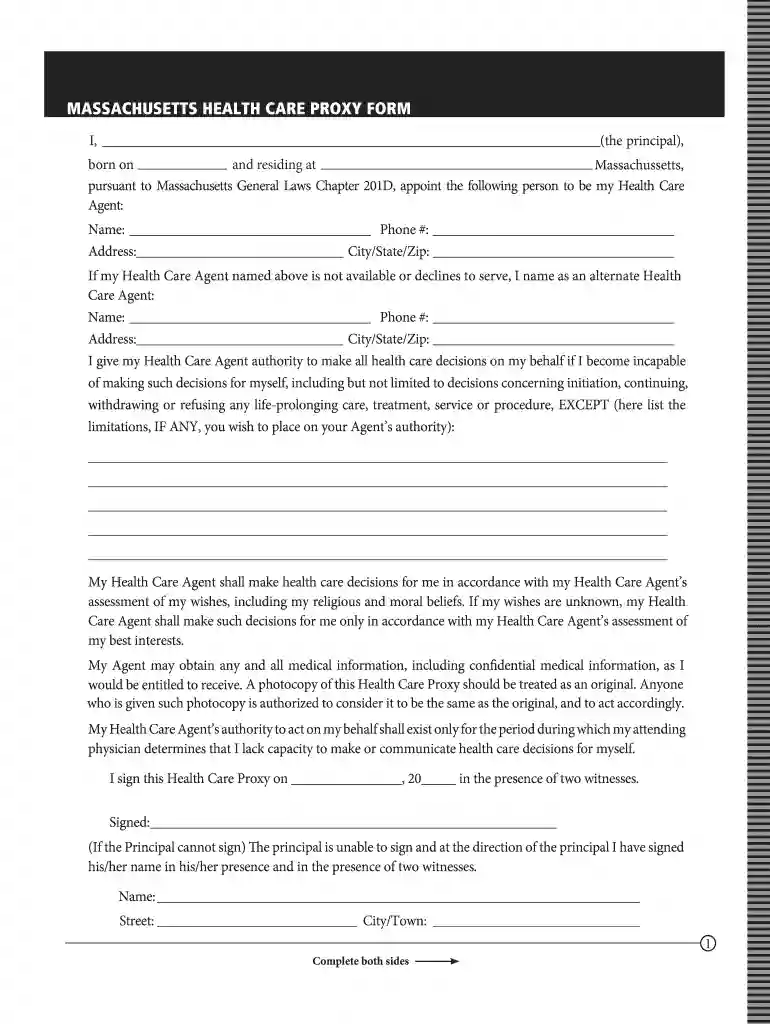
Type text, add images, blackout confidential details, add comments, highlights and more.

Draw your signature, type it, upload its image, or use your mobile device as a signature pad.

Send what is a health care proxy massachusetts via email, link, or fax. You can also download it, export it or print it out.
The Massachusetts Health Care Proxy is a legal document that allows individuals to assign a Health Care Agent to make medical decisions on their behalf should they become incapacitated. This proxy empowers the designated agent to consult with medical professionals and decide on treatments based on the principal's wishes. The form is a crucial component of advance care planning, ensuring medical decisions align with personal preferences when one cannot advocate for themselves.
To effectively use the Massachusetts Health Care Proxy, the principal must carefully select a trusted Health Care Agent and alternates. Once completed, the form should be shared with involved parties, such as family members, primary care providers, and specialists. This ensures that the health care team is aware of the proxy and respect the principal's circumstances and preferences. Crucially, the Health Care Agent should have a clear understanding of the principal's medical desires, such as treatment preferences or aversion to certain interventions, to execute their duties effectively.
In Massachusetts, the Health Care Proxy is a legally binding document under the Uniform Health-Care Decisions Act. This grants the appointed agent the authority to make health-related decisions if the principal is deemed incapable by a licensed physician. It is important to note that this document only activates under these conditions. The form’s integrity is maintained through specific signing requirements, including the need for disinterested witnesses, ensuring the document is legitimate and free from external pressure.
Within Massachusetts, there are distinct regulations concerning the Health Care Proxy's creation and execution. The document only comes into effect when the principal is declared unable to make decisions by a physician. It’s imperative to ensure that the Health Care Agent is not also a witness to avoid potential conflicts of interest. Additionally, Massachusetts law does not require the proxy to be notarized, unlike in some other states.
Understanding key terminology is essential for the effective execution of the Massachusetts Health Care Proxy:
The Health Care Proxy can be instrumental in scenarios where an individual faces complex medical conditions, such as Alzheimer's or severe injuries that lead to impaired consciousness. For instance, someone undergoing a risky surgery might activate the proxy to ensure their agent can make immediate decisions during post-operative recovery if complications arise. In such scenarios, having a proxy ensures continuity of care aligned with the principal’s wishes, providing peace of mind to all parties involved.
We've got more versions of the free health care proxy form massachusetts form. Select the right free health care proxy form massachusetts version from the list and start editing it straight away!
At DocHub, your data security is our priority. We follow HIPAA, SOC2, GDPR, and other standards, so you can work on your documents with confidence.




The Healthcare Proxy will remain in effect until either you (the principal) regains capacity as determined by the treating clinician, or a court of competentRead more
Photocopies of this Health Care Proxy shall have the same force and effect as the original and may be given to other health care providers. My Health CareRead more
Jun 29, 2017 The BRFSS is a system of ongoing health-related telephone surveys designed to collect data on health-related risk behaviors, chronic healthRead more


