
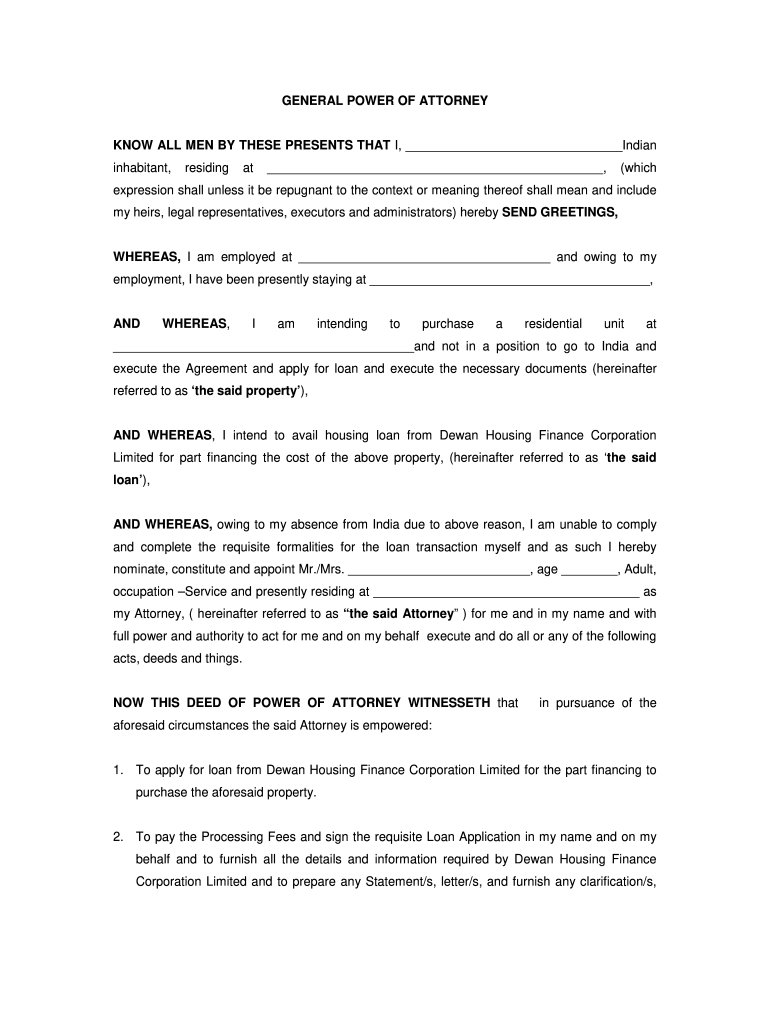







Definition and Meaning of Power of Attorney in India
A power of attorney (POA) is a legal document that grants one person (the agent or attorney-in-fact) the authority to act on behalf of another person (the principal) in specified legal or financial matters. In the context of India, this document is crucial for facilitating transactions when the principal is unable to be physically present to act on their own behalf.
Types of Power of Attorney
- General Power of Attorney: This grants broad powers to the agent, allowing them to manage various aspects of the principal's affairs, such as financial transactions, property management, or business decisions.
- Special Power of Attorney: This is limited to specific tasks, such as purchasing property or signing a particular document. For example, a special power of attorney may authorize someone to finalize the purchase of real estate, ensuring that the agent can only execute transactions related to that property.
Key Elements of Power of Attorney Format in India
A well-structured power of attorney document should include several vital components to ensure its legal validity and clarity:
- Principal's Details: Full name, address, and identification proof of the principal.
- Agent's Details: Full name, address, and identification proof of the agent or attorney-in-fact.
- Scope of Authority: Clearly outlined powers delegated to the agent, specifying whether it is a general or special authority.
- Duration: The time period for which the authority is granted. This can be for a specific task, for a set duration, or until revoked.
- Signatures: Signatures of the principal and the agent, along with witnesses, if required under state law. Authentication through notarization may also be necessary.
- Governing Law: A statement specifying that the POA is governed by Indian law or the laws of specific Indian states if applicable.
How to Complete the Power of Attorney Format in India
To ensure the effective execution of a power of attorney format in India, follow these detailed steps:
- Choose the Right Type: Determine whether a general or special power of attorney suits your needs based on the scope of authority required.
- Draft the Document: Use a template or write a draft that includes all essential elements: parties' details, authority granted, and any limitations on the powers.
- Review and Revise: Ensure clarity in each section of the document. Legal terminology should be precise, and the intentions should be unambiguous.
- Sign and Date: The principal must sign the document, preferably in the presence of witnesses. Depending on local laws, notarization may be required.
- Distribute Copies: Provide copies to the agent, any relevant financial institutions, and keep a personal copy for your records.
Important Terms Related to Power of Attorney in India
Understanding key legal terms and concepts associated with power of attorney can enhance comprehension and usability:
- Grantor: The individual who creates the power of attorney and delegates authority.
- Recipient or Agent: The person appointed by the grantor to act on their behalf.
- Revocation: The process through which the grantor cancels the authority conveyed to the agent, typically requiring a written notice.
- Durable POA: A power of attorney that remains valid even if the grantor becomes incapacitated or unable to make decisions.
- Non-Durable POA: An authority that ceases to be effective if the grantor becomes incapacitated.
Examples of Using Power of Attorney in India
There are various real-world scenarios where a power of attorney may be utilized effectively:
- Property Transactions: An individual living abroad may authorize a family member to finalize a property purchase. The agent can negotiate terms, sign papers, and fulfill contractual obligations on behalf of the principal.
- Financial Affairs: A business owner could grant a general power of attorney to a trusted partner to handle company finances, sign checks, and manage tax-related activities while they are unavailable.
- Medical Decisions: Though not always formalized as a traditional power of attorney, individuals can assign someone to make healthcare decisions in case of incapacitation.
By understanding these elements, individuals can create effective and legally sound power of attorney documents that meet their specific needs.




