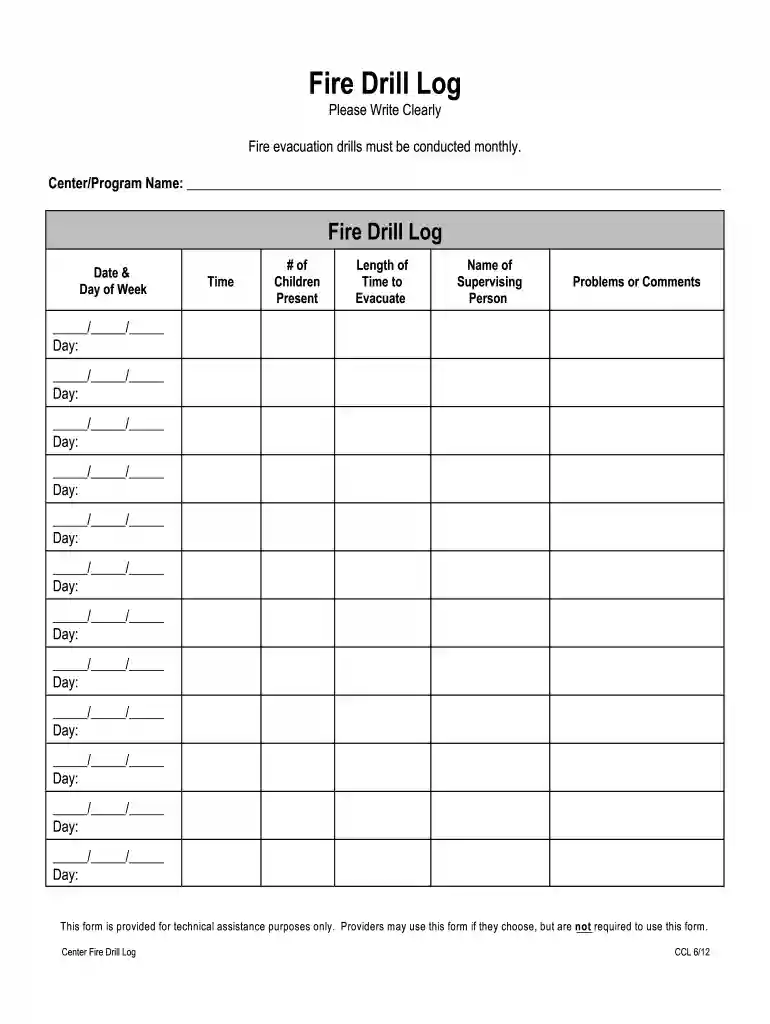
Definition and Purpose of the Fire Drill Log
The Fire Drill Log is an essential tool mandated by the Utah Department of Health that documents fire drills conducted within various facilities, including schools and childcare programs. This log serves multiple purposes including ensuring compliance with state regulations, promoting safety awareness, and enhancing preparedness for emergency situations. Each entry in the log provides a historical account of fire drills, critical for evaluating the effectiveness of emergency procedures and identifying areas for improvement.
Importance of Maintaining the Fire Drill Log
- Regulatory Compliance: Facilities are required to conduct fire drills to meet health and safety regulations. Consistent logging is necessary to demonstrate adherence to the law.
- Safety Assessment: Analyzing logs over time can reveal patterns or recurring issues that require attention, helping to enhance the safety protocols in place.
- Training and Improvement: By reviewing drill logs, organizations can assess staff performance and identify training needs, contributing to better preparedness during emergencies.
How to Use the Fire Drill Log Effectively
Utilizing the Fire Drill Log effectively involves understanding its structure and the information it captures. Facilities should ensure the log is easily accessible and regularly updated to reflect recent drills.
Key Components of the Fire Drill Log
- Date and Time of Drill: Essential for tracking frequency and timing of drills within the required schedule.
- Participants: Documentation of the number of individuals present during each drill helps ensure all personnel, including children in daycare settings, are familiar with evacuation routes.
- Duration of Evacuation: This records how long it takes to evacuate, offering insight into potential inefficiencies.
- Supervising Individual: Logging the name of the supervising person reinforces accountability and ensures a designated leader for safety drills.
- Comments and Observations: Any notable issues encountered during the drill, such as delays or participant behavior, should be captured to inform future improvements.
Steps to Complete the Fire Drill Log
Completing the Fire Drill Log involves several straightforward steps:
- Prepare in Advance: Identify a date and time for the drill, ensuring all participants are aware and prepared for the exercise.
- Conduct the Drill: Execute the fire drill according to predetermined protocols. Observe participants and note any delays or issues encountered.
- Fill Out the Log Immediately Post-Drill: Record the date, time, number of participants, duration of the drill, supervising individual, and any comments from the drill.
- Review Regularly: Periodically analyze the log entries to identify trends and areas for improvement, ensuring ongoing compliance and safety.
Who Typically Uses the Fire Drill Log
The Fire Drill Log is widely used by various organizations, including:

- Educational Institutions: Schools and daycare centers are required to maintain logs to ensure safety and preparedness among students and staff.
- Healthcare Facilities: Hospitals and clinics must adhere to stringent safety protocols, making fire drills essential for patient and staff safety.
- Commercial Properties: Businesses with public access must conduct drills for compliance with safety regulations and to protect employees and customers.
Legal Requirements Surrounding the Fire Drill Log
Adhering to the legal requirements for fire drill logs is crucial for organizational compliance. The Utah Department of Health specifies that:
- Frequency of Drills: Fire drills must occur at least once per month, with other emergency drills conducted every six months.
- Documentation: Logs must be maintained with accurate records of each drill, including participant details and any encountered issues.
- Retention Period: Facilities should retain logs for a specified time frame, typically three years, to comply with regulatory audits or inspections.
State-Specific Rules for the Fire Drill Log
In Utah, specific rules govern the fire drill log's management and maintenance, ensuring the safety of occupants in various facilities. These rules specify:
- Monthly Fire Drills: Each facility must conduct at least one fire drill every month to promote readiness among staff and participants.
- Feedback Mechanisms: Immediate feedback from drills must be collected to address and resolve any identified issues quickly, ensuring continuous improvement.
- State Reporting: Certain institutions may be required to submit their fire drill logs to state authorities as part of regulatory compliance checks.
Examples of Using the Fire Drill Log
In practice, organizations can implement the Fire Drill Log in various scenarios:
- School Environment: A school conducts a fire drill on the first Tuesday of the month, documenting the time taken for all students to evacuate. Observations noted a five-minute delay in one classroom, prompting additional training.
- Childcare Facility: A daycare center uses the log to track drills, noting that children need repeated instructions for quiet behavior during evacuations. Adjustments are made to improve compliance.
- Healthcare Settings: A clinic logs evacuation drills quarterly, highlighting staff roles during emergencies. A recent drill revealed the need for better communication systems, which leads to the implementation of walkie-talkies for instant communication during emergencies.
Using these practical examples showcases the Fire Drill Log's effectiveness in promoting safety and ensuring compliance with regulations.