Mineral rights 2026

Get Form
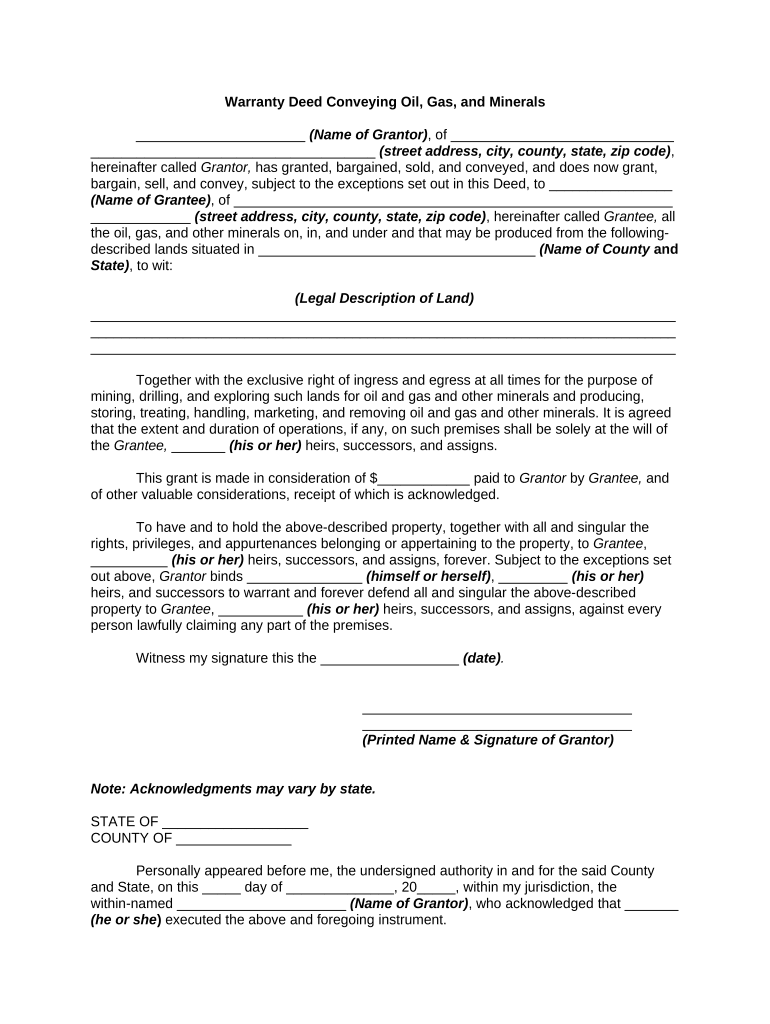
mineral rights Preview on Page 1

Here's how it works

01. Edit your form online
Type text, add images, blackout confidential details, add comments, highlights and more.
02. Sign it in a few clicks
Draw your signature, type it, upload its image, or use your mobile device as a signature pad.
03. Share your form with others
Send it via email, link, or fax. You can also download it, export it or print it out.

How to use or fill out mineral rights with our platform

Form edit decoration
9.5
Ease of Setup
DocHub User Ratings on G2
9.0
Ease of Use
DocHub User Ratings on G2
  1. Click ‘Get Form’ to open the Warranty Deed Conveying Oil, Gas, and Minerals in the editor.
  2. Begin by entering the name of the Grantor in the designated field, followed by their complete address including street, city, county, state, and zip code.
  3. Next, input the name of the Grantee along with their full address in a similar format as above.
  4. Provide a legal description of the land being conveyed. This is crucial for identifying the specific property involved in the transaction.
  5. Fill in the consideration amount paid to the Grantor by the Grantee. This could be a monetary value or other valuable considerations.
  6. Ensure that both parties' names are printed clearly where indicated for signatures. The Grantor must sign and date at the bottom of the document.
  7. If required, complete any acknowledgment sections for notarization by entering details such as state and county before signing.

Start using our platform today to streamline your mineral rights documentation process for free!

be ready to get more

Complete this form in 5 minutes or less

Get form

Got questions?

We have answers to the most popular questions from our customers. If you can't find an answer to your question, please contact us.
Contact us
What Are Mineral Rights? Mineral rights are ownership rights that allow the owner the right to exploit minerals from underneath a property. The rights refer to solid and liquid minerals, such as gold and oil. Mineral rights can be separate from surface rights and are not always possessed by the property owner.
Some of the major advantages of owning mineral rights include; Mineral owners do not take any drilling liability and pay no expenses. There are no environmental risks. It is an investment into real property. Investing In Mineral Rights: Benefits, Risk, Considerations Advices pheasantenergy.com investing-in-mineral- pheasantenergy.com investing-in-mineral-
Potential for Financial Gain Purchasing land with mineral rights provides the buyer with the opportunity to profit from valuable resources present on the property, such as oil, gas, or minerals. Successful extraction, usually with an experienced oil company, can result in substantial financial gains.
Lets go over the states where mineral rights are most prevalent and the resources that make them stand out. Texas. The king of oil, Texass vast reserves have made it a hotspot for oil and gas investors. Oklahoma. Louisiana. Alaska. Wyoming. West Virginia. Pennsylvania. Colorado.
To estimate mineral rights value for producing properties, take the average of your last 3 months of royalty income. Once you have a monthly average, plug it into the mineral rights calculator below. You can expect to sell mineral rights for around 4 years to 6 years times the average monthly income you receive.

Security and compliance

At DocHub, your data security is our priority. We follow HIPAA, SOC2, GDPR, and other standards, so you can work on your documents with confidence.

Learn more
ccpa2
pci-dss
gdpr-compliance
hipaa
soc-compliance
be ready to get more

Complete this form in 5 minutes or less

Get form

People also ask

The eight primary types of mineral rights including mineral interest (MI), leasehold interest, royalty interest (RI), overriding royalty interest (ORRI), non-participating royalty Interest (NPRI), working Interest (WI), non-operated working interest, and net profits interest. Types of Mineral Rights bluemesaminerals.com types-of-mineral-rights bluemesaminerals.com types-of-mineral-rights
When it comes to mineral rights, the standard admonition has long been consistent and emphatic: Avoid selling them. After all, simply owning mineral rights costs you nothing. There are no liability risks, and in most cases, taxes are assessed only on properties that are actively producing oil or gas.
Mineral rights refer to the rights to extract minerals from a parcel of land. This can include the right to mine for precious metals or gems, quarry materials such as gravel and sand, and even drill for oil and natural gas.

Related links