Florida notice trial 2026

Get Form
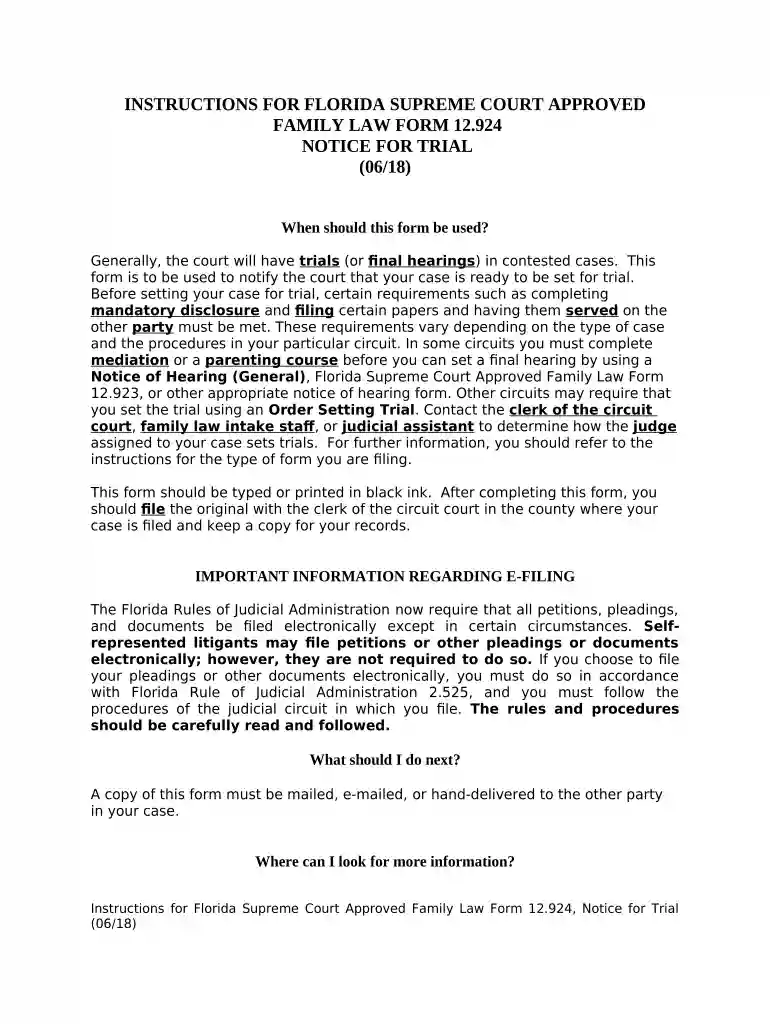
florida notice trial Preview on Page 1

Here's how it works

01. Edit your form online
Type text, add images, blackout confidential details, add comments, highlights and more.

02. Sign it in a few clicks
Draw your signature, type it, upload its image, or use your mobile device as a signature pad.

03. Share your form with others
Send it via email, link, or fax. You can also download it, export it or print it out.

How to use or fill out Florida Notice for Trial with our platform

Form edit decoration
9.5
Ease of Setup
DocHub User Ratings on G2
9.0
Ease of Use
DocHub User Ratings on G2
  1. Click ‘Get Form’ to open the Florida Notice for Trial in the editor.
  2. Begin by entering the case information at the top of the form, including the judicial circuit, county, and case number.
  3. In the 'Petitioner' and 'Respondent' sections, fill in the names of both parties involved in the case.
  4. Indicate whether this is for an original action or a subsequent proceeding by checking the appropriate box.
  5. Estimate and enter the time required for trial presentation in hours or days.
  6. Specify if there are issues to be tried by jury by selecting 'Yes' or 'No'.
  7. Complete the certification section by indicating how you served this document to the other party and filling in their contact details.
  8. Finally, sign and print your name at the bottom of the form, ensuring all blanks are filled accurately before submission.

Start using our platform today to streamline your document editing and filing process for free!

See more florida notice trial versions

We've got more versions of the florida notice trial form. Select the right florida notice trial version from the list and start editing it straight away!
Versions Form popularity Fillable & printable
2018 4.8 Satisfied (164 Votes)
be ready to get more

Complete this form in 5 minutes or less

Get form

Got questions?

We have answers to the most popular questions from our customers. If you can't find an answer to your question, please contact us.
Contact us
The grounds for granting a motion for a new trial include a significant error of law, verdict going against the weight of evidence, irregularity in the court proceeding, jury misconduct, newly discovered material evidence, and improper damages .
Florida Rule of Criminal Procedure 3.590 expressly states that a written motion for new trial or in arrest of judgment may be made within ten days after the rendition of the verdict.
This form is to be used to notify the court that your case is ready to be set for trial. Before setting your case for trial, certain requirements such as completing mandatory disclosure and filing certain papers and having them served on the other party must be met.
While a motion for a new trial is hard to win, it can be successful if the defendant presents evidence of significant errors during the trial or new exculpatory evidence. Often, the standard for prevailing on these motions is showing that the defendants right to a fair trial was violated.
(b) All parties shall be afforded an opportunity for a hearing after reasonable notice of not less than 14 days; however, the 14-day notice requirement may be waived with the consent of all parties. The notice shall include: 1. A statement of the time, place, and nature of the hearing.

Security and compliance

At DocHub, your data security is our priority. We follow HIPAA, SOC2, GDPR, and other standards, so you can work on your documents with confidence.
Learn more
ccpa2
pci-dss
gdpr-compliance
hipaa
soc-compliance
be ready to get more

Complete this form in 5 minutes or less

Get form

People also ask

A new trial is a re-examination of an issue of fact in the same court after a trial and decision by a jury, court, or referee.
Rule 12.440 - SETTING ACTION FOR TRIAL (a) When at Issue. An action is at issue after any motions directed to the last pleading served have been disposed of or, if no such motions are served, 20 days after service of the last pleading.
The court shall grant a new trial only if: (1) the jurors decided the verdict by lot; (2) the verdict is contrary to law or the weight of the evidence; or (3) new and material evidence, which, if introduced at the trial would probably have changed the verdict or finding of the court, and which the defendant could not

Related links