Authorization court 2026

Get Form
authorization court Preview on Page 1

Here's how it works

01. Edit your form online
Type text, add images, blackout confidential details, add comments, highlights and more.
02. Sign it in a few clicks
Draw your signature, type it, upload its image, or use your mobile device as a signature pad.
03. Share your form with others
Send it via email, link, or fax. You can also download it, export it or print it out.

How to use or fill out authorization court with our platform

Form edit decoration
9.5
Ease of Setup
DocHub User Ratings on G2
9.0
Ease of Use
DocHub User Ratings on G2
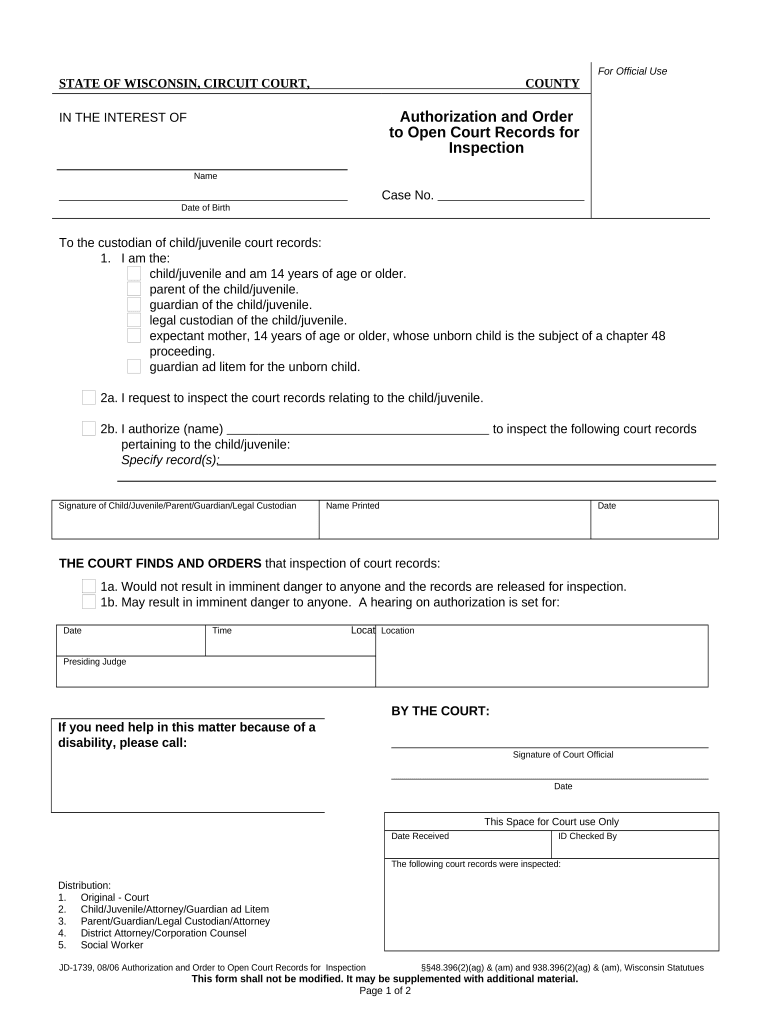
  1. Click ‘Get Form’ to open the Authorization and Order to Open Court Records for Inspection in the editor.
  2. Begin by filling in the 'Name' and 'Case No.' fields at the top of the form. Ensure that you enter accurate information as it is crucial for identification.
  3. Indicate your relationship to the child/juvenile by selecting one of the options provided: child/juvenile, parent, guardian, legal custodian, expectant mother, or guardian ad litem. This helps clarify your authority in requesting access.
  4. In section 2a, check the box requesting to inspect court records related to the child/juvenile. In section 2b, specify who you authorize to inspect these records by entering their name.
  5. Sign and print your name in the designated areas. Make sure to include the date of signing for proper documentation.
  6. Review all entered information for accuracy before submitting. Once confirmed, save your document and proceed with any necessary distribution as indicated at the bottom of the form.

Start using our platform today for free to streamline your document editing and signing process!

be ready to get more

Complete this form in 5 minutes or less

Get form

Got questions?

We have answers to the most popular questions from our customers. If you can't find an answer to your question, please contact us.
Contact us
I, [Your Name], am writing to formally authorize [Authorized Persons Name] to act on my behalf regarding [specific task or purpose, e.g., collecting documents, attending meetings, etc.]. Details of the Authorized Person: Name: [Authorized Persons Name] Relationship: [e.g., friend, colleague, etc.]
The document is saved into the court system and into a specific case file. After this happens, the order is considered to be entered, meaning that it is an official legal document requiring certain actions of the parties, their attorneys, or creating other requirements related to the case.
Authority: Items that may bind a court or influence a court. Jurisdiction and court level determine whether legal authority is mandatory or persuasive. Mandatory (Binding): Authority that a court must follow, i.e., that is binding on a court. Persuasive: Authority that a court may, but is not bound to, follow.
Subject: Legal Authorization Letter Dear [Lawyers Name], I, [Your Full Name], hereby authorize [Authorized Persons Full Name], bearing ID number [ID Details], to act on my behalf in legal matters related to [Case Name/Number or Legal Purpose]. The authorized person is permitted to: Sign legal documents.
How do I write a simple letter of authorization? Start with your name and contact information at the top. Include the current date. Write the recipients name and contact information. Clearly state your name and that youre writing to grant authorization to another individual or organization.

Security and compliance

At DocHub, your data security is our priority. We follow HIPAA, SOC2, GDPR, and other standards, so you can work on your documents with confidence.

Learn more
ccpa2
pci-dss
gdpr-compliance
hipaa
soc-compliance

People also ask

A letter of authorization (or authority letter) is a legal document that allows a third party (usually referred to as an agent) to act on behalf of the person writing the letter. In simple terms, when you write an authorization letter, you are legally permitting someone to act on your behalf.
Jurisdiction. There are limits to the legal authority of each court to hear and decide a case. For a court to be able to decide a case, it has to have jurisdiction. Jurisdiction over the legal issue or dispute you are suing about, called subject-matter jurisdiction.

Related links