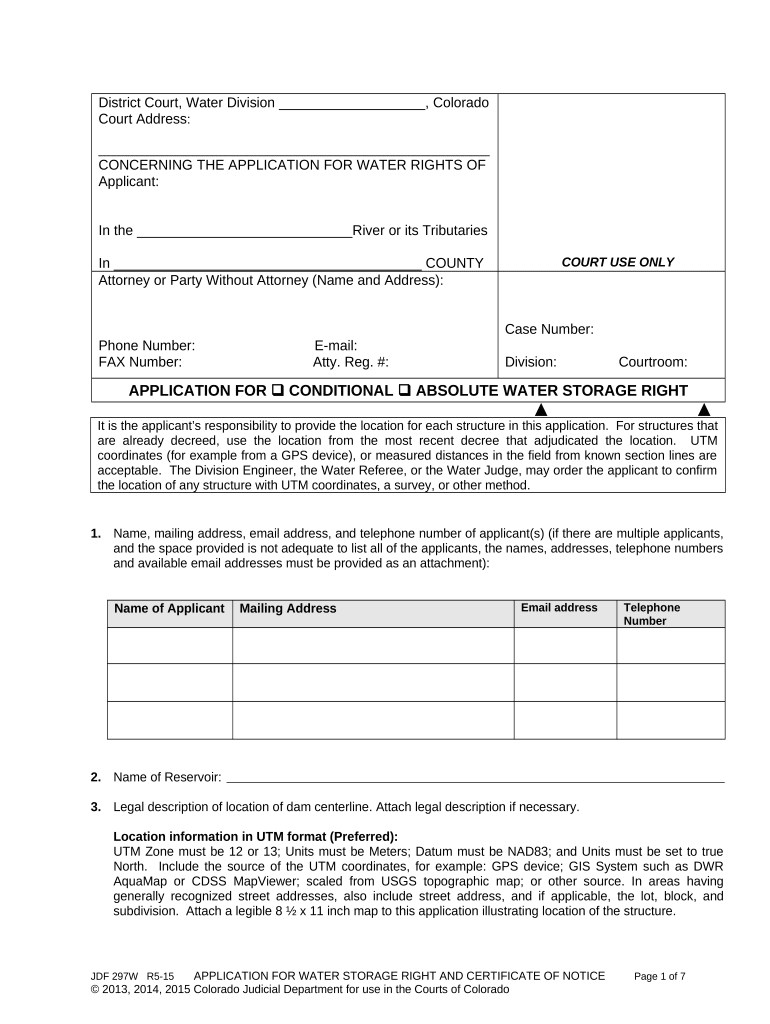
Application for Water Storage Right - Colorado 2026

Get Form
Application for Water Storage Right - Colorado Preview on Page 1

Here's how it works

01. Edit your form online
Type text, add images, blackout confidential details, add comments, highlights and more.
02. Sign it in a few clicks
Draw your signature, type it, upload its image, or use your mobile device as a signature pad.
03. Share your form with others
Send it via email, link, or fax. You can also download it, export it or print it out.

How to use or fill out Application for Water Storage Right - Colorado with our platform

Form edit decoration
9.5
Ease of Setup
DocHub User Ratings on G2
9.0
Ease of Use
DocHub User Ratings on G2
  1. Click ‘Get Form’ to open the Application for Water Storage Right - Colorado in the editor.
  2. Begin by entering your name, mailing address, email address, and telephone number in the designated fields. If there are multiple applicants, attach a separate document with their details.
  3. Provide the name of the reservoir and legal description of the dam's location. Use UTM coordinates if available, ensuring you include the source of these coordinates.
  4. Fill in details about the water source and any ditches used to fill the reservoir. Include UTM coordinates and legal descriptions as required.
  5. Indicate dates related to appropriation and beneficial use of water. Specify amounts claimed in acre feet and diversion rates if applicable.
  6. List all proposed uses for the water right, including irrigation details if relevant. Attach maps as needed.
  7. Complete any additional remarks or pertinent information before signing and dating your application.

Start using our platform today to streamline your application process for free!

be ready to get more

Complete this form in 5 minutes or less

Get form

Got questions?

We have answers to the most popular questions from our customers. If you can't find an answer to your question, please contact us.
Contact us
A water right in Colorado is regarded as a real property interest akin to land for the purposes of ownership and conveyancing. It can be bought, sold, moved and put to different uses without limitation, so long as that change does not injure the vested rights of other water rights owners.
Water rights in Colorado are unique when compared to other parts of the United States. The use of water is governed by what is known as the Prior Appropriation System. This system of water allocation controls who uses how much water, the types of uses allowed, and when those waters can be used.
Polyethylene water tanks are ideal for holding water up to 20,000 gallons. For larger volumes up to 100,000 gallons, galvanized steel water tanks are the way to go. If you are collecting water on your property and storing it, sometimes the growth of algae can be a problem.
In Colorado, there is no ownership registry for water rights, and the Office of the State Engineer does not have ownership information. To determine which water rights go with your land, you must research the deeds at your county clerks office.
Under the Colorado Constitution, the water of every natural stream that is not claimed by a water right owner, called unappropriated water, is the property of the public and available for appropriation. Water rights are created by using water for a legally recognized use, such as irrigation.

Security and compliance

At DocHub, your data security is our priority. We follow HIPAA, SOC2, GDPR, and other standards, so you can work on your documents with confidence.

Learn more
ccpa2
pci-dss
gdpr-compliance
hipaa
soc-compliance

People also ask

In Colorado, water rights are primarily governed by the doctrine of prior appropriation, often summarized as first in time, first in right. This means that the first person to divert water and put it to beneficial use has priority over others who may wish to use the water later.
Littoral rights are granted to property owners whose land borders large, non-flowing bodies of water, such as ponds, lakes, seas, and oceans. These rights typically allow property owners to use and enjoy the shoreline adjacent to their property.

Related links