

Law enforcement officer 2025

Get Form
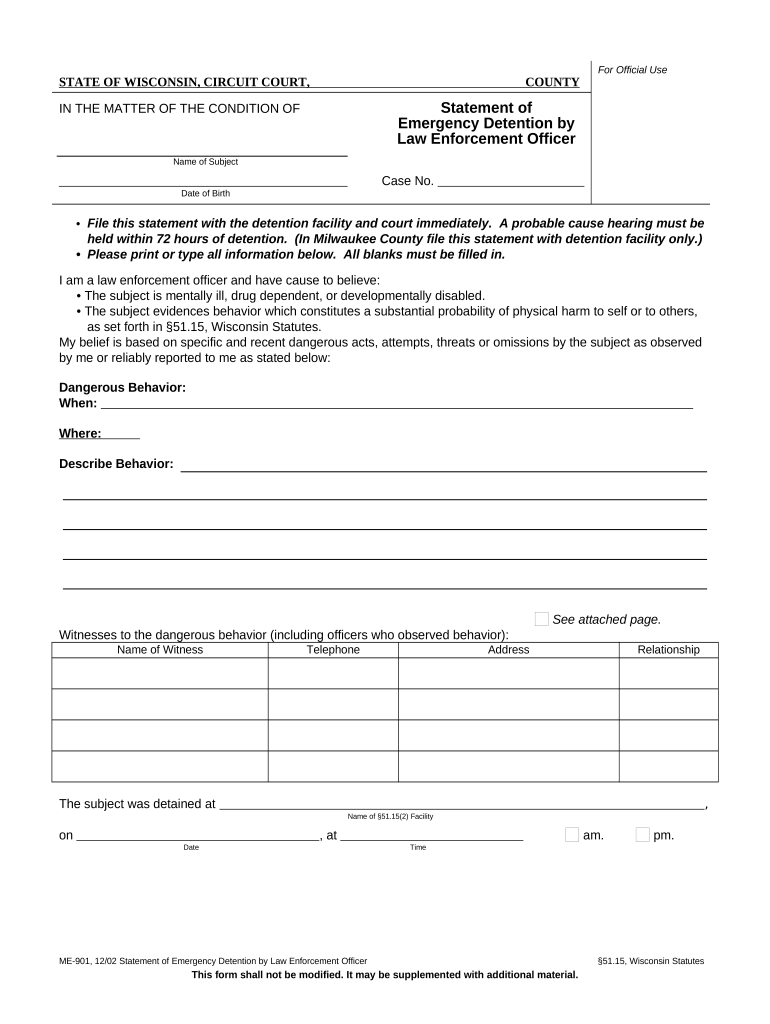
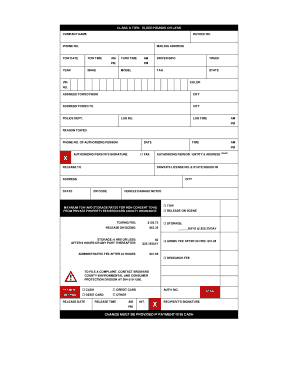
law enforcement officer Preview on Page 1

Here's how it works

01. Edit your form online
Type text, add images, blackout confidential details, add comments, highlights and more.
02. Sign it in a few clicks
Draw your signature, type it, upload its image, or use your mobile device as a signature pad.
03. Share your form with others
Send it via email, link, or fax. You can also download it, export it or print it out.

How to use or fill out law enforcement officer form

Form edit decoration
9.5
Ease of Setup
DocHub User Ratings on G2
9.0
Ease of Use
DocHub User Ratings on G2
  1. Click ‘Get Form’ to open it in the editor.
  2. Begin by entering the 'Name of Subject' and 'Date of Birth' in the designated fields. Ensure all information is printed clearly.
  3. In the section regarding your belief about the subject, select the appropriate options indicating whether they are mentally ill, drug dependent, or developmentally disabled.
  4. Detail the dangerous behavior observed. Fill in specifics such as 'When', 'Where', and a description of the behavior in the provided fields.
  5. List any witnesses to the dangerous behavior, including their names, telephone numbers, addresses, and relationships to the subject.
  6. Indicate where the subject was detained by filling in the name of the facility and date/time of detention.
  7. Finally, sign and print your name as an officer, along with your department and contact number before submitting.

Start using our platform today for free to streamline your document editing and signing process!

be ready to get more

Complete this form in 5 minutes or less

Get form

Got questions?

We have answers to the most popular questions from our customers. If you can't find an answer to your question, please contact us.
Contact us
Federal, state, county, and municipal law enforcement agenies. Federal law enforcement agencies, legally part of the executive branch of the U.S. government, are independent of other law enforcement agencies and of legislative and judicial agencies (see Chapter 1).
A law enforcement officer (LEO), or police officer or peace officer in North American English, is a public-sector or private-sector employee whose duties primarily involve the enforcement of laws, protecting life property, keeping the peace, and other public safety related duties. Law enforcement officer - Wikipedia wikipedia.org wiki Lawenforcementofficer wikipedia.org wiki Lawenforcementofficer
The different levels of law enforcement agencies include federal agencies such as the FBI, DEA, and U.S. Marshals, and state agencies such as state bureaus of investigation, state troopers, and state highway patrol. Counties have local sheriff departments, and cities and municipalities have local police departments.
Duties Respond to emergency and nonemergency calls. Patrol assigned areas, observing people and activities. Conduct traffic stops and issue citations. Search restricted-access databases for vehicle or other records and warrants. Obtain and serve warrants for arrests, searches, and other purposes.
Job Overview The Enforcement Officer is responsible for enforcing laws, regulations, and ordinances within a designated jurisdiction. This role demands a high level of responsibility, integrity, and dedication.

People also ask

Local Police includes municipal, county, tribal, and regional police that derive authority from the local governing body that created it. The primary purpose is to uphold the laws of the jurisdiction, provide patrol, and investigate local crimes.
Police departments also have a clear hierarchy, with the chief of police leading the department, followed by the deputy chief, assistant chief, captain, lieutenant, sergeant and officer. The captain may be responsible for a specific unit, while the sergeant may be responsible for a squad of officers.

Related links