Dispositional Order Concerning Petition to Appoint Relative as Guardian - Wisconsin 2026

Get Form
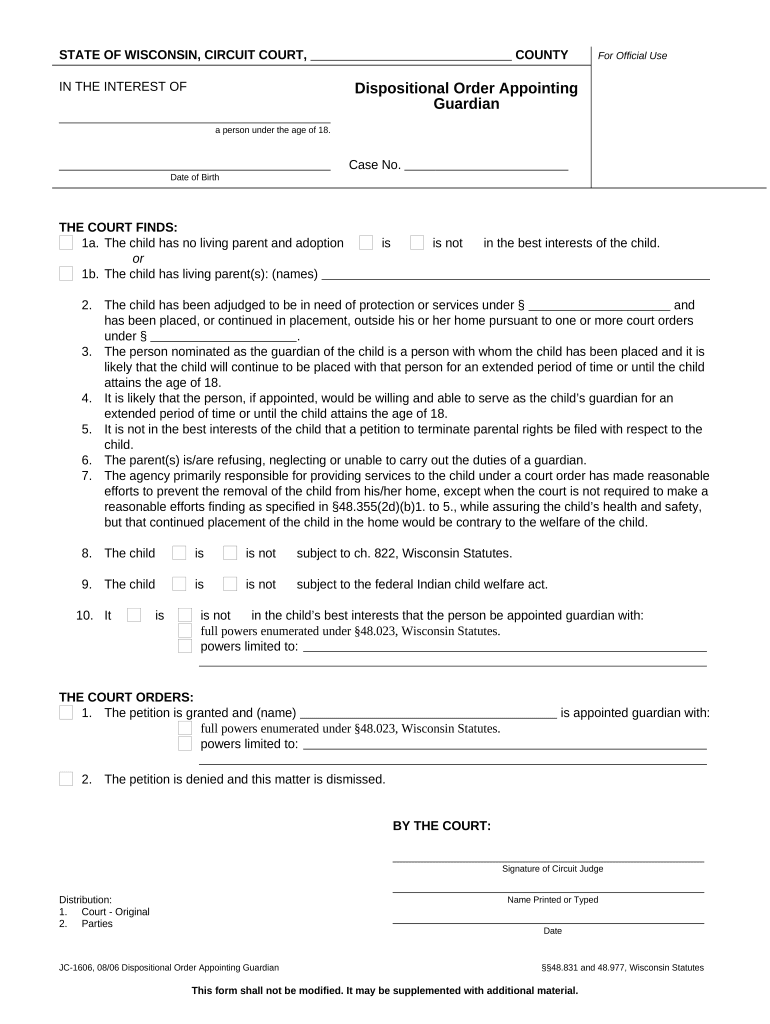
Dispositional Order Concerning Petition to Appoint Relative as Guardian - Wisconsin Preview on Page 1

Here's how it works

01. Edit your form online
Type text, add images, blackout confidential details, add comments, highlights and more.
02. Sign it in a few clicks
Draw your signature, type it, upload its image, or use your mobile device as a signature pad.
03. Share your form with others
Send it via email, link, or fax. You can also download it, export it or print it out.

How to use or fill out Dispositional Order Concerning Petition to Appoint Relative as Guardian - Wisconsin

Form edit decoration
9.5
Ease of Setup
DocHub User Ratings on G2
9.0
Ease of Use
DocHub User Ratings on G2
  1. Click ‘Get Form’ to open it in the editor.
  2. Begin by entering the child's name and case number at the top of the form. Ensure accuracy as this information is crucial for identification.
  3. In section 1, indicate whether the child has living parents and provide their names if applicable. This helps establish the context of guardianship.
  4. Proceed to section 2, where you will confirm if the child has been adjudged in need of protection or services. Fill in relevant court order details as required.
  5. In section 3, specify the nominated guardian's name and confirm their relationship with the child, ensuring that it reflects your intentions accurately.
  6. Complete sections 4 through 10 by providing necessary details regarding the guardian's willingness and ability to serve, along with any statutory references.
  7. Finally, review all entries for completeness and accuracy before signing at the bottom of the form. This ensures that your submission is valid and ready for court processing.

Start using our platform today to easily complete your Dispositional Order form online for free!

be ready to get more

Complete this form in 5 minutes or less

Get form

Got questions?

We have answers to the most popular questions from our customers. If you can't find an answer to your question, please contact us.
Contact us
A caregiver who is appointed guardian of a child by the court has the duty and authority to make important decisions for the child without severing the childs legal relationship to their parents and other family members.
Full guardianship removes most, if not all, of the individuals independence, as the guardian has full control. Limited guardianship preserves the individuals independence in areas where they can still manage their own affairs, promoting autonomy where possible.
There are four different types of 48.9795 guardianships: Full, Limited, Temporary, or Emergency. 3) Is there a guide to help with filing a guardianship? Yes. The Filing a Minor Guardianship of the Person Case guide can assist individuals filing a 48.9795 guardianship.
There are three types of guardianship: Guardianship of the person and estate. The guardian is responsible for the individuals healthcare and financial management. Guardianship of the person only. This applies when the ward needs to be looked after but does not have assets to manage. Guardianship of the estate only.
How Hard is it to Terminate Guardianship in Wisconsin? Terminating guardianship in Wisconsin requires proving to the courts that it is no longer necessary. While this may seem straightforward, the court considers factors such as the best interest of the Ward and may not agree to appoint a new guardian.

Security and compliance

At DocHub, your data security is our priority. We follow HIPAA, SOC2, GDPR, and other standards, so you can work on your documents with confidence.

Learn more
ccpa2
pci-dss
gdpr-compliance
hipaa
soc-compliance

People also ask

New State Law Mandates Training for Proposed Guardians Under this law, every individual nominated to be a guardian of the person or the estate on or after January 1, 2023, must complete training on a variety of topics, and submit a sworn, docHubd affidavit of such prior to the final guardianship hearing.
Protective placement is required for anyone under guardianship who lives in a licensed facility of more than 16 beds. Protective placements must be the least restrictive setting necessary to meet the individuals needs, and are reviewed annually by the court.

Related links