




01. Edit your voluntary termination of parental rights indiana form online
Type text, add images, blackout confidential details, add comments, highlights and more.

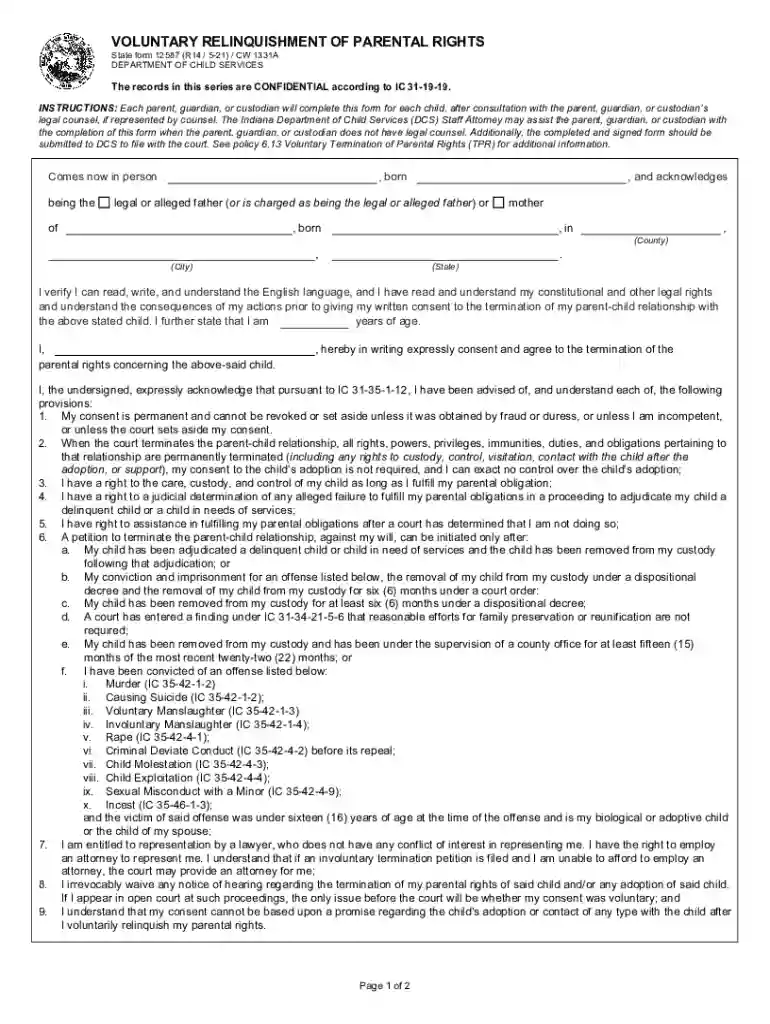
Type text, add images, blackout confidential details, add comments, highlights and more.

Draw your signature, type it, upload its image, or use your mobile device as a signature pad.

Send voluntary relinquishment of parental rights form via email, link, or fax. You can also download it, export it or print it out.
The Indiana termination of parental rights form is a legal document that allows a parent or guardian to voluntarily relinquish their parental rights to a child. This process has significant implications and requires a thorough understanding of both the legal context and emotional aspects involved.
The termination of parental rights (TPR) is a permanent legal action that severs the relationship between a parent and child. Once the consent is given and the court approves, the individual relinquishing their rights will no longer have any legal obligations or privileges concerning that child.
Permanent Consequences: Parents should be aware that signing over their parental rights is irreversible. Any future attempts to reclaim these rights are typically not permitted unless there are extenuating circumstances.
Impact on Custody: Terminating parental rights also means losing custody and all rights regarding the child’s upbringing, including decisions about education, healthcare, and general welfare.
Completing the termination of parental rights form involves several important steps. Each step ensures that the process is legally compliant and that the consent is fully informed.
Consult Legal Counsel: Before initiating the process, it is crucial to seek legal advice. A lawyer experienced in family law can explain the ramifications and assist in completing the form accurately.
Obtain the Form: The official termination of parental rights form can typically be accessed through state family court websites or legal aid organizations.
Fill Out the Form: Accurately complete all necessary sections of the document. This may include information about:
Submit the Form to Court: Once completed, the form must be submitted to the appropriate court. It may require a filing fee, depending on the jurisdiction.
Court Hearing: A hearing may be held to allow the judge to review the case. The parent will need to provide reasons for the termination and affirm their understanding of the consequences.
Deciding to terminate parental rights can be an emotionally challenging process. Support systems and resources are vital to help individuals navigate this decision.
Counseling Services: Many individuals benefit from speaking with a mental health professional who can guide them through their feelings and help clarify their decision.
Support Groups: Connecting with other individuals who have undergone similar experiences can provide emotional support and practical advice.
Several situations may prompt a parent to consider terminating their rights voluntarily. Understanding these scenarios can provide context for the process.
Inability to Care: A parent may feel overwhelmed by personal circumstances, such as financial difficulties or health issues, leading them to make the difficult choice to relinquish their rights.
Reunification with Adoptive Families: Some biological parents choose to terminate their rights to allow a child to be adopted by a loving family, believing this is in the child's best interest.
Once the court approves the termination of parental rights, several additional steps must be taken to formalize the decision:
Receive the Final Order: The court will issue a written order terminating parental rights, which should be kept for legal records.
Update Records: It may be necessary to update relevant records (e.g., birth certificates) to reflect the change in parental status.
Understand Post-Termination Rights: After termination, individuals should be aware they no longer have child support obligations or rights to visitation.
The Indiana termination of parental rights form represents a significant legal document tied to complex emotional and legal outcomes. Individuals considering this action should approach it with care, ensuring they understand the implications and have access to the appropriate support throughout the process.
We've got more versions of the voluntary termination of parental rights indiana form form. Select the right voluntary termination of parental rights indiana form version from the list and start editing it straight away!
At DocHub, your data security is our priority. We follow HIPAA, SOC2, GDPR, and other standards, so you can work on your documents with confidence.
by KA Wyle 2011 Cited by 3 It thus appears that Indiana case law provides no special justification for deferring substantially more to trial court orders terminating parental rights thanRead more
Mar 31, 2014 Form 20-F. REGISTRATION STATEMENT PURSUANT TO SECTION 12(b) OR 12(g) OF THE SECURITIES EXCHANGE ACT OF 1934.Read more
INSTRUCTIONS: Each parent, guardian, or custodian will complete this form for each child, after consultation with the parent, guardian, or custodians legalRead more


