Study Skills Inventory - South Central College - southcentral 2026

Get Form
study skills inventory Preview on Page 1

Here's how it works

01. Edit your study skills inventory online
Type text, add images, blackout confidential details, add comments, highlights and more.

02. Sign it in a few clicks
Draw your signature, type it, upload its image, or use your mobile device as a signature pad.

03. Share your form with others
Send approaches and study skills inventory for students via email, link, or fax. You can also download it, export it or print it out.

How to use or fill out Study Skills Inventory - South Central College - southcentral

Form edit decoration
9.5
Ease of Setup
DocHub User Ratings on G2
9.0
Ease of Use
DocHub User Ratings on G2
  1. Click ‘Get Form’ to open it in the editor.
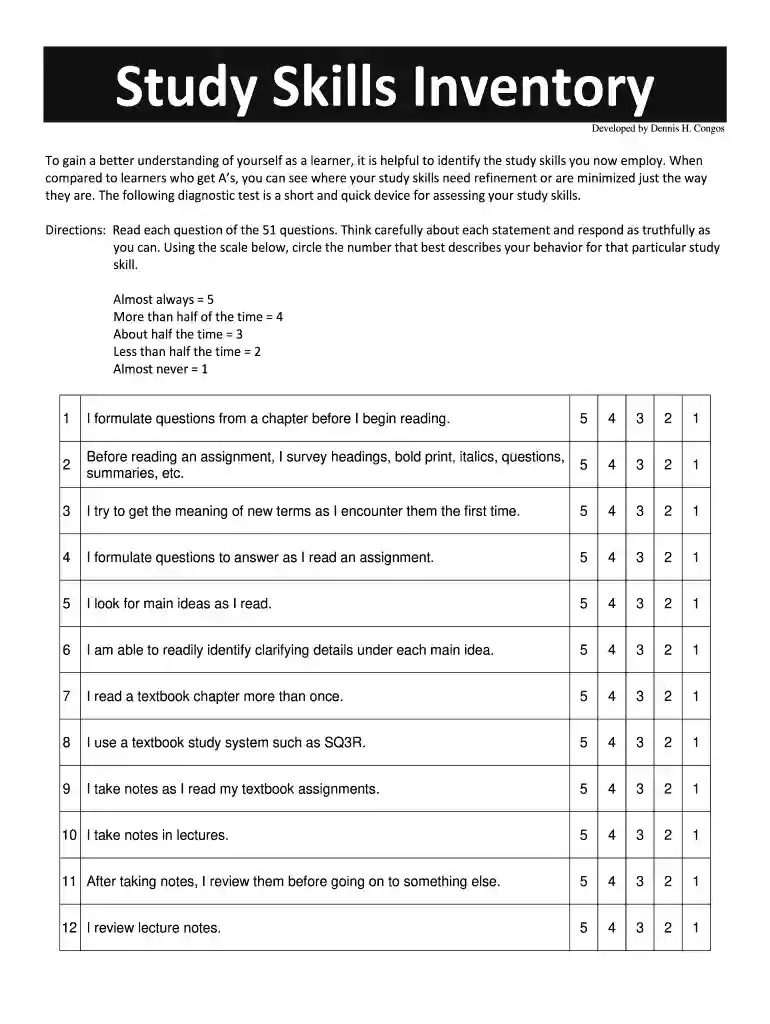
  2. Begin by reading each of the 51 questions carefully. Reflect on your study habits and select a number from the provided scale that best represents your behavior for each statement.
  3. Circle the corresponding number for each question, using the scale: Almost always = 5, More than half of the time = 4, About half the time = 3, Less than half the time = 2, Almost never = 1.
  4. After completing all questions, transfer your scores to the designated sections at the end of the form to calculate your effectiveness scores in various study skills categories.
  5. Review your total scores and reflect on areas where improvement is needed. Consider scheduling an appointment with a study skills tutor if necessary.

Start enhancing your study skills today by filling out the Study Skills Inventory online for free!

See more Study Skills Inventory - South Central College - southcentral versions

We've got more versions of the Study Skills Inventory - South Central College - southcentral form. Select the right Study Skills Inventory - South Central College - southcentral version from the list and start editing it straight away!
Versions Form popularity Fillable & printable
2015 4 Satisfied (55 Votes)
be ready to get more

Complete this form in 5 minutes or less

Get form

Got questions?

We have answers to the most popular questions from our customers. If you can't find an answer to your question, please contact us.
Contact us
How to create a skills inventory in 5 steps 1) Establish the business goals you want to achieve. 2) Identify the skills needed to hit your goals. 3) Conduct an employee skills assessment. 4) Map the results in a skills matrix. 5) Regularly update your inventory.
Conclusions. This evaluation shows that a study skills course improves students self-assessment of skills and attitudes associated with success in post-secondary education. Future studies will look at the effect of such a course on academic outcomes.
How to make a skills inventory List and categorize your skills. Separate skills based on competency. Assess current skill level. Adjust career plan to reflect skills. Choose a method for tracking. Begin contacting employees. Update your skills inventory regularly.
A skills inventory includes information such as: Employee name, role, and department. The skills, knowledge, and competencies of the employee. Qualifications, training, certifications, and education background.
A typical skills inventory includes various categories of skills such as technical skills, soft skills, specialized knowledge, certifications, educational qualifications, and work experience. Each individuals skills are typically rated or ranked to provide a clear picture of their proficiency level in each area.

Security and compliance

At DocHub, your data security is our priority. We follow HIPAA, SOC2, GDPR, and other standards, so you can work on your documents with confidence.

Learn more
ccpa2
pci-dss
gdpr-compliance
hipaa
soc-compliance

People also ask

What are the 4 study skills? Mind Mapping: The Web of Knowledge. Imagine having the ability to see connections between different pieces of information, much like a spider weaving its intricate web. Chunking: The Memory Booster. Active Recall: The Memory Muscle. Time Blocking: The Master of Time.
Students will practice skills in the areas of listening and note-taking, reading strategies, test-taking, studying and time management. Outcomes for the class include: Listening: Students will be able to understand the main ideas and organization of a short academic lecture.

Related links