
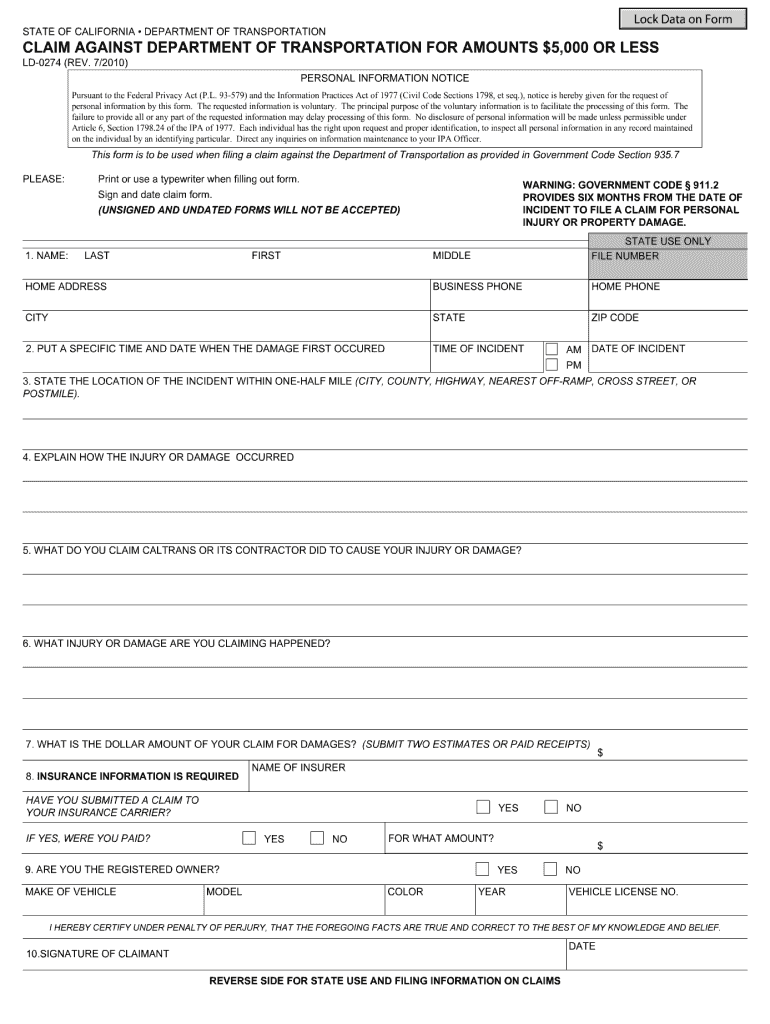





Caltrans pothole claim form 2026

Get Form
caltrans pothole claim Preview on Page 1

Here's how it works

01. Edit your caltrans pothole claim online
Type text, add images, blackout confidential details, add comments, highlights and more.
02. Sign it in a few clicks
Draw your signature, type it, upload its image, or use your mobile device as a signature pad.
03. Share your form with others
Send caltrans claim form via email, link, or fax. You can also download it, export it or print it out.

Definition & Meaning

The Caltrans pothole claim form is a specific document designed to help individuals file claims for damages incurred by potholes on state-maintained roads in California. This form is part of the California Department of Transportation’s process to address and compensate for vehicle damage caused by road maintenance issues. The form allows vehicle owners to formally request reimbursement for repair costs, provided they can demonstrate that the damage was directly caused by a pothole on a road overseen by Caltrans.

Importance of Understanding the Form

  • Clarification of Purpose: Knowing the purpose of the form ensures applicants understand its utility in state vehicle damage claims.
  • Eligibility Assurance: Understanding who can file prevents ineligible claims and saves time.
  • Accurate Reimbursement: A clear understanding aids in acquiring the deserved reimbursement for pothole damages.

How to Obtain the Caltrans Pothole Claim Form

The Caltrans pothole claim form is available through several channels, ensuring accessibility for all claimants.

Access Points

  • Online Access: You can visit the official California Department of Transportation website to download the form.
  • Physical Locations: Forms can often be picked up at local DMV offices or at Caltrans district offices.
  • Mail Requests: Requesting the form via mail is possible, but it may take longer compared to digital methods.

Steps to Complete the Caltrans Pothole Claim Form

Filling out the Caltrans pothole claim form requires precision and attention to detail to ensure successful processing.

Step-by-Step Completion

  1. Gather Information: Before starting, collect documentation of the incident, such as photos of the pothole and damage, repair invoices, and witness statements.
  2. Personal Information: Fill in your contact details, including name, address, phone number, and email.
  3. Incident Details: Explain where and when the incident occurred, providing specific details of the road and nearest landmarks.
  4. Damage Description: Offer a detailed account of the damage sustained by your vehicle and attach photographic evidence.
  5. Repair and Cost Documentation: Submit any repair invoices, cost estimates, and other financial documents that support your claim.
  6. Submission Review: Double-check for accuracy and completeness before submission.

Tips for Effective Submission

  • Detailed Descriptions: Be precise about the incident's location, date, and description to avoid processing delays.
  • Supporting Documents: Attach all required documentation to strengthen the claim and expedite processing.

Who Typically Uses the Caltrans Pothole Claim Form

The form is primarily used by California residents who have suffered vehicle damage due to poorly maintained state roads.


decoration image ratings of Dochub

Typical Users

  • Daily Commuters: Regular travelers who often encounter state roadways.
  • Commercial Drivers: Operators of delivery trucks or taxis who rely heavily on road networks.
  • Tourists: Visitors encountering road damage while traveling through California.

User Scenarios

  • Highway Travelers: Individuals frequently on highways with high-speed limits.
  • Urban Drivers: Residents in cities where pothole issues are prevalent.

Key Elements of the Caltrans Pothole Claim Form

The form includes several crucial sections that claimants must complete correctly.

Essential Sections

  • Claimant Information: Personal identification details.
  • Incident Report: Specific circumstances and evidence of the incident.
  • Damage Report: Visual and descriptive evidence of damage.
  • Financial Claim: Inclusion of repair costs and financial impact.

Common Mistakes

  • Incomplete Information: Missing out on details can lead to claim rejection.
  • Lack of Evidence: Providing insufficient proof of damage and cause.
  • Incorrect Form Use: Submitting the wrong form variant.

State-Specific Rules for the Caltrans Pothole Claim Form

The form adheres to California-specific regulations regarding road maintenance claims.

Notable Regulations

  • Eligibility Criteria: Must prove the pothole existed on a state-maintained road.
  • Filing Deadlines: Claims usually need to be filed within six months of the incident.

Unique State Conditions

  • Regional Differences: Regulations might vary slightly based on county and district.
  • Seasonal Variations: Road conditions and therefore form usage can peak during certain seasons.

Legal Use of the Caltrans Pothole Claim Form

Filing a Caltrans pothole claim is a legal action that ensures the state is held accountable for road maintenance.

Legal Considerations

  • Claim Validity: Ensure that the damage was unavoidable and due to a clearly identifiable pothole.
  • Reimbursement Eligibility: Claims are processed only if the claimant follows the legal avenues outlined specifically for California state roads.

Legal Assistance

  • Consultation with Lawyers: Legal advice may be sought to ensure compliance and improve the likelihood of a successful claim.

Required Documents

Supported documents add weight to your claim when submitting the form.

Documentation Checklist

  • Photographs: Clear images showing the pothole and damage.
  • Repair Receipts: Detailed invoices from a recognized repair shop.
  • Witness Statements: Optional but helpful, written accounts from witnesses to the incident.

Submission Practices

  • Electronic Copies: Digital scans or photographs to accompany online submissions.
  • Organized Files: Ensuring all documents are clear and legible to aid in verification.

Using these sections, filers can comprehend the necessary actions and expectations associated with the Caltrans pothole claim form, ensuring a direct and processed path to remedy vehicle damage from state-controlled road conditions.

See more caltrans pothole claim form versions

We've got more versions of the caltrans pothole claim form form. Select the right caltrans pothole claim form version from the list and start editing it straight away!
Versions Form popularity Fillable & printable
2017 4.8 Satisfied (20 Votes)
2010 4.9 Satisfied (366 Votes)
2004 4.3 Satisfied (40 Votes)
2003 3.9 Satisfied (26 Votes)
be ready to get more

Complete this form in 5 minutes or less

Get form

Got questions?

We have answers to the most popular questions from our customers. If you can't find an answer to your question, please contact us.
Contact us
Under California law, the public entity responsible for maintaining the roadway, whether a city, county, or state agency, may be held liable for pothole damage. However, financial responsibility is not automatic. To recover damages from a government entity, a driver must prove negligence.Jan 5, 2026
Pothole claims are generally not very successful, with most being denied due to government immunity, strict notice requirements, and the need to prove agency negligence, though success rates vary DocHubly by location, with some areas paying out a low percentage (e.g., 1-12%) while others (like Chicago) might be more generous if all conditions are met. Key factors for success include timely documentation (photos, reports) and demonstrating the responsible body knew about the pothole and failed to fix it in a reasonable time. Why claims are often denied Government Immunity: Laws often protect government entities from liability unless specific conditions are met. Lack of Notice: The agency must have known about the pothole and had enough time to repair it but didnt, which is hard to prove. Strict Deadlines: Many jurisdictions have short windows (sometimes days) to file a formal notice of claim. Proof of Negligence: You must prove the agency was negligent, not just that the pothole existed. Examples of success rates Low Success: Michigan saw only 1 repay out of 33 claims in one region; South Carolina denied nearly 70% of claims; Tennessee approved about 1%. Higher (with caveats): Chicago pays up to half the repair cost if a police report is filed and the claim is approved. Steps to improve your chances Document Everything: Take photos with measurements, get repair estimates, and file a police report immediately. Know Your Agency: Identify the correct authority (state, county, city) responsible for that road section. File Promptly: Adhere to strict deadlines for reporting the incident. Be Thorough: Provide detailed evidence proving the agencys negligence. AI can make mistakes, so double-check responsesWhats the success rate of claiming compensation from pothole damage?May 9, 2024 Proving Council Negligence: Success in claiming compensation often hinges on proving council negligence, such as inadeqRReddit r/glasgowHas anyone here successfully filed a pothole damage claim? - RedditJun 4, 2024 Comments Section * 2y ago. As long as the pothole was actually in the road, typically you will get reimbursed. HowevReddit
Filing a pothole claim can be worth it for DocHub damage (e.g., suspension, alignment, bent rims) if repair costs exceed your insurance deductible, but its often not worth it for minor issues like a small tire nick, as youll need to prove the government was negligent, which is difficult (only about 10% success rate) and requires thorough documentation of the potholes location, your damage, and prior reports to the city/state. You can claim through your collision insurance (if you have it) for easier processing but higher deductibles, or directly to the government agency (city, county, state) responsible for the road, which is harder but avoids raising your insurance rates. When to file an insurance claim (Collision Coverage) DocHub Damage: If repairs (alignment, suspension, new tire/rim) cost more than your deductible (often $500-$1000). Process: Take photos, document location/time, call your insurer, file a claim. Downside: May increase premiums, even if you get reimbursed. When to file a government claim (Direct Reimbursement) Minor Damage: To avoid insurance deductibles/rate hikes. Proof Needed: Must prove the agency knew about the pothole and failed to fix it (e.g., it was previously reported). Process: Document: Photos/video of pothole and damage, exact location, time, weather. Get Estimates: Obtain repair quotes or receipts. File Form: Find the claim form (city/county/state website) and submit within deadlines (e.g., 180 days). Downside: Low success rate (around 10%), complex process, often requires proving government negligence. Key Takeaway For large repairs: Insurance is often easier. For small repairs: Government claim might save money, but its a long shot. Always: Document everything immediately, regardless of which route you choose. AI can make mistakes, so double-check responsesDoes Car Insurance Cover Pothole Damage? | ProgressiveDoes insurance cover pothole damage? Yes, but only if you carry collision coverage. This coverage is optional, but it can cover yoProgressiveLegal expert weighs in on pothole damage and filing a claimJun 23, 2023 on most all of these claims whether it be a road condition whether it be other things is to deny them i said sat down YouTube ABC15 Arizona
Yes, it can be too late to make an insurance claim, as policies and state laws set deadlines, often requiring filing promptly or within specific windows (e.g., 30 days to 2-3 years), but waiting longer than necessary risks denial, weaker evidence, and more scrutiny from the insurer. While some policies offer grace periods or allow longer times for lawsuits (statutes of limitation), always report incidents and file claims as soon as possible to avoid complications, as the exact time limit depends on your policy type (auto, health, property) and state laws. Key Factors Deadlines Policy Wording: Most policies require prompt notice, often within days or weeks, even if the legal limit is longer. Health Insurance: Often 90 to 180 days from the date of service, but varies by insurer. Auto Insurance: Varies, but often as soon as possible, with state statutes of limitation ranging from 1 to 6+ years for lawsuits, though insurers prefer much faster reporting. Property Insurance: Can range from 30 days to 3 years. Government Claims: Very strict, often 60-180 days for formal notice. Why You Should File Quickly Avoid Denial: Late claims are often denied for bDocHub of contract or failure to provide timely notice. Preserve Evidence: Memories fade, and evidence (like photos, witness details, or damage) can disappear. Build Credibility: Delayed claims raise suspicion and trigger more extensive investigations. What to Do if Youre Late File Anyway: Even if you think its too late, start the process and see if the insurer accepts it, as you can dispute rejections. Document Everything: Gather all records, photos, and reports. Seek Legal Advice: An attorney can help you understand state laws and your rights, especially for complex cases. AI can make mistakes, so double-check responsesTime Limits for Filing Car Insurance Claims by State | InsuredBetterFeb 23, 2026 One of them is probably How long after a car accident can I claim injury? Statutes of limitation typically fall withInsuredBetter.comIs it too late to file a health insurance claim (for last year)?Jan 19, 2017 The typical window to file a health insurance claim is 90 days after the date of service. However, the time frame can Stack Exchange
Insurers tell us drivers should notify them of pothole damage immediately, regardless of whether they intend to claim. Youll then usually have around five or six months before you have to file an insurance claim, which gives you time to see if a claim to the responsible authority will work first.

Security and compliance

At DocHub, your data security is our priority. We follow HIPAA, SOC2, GDPR, and other standards, so you can work on your documents with confidence.

Learn more
ccpa2
pci-dss
gdpr-compliance
hipaa
soc-compliance

People also ask

Claiming from the municipality for pothole damage If its on a municipal road, the local municipality or Department of Public Works are more likely to be liable for damages. If its on a regional road, the city council or local municipality will usually be liable.
If you hit a pothole big enough to cause front-end damage, your collision coverage may help pay for repairs. But remember, youd be responsible for your deductible first the amount you must pay before your insurer will pay for a covered claim.

caltrans claims

