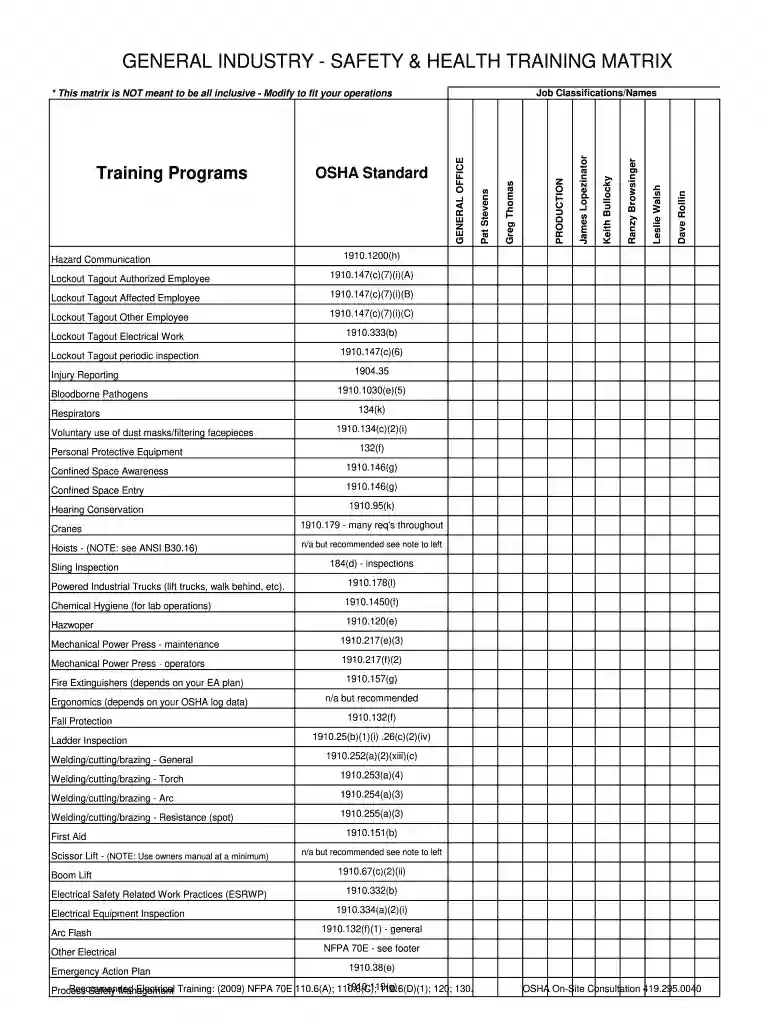
GENERAL INDUSTRY - SAFETY & HEALTH TRAINING MATRIX 2026

Get Form
osha training requirements matrix Preview on Page 1

Here's how it works

01. Edit your osha training requirements matrix online
Type text, add images, blackout confidential details, add comments, highlights and more.

02. Sign it in a few clicks
Draw your signature, type it, upload its image, or use your mobile device as a signature pad.

03. Share your form with others
Send osha training matrix via email, link, or fax. You can also download it, export it or print it out.

Understanding the General Industry - Safety & Health Training Matrix

The General Industry - Safety & Health Training Matrix is a structured guide designed to outline essential safety and health training requirements for workplaces under the Occupational Safety and Health Administration (OSHA) standards. This matrix serves as a vital tool for employers to ensure compliance and safeguard employee well-being by identifying necessary training programs based on job classifications, operational hazards, and safety procedures. The matrix typically includes key areas such as hazard communication, personal protective equipment, lockout/tagout procedures, and other crucial safety protocols.

How to Utilize the Safety & Health Training Matrix Effectively

To effectively use the General Industry - Safety & Health Training Matrix, employers should start by assessing their specific workplace operations and hazards. They can accomplish this using the following steps:

  1. Identify Job Classifications: Determine the various job roles within the organization that require different training based on the associated hazards.
  2. Review OSHA Standards: Consult relevant OSHA regulations to understand required safety training linked to identified hazards.
  3. Tailor Training Programs: Based on job classifications and hazards, customize training programs that align with the matrix's recommendations to ensure comprehensive coverage.
  4. Document Training Activities: Maintain detailed records of training activities, including dates, participants, and completion status to facilitate audits and ensure compliance.

Obtaining the General Industry - Safety & Health Training Matrix

The General Industry - Safety & Health Training Matrix can often be obtained through various channels. Employers can:

  • Access Online Resources: OSHA’s official website offers downloadable training matrices tailored to different industries, including general industry.
  • Consult Third-party Training Providers: Many safety training organizations provide pre-made matrices customized to meet specific compliance needs and ensure thorough coverage of required training areas.
  • Develop In-house: Organizations can create their own training matrix by compiling required training elements per OSHA standards and mapping them to specific job functions.

Completing the Safety & Health Training Matrix

Completing the General Industry - Safety & Health Training Matrix involves the following steps:

  1. Gather Input from Stakeholders: Engage with safety officers, HR personnel, and employees to determine relevant safety issues and training needs.
  2. Map Out Required Training: Using the insights gathered, outline required training programs against specific job roles within the matrix.
  3. Implement Training Programs: Schedule and conduct the training sessions as per the established timeline. Ensure trainers are knowledgeable and effective in conveying safety information.
  4. Evaluate Training Effectiveness: After conducting training, assess participant comprehension and application of safety procedures through evaluations and feedback.

Advantages of the General Industry - Safety & Health Training Matrix

Utilizing the General Industry - Safety & Health Training Matrix has several advantages:

  • Compliance Assurance: It helps ensure organizations meet OSHA training requirements, reducing the risk of legal penalties and enhancing workplace safety.
  • Customized Safety Training: The matrix allows employers to tailor training programs to fit specific job roles and associated hazards, ensuring relevancy and effectiveness.
  • Enhanced Employee Awareness: Through structured training, employees become more aware of potential hazards and safety practices, fostering a safety-oriented culture within the organization.
  • Efficient Use of Resources: The matrix enables better allocation of training resources by identifying the most pertinent training needs and scheduling them accordingly, thereby minimizing downtime.

Key Elements of the General Industry - Safety & Health Training Matrix

The matrix includes critical components essential for effective safety training programs:

  • Training Topics: Specific subjects such as fire safety, emergency response, and ergonomic practices must be highlighted based on the nature of the workplace and its respective hazards.
  • Frequency Requirements: The matrix outlines how often each training program should be conducted, considering factors like regulatory requirements and employee turnover.
  • Training Methods: A variety of teaching methods, including workshops, hands-on training, and online courses, should be included to cater to different learning preferences.
  • Recordkeeping Protocols: Clear guidelines detailing how to document training sessions, including completion dates and participant lists, enable organizations to maintain compliance and facilitate audits.

Legal Use of the General Industry - Safety & Health Training Matrix

The General Industry - Safety & Health Training Matrix must be used within the parameters set by legal and regulatory requirements. Organizations are responsible for:

  • Adhering to OSHA Standards: Employers must ensure that their training programs meet or exceed the requirements set forth by OSHA to mitigate risks of penalties for non-compliance.
  • Maintaining Comprehensive Records: Accurate recordkeeping not only aids in compliance audits but also serves to demonstrate due diligence in training provision, should any workplace incident occur.
  • Updating Training Lists Regularly: The safety landscape is increasingly evolving, including changes in regulations. Regularly reviewing and adjusting the training matrix is essential to ensure ongoing compliance.

Examples of Using the General Industry - Safety & Health Training Matrix

Practical applications of the General Industry - Safety & Health Training Matrix vary based on industry needs:

  • Construction Sites: A construction firm could utilize the matrix to create a comprehensive training program addressing fall protection, equipment safety, and hazardous material handling.
  • Manufacturing Facilities: A factory may employ the matrix to ensure training in machinery safety, lockout/tagout procedures, and emergency response protocols.
  • Healthcare Settings: Healthcare employers can use the matrix to structure training around infection control, patient handling, and workplace violence prevention, ensuring compliance while promoting staff safety.

This structured approach to developing and implementing a safety and health training matrix significantly enhances workplace safety and ensures legal compliance while fostering a culture of proactive health and safety among employees.

be ready to get more

Complete this form in 5 minutes or less

Get form

Got questions?

We have answers to the most popular questions from our customers. If you can't find an answer to your question, please contact us.
Contact us
Also known as 21s or partials, Matrix 21s comprise a single set of exercises targeting a particular muscle or muscle group using three phases of motion: an outer, inner and full range. The 21 in the name refers to the number of reps, which are split into 3 x 7 reps for the three ranges of motion (ROM).
An OSHA compliance checklist is a useful tool for assessing compliance with the standards developed by the Occupational Safety and Health Administration to ensure a healthy and safe workplace for employees. Please note that this OSHA compliance checklist has been compiled based on federal OSHA standards.
Employee training is a key component of any safety program. The matrix provides guidance for supervisors to identify common employee training requirements. The matrix does not include every training topic needed. Keep in mind that an employee must have training to do their job safely.
Recommended Practices for Safety and Health Programs Management Leadership. Worker Participation. Hazard Identification and Assessment. Hazard Prevention and Control. Education and Training. Program Evaluation and Improvement. Communication and Coordination for Host Employers, Contractors, and Staffing Agencies.
A training matrix, also known as a skills matrix, is a table used by organisations to plan, track and manage employee training. It helps LD and HR teams monitor progress, identify skill gaps and provide targeted training opportunities.

Security and compliance

At DocHub, your data security is our priority. We follow HIPAA, SOC2, GDPR, and other standards, so you can work on your documents with confidence.

Learn more
ccpa2
pci-dss
gdpr-compliance
hipaa
soc-compliance
be ready to get more

Complete this form in 5 minutes or less

Get form

People also ask

The OSHA 10-Hour General Industry Outreach Training course is a voluntary program. This safety training focuses on recognition, avoidance, abatement and prevention of workplace hazards. It also includes information on your rights, your employers responsibilities and procedures for filing an official complaint.
It provides alarms for the matrix, cause, and effect. The Safety Matrix is an integrated tool for all activities, including maintenance, error handling, and change management during operation.

safety training skills matrix template