Cash drawer count sheet 2026

Get Form
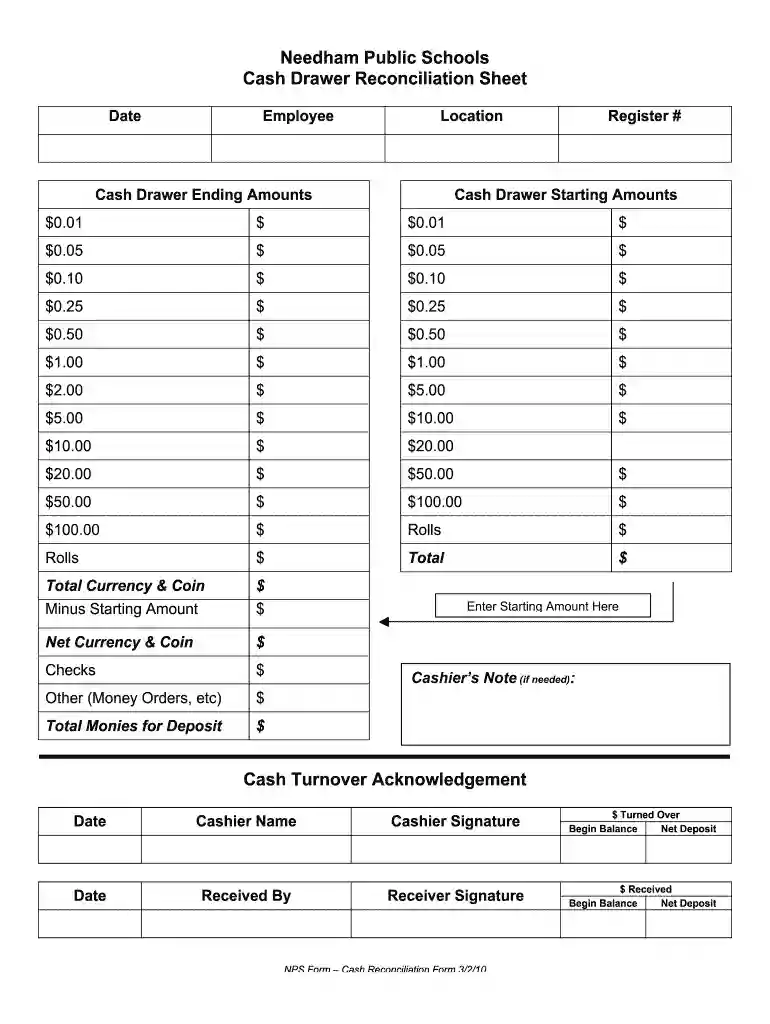
free printable cash drawer count sheet pdf Preview on Page 1

Here's how it works

01. Edit your free printable cash drawer count sheet pdf online
Type text, add images, blackout confidential details, add comments, highlights and more.

02. Sign it in a few clicks
Draw your signature, type it, upload its image, or use your mobile device as a signature pad.

03. Share your form with others
Send free printable cash count sheet via email, link, or fax. You can also download it, export it or print it out.

Definition and Meaning of the Cash Drawer Count Sheet

A cash drawer count sheet is a financial document used to record and reconcile cash transactions at the end of a business shift or at various intervals throughout the day. This sheet typically includes a detailed breakdown of cash and cash equivalents, capturing starting and ending amounts for different denominations, checks, and other payment forms. The primary purpose is to ensure that all incoming receipts match the cash available, aiding in the prevention of discrepancies due to miscounting or theft.

The cash drawer count sheet serves several crucial functions in business operations:

  • Accountability: It holds cashiers accountable for their transactions, as they must declare the amount at the start and end of their shifts.
  • Reconciliation: Businesses can identify discrepancies between expected and actual cash, which is essential for accurate bookkeeping.
  • Data Collection: Frequent use of this sheet allows businesses to track sales trends and monitor cash flow more effectively.

Understanding the definition and functionality of the cash drawer count sheet is vital for those managing financial transactions, particularly in retail and service-oriented businesses.

How to Use the Cash Drawer Count Sheet Effectively

Using a cash drawer count sheet begins by familiarizing yourself with its layout and structure. Typically, the sheet will have designated sections for entering the starting cash balance, cash received during the period, total cash counted at the end, and notes regarding any discrepancies or irregularities.

Steps to Use the Sheet

  1. Initialization:

    • At the beginning of your shift, record the initial cash amount in the designated box. This should include all denominations of bills and coins.
  2. Daily Transactions:

    • Throughout your shift, whenever cash is received, it should be logged appropriately. Specifying the amount and source (e.g., customer sales, payments) can provide clarity.
  3. End of Shift Count:

    • At the end of your shift, perform a physical count of the cash drawer. Be thorough, ensuring you account for every bill and coin.
  4. Reconciliation:

    • Compare the physically counted cash with the expected cash balance calculated from the initial balance plus any transactions recorded during the shift.
  5. Documentation:

    • Note any discrepancies in the comments section of the sheet. These notes should clarify reasons for variances, such as errors in data entry or potential theft or loss.

By following these steps, you can efficiently manage your cash drawer, reduce discrepancies, and ensure better financial reporting.

Steps to Complete the Cash Drawer Count Sheet

Filling out a cash drawer count sheet accurately is crucial for maintaining financial integrity. There are specific steps to follow to ensure you capture all necessary information.

  1. Prepare the Sheet: Start with a blank cash drawer count sheet, which can be printed from various online sources, or use a digital format as preferred.

  2. Enter Initial Amount:

    • Begin with the date and shift information, then record the starting cash amount, itemizing by denomination:
      • $1 bills: quantity and total
      • $5 bills: quantity and total
      • Coin types: quantity of each type and total
  3. Log Cash Transactions:

    • As transactions occur, keep a tally of incoming cash in a separate section of the sheet. This includes all cash payments received from sales.
  4. Conduct an End-of-Day Count:

    • At the end of your shift, physically recount all cash present in the drawer, ensuring you include all denominations.
  5. Calculate Total Cash:

    • Sum up the counted cash and record this total. Compare it against the expected amount, which is calculated as follows:
      • Expected Total = Starting Cash + Total Cash Recorded from Transactions
  6. Note Discrepancies:

    • If discrepancies exist, record them along with any explanations to maintain transparency and facilitate later investigations if necessary.
  7. Signatures: Have both the cashier and a supervisor or manager sign the completed sheet for accountability.

Following these steps ensures that cash management is both efficient and trustworthy.

Key Elements of a Cash Drawer Count Sheet

Understanding the key elements of a cash drawer count sheet helps ensure that it is used effectively. The main components typically include:

  • Date and Shift Information: Essential for tracking when the count occurred and associating it with a specific cashier.
  • Starting Cash Balance: A detailed inventory of the cash present at the beginning, including breakdowns by denomination.
  • Cash Inflows: Section for logging incoming cash based on sales or payments throughout the shift.
  • End Cash Count: Area to record the final tally of cash in the drawer at the end of the shift.
  • Discrepancy Notes: Space for documenting any discrepancies found during reconciliation, explaining what may have caused them.
  • Signatures: Areas for both the cashier and a supervisor or manager to sign off on the count, confirming accuracy and accountability.

By including these elements in the count sheet, businesses can enhance their financial tracking and accountability.

Examples of Using the Cash Drawer Count Sheet

Real-world examples illustrate how a cash drawer count sheet can function effectively in various business environments. These scenarios help in visualizing its application.

  • Retail Store Example: A cashier at a retail store opens their shift with $200 in the cash drawer, itemized as follows:

    • 20 x $1 bills = $20
    • 10 x $5 bills = $50
    • 10 x $10 bills = $100
    • Total: $200

    Throughout their shift, they record Cash Inflows totaling $650. At the end of the shift, they count $820 in the drawer. The expected total matches: $200 + $650 = $850, revealing a $30 discrepancy. Noting this with an explanation leads to a review process.

  • Restaurant Scenario: A server records cash from diners totaling $500 in tips during the shift. Starting with $100 in the drawer, at shift's end, the count reflects $605, indicating accuracy or prompting an audit if discrepancies arise.

These examples showcase how cash drawer count sheets facilitate accurate financial management and reveal any issues that may require attention.

Business Types That Benefit Most from Cash Drawer Count Sheets

Different business types use cash drawer count sheets, and recognizing which sectors benefit the most can help identify target audiences for this tool.

  • Retail Stores: High-volume cash transactions make retail environments particularly reliant on cash drawer count sheets to monitor daily sales and cash flow accurately.
  • Restaurants and Cafés: Service-oriented businesses use these sheets extensively to tally tips, cash transactions, and reconcile payments after shifts, ensuring accountability for servers.
  • Entertainment Venues: Facilities such as theaters and amusement parks also rely on cash count sheets to manage ticket sales and concession stand revenue efficiently.
  • Childcare and Education Centers: Programs that collect tuition and fees often need systematic cash handling processes to ensure accountability and track income from various sources.
  • Market Stalls and Food Trucks: Smaller operations with high cash transaction volume benefit significantly from the use of cash drawer count sheets, ensuring they maintain accurate records amid a fast-paced environment.

Recognizing these business types aids in crafting targeted solutions that can improve financial tracking and operational efficiency.

See more cash drawer count sheet versions

We've got more versions of the cash drawer count sheet form. Select the right cash drawer count sheet version from the list and start editing it straight away!
Versions Form popularity Fillable & printable
2010 4.9 Satisfied (477 Votes)
be ready to get more

Complete this form in 5 minutes or less

Get form

Got questions?

We have answers to the most popular questions from our customers. If you can't find an answer to your question, please contact us.
Contact us
At the completion of each sales day, the cash drawer needs to reconcile. The amount in the cash drawer needs to equal the balance that it was established with. If the remaining funds do not equal the exact amount of the day sales, an additional line may be added to the sales deposit to account for this.
Follow these steps to balance your cash drawers. Count drawer at the start of a shift. Get a sales report at end of a shift. Count physical cash. Reconcile any differences. Record cash drawer transactions. Return starting balance to drawer.
This is inconvenient for patrons and it can also prevent you from making a sale. Though the exact amount might vary from business to business, make sure to have cash, sometimes referred to as petty cash, on-hand in the morning. For a small business, $100 to $150 should be more than enough.
Counting the Cash in the Till Count and enter the number of each type of coin (pennies, nickles, dimes, quarters, and so on). Dollar coins are counted with the dollar bills. Half-dollar coins are counted as two quarters. Count and enter the number of each type of bill (ones, fives, tens, and so on).
You count a till by starting with the biggest bills, and tallying the total number for each bill denomination down to the coins. Many businesses will use a till counting sheet, where the grand total will be added up and reconciled with an end of day sales report.

Security and compliance

At DocHub, your data security is our priority. We follow HIPAA, SOC2, GDPR, and other standards, so you can work on your documents with confidence.

Learn more
ccpa2
pci-dss
gdpr-compliance
hipaa
soc-compliance

People also ask

A cash count sheet template is a document that provides a standardized format for recording and reconciling cash transactions. It typically includes columns or sections for recording the denominations and quantities of cash received, cash disbursed, cash on hand, and any discrepancies.
0:18 0:55 Finally just make sure your cash drawer is unlocked it will open automatically whenever you print. AMoreFinally just make sure your cash drawer is unlocked it will open automatically whenever you print. A receipt.

printable cash drawer count sheet