Disaster outline form template 2026

Get Form
outline form Preview on Page 1

Here's how it works

01. Edit your outline form online
Type text, add images, blackout confidential details, add comments, highlights and more.
02. Sign it in a few clicks
Draw your signature, type it, upload its image, or use your mobile device as a signature pad.
03. Share your form with others
Send summary outline via email, link, or fax. You can also download it, export it or print it out.

How to use or fill out disaster outline form template with our platform

Form edit decoration
9.5
Ease of Setup
DocHub User Ratings on G2
9.0
Ease of Use
DocHub User Ratings on G2
  1. Click ‘Get Form’ to open the disaster outline form template in the editor.
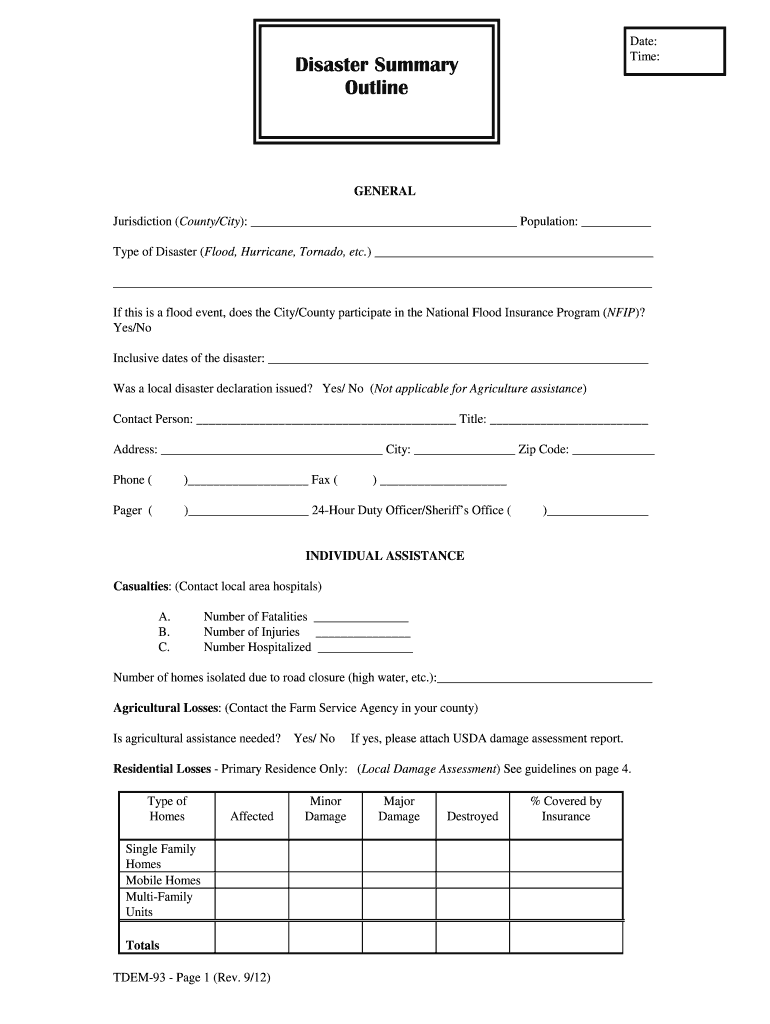
  2. Begin by filling in the 'GENERAL' section. Enter the jurisdiction, population, and type of disaster. If applicable, indicate participation in the National Flood Insurance Program (NFIP) and provide inclusive dates of the disaster.
  3. Complete the 'INDIVIDUAL ASSISTANCE' section by documenting casualties, injuries, and agricultural losses. Ensure to specify if agricultural assistance is needed and attach any necessary reports.
  4. In the 'PUBLIC ASSISTANCE' section, categorize damage costs into specified categories such as debris clearance and road repairs. Provide estimated repair costs and anticipated insurance for each category.
  5. Review all sections for accuracy before submitting. Once completed, submit pages 1-3 to your local Disaster District Committee as instructed.

Start using our platform today to efficiently complete your disaster outline form for free!

See more disaster outline form template versions

We've got more versions of the disaster outline form template form. Select the right disaster outline form template version from the list and start editing it straight away!
Versions Form popularity Fillable & printable
2015 4.8 Satisfied (32 Votes)
2012 4.3 Satisfied (144 Votes)
be ready to get more

Complete this form in 5 minutes or less

Get form

Got questions?

We have answers to the most popular questions from our customers. If you can't find an answer to your question, please contact us.
Contact us
The New Zealand integrated approach to civil defence emergency management can be described by the four areas of activity, known as the 4 Rs; Reduction, readiness, response and recovery.
A disaster recovery plan (DRP) is a contingency planning document that outlines the procedures an organization will follow to recover and restore its critical systems, operations, and data after a disaster.
Prevention, mitigation, preparedness, response and recovery are the five steps of Emergency Management.
The path to recovery is shaped by four core principles, often referred to as the 4 Cs: Communication, Coordination, Continuity, and Collaboration. These principles establish the foundation for developing resilient and adaptable disaster response strategies.
May 1622, 2022 Phase 1: Disaster Mitigation. Phase 2: Disaster Preparedness. Phase 3: Disaster Response. Phase 4: Recovery from a Disaster.

Security and compliance

At DocHub, your data security is our priority. We follow HIPAA, SOC2, GDPR, and other standards, so you can work on your documents with confidence.

Learn more
ccpa2
pci-dss
gdpr-compliance
hipaa
soc-compliance

People also ask

In summary, the 4 Cs of disaster recovery - Communication, Coordination, Continuity, and Collaboration - serve as the cornerstone of effective disaster preparedness and response. When faced with challenges such as fire and water damage, swift action is imperative.
Include Common Emergency Scenarios When You Plan Plan for the emergencies that are most likely to happen where you live. Plan what to do in case you are separated during an emergency. Plan what to do if you have to evacuate. Plan for everyone in your home. Plan to let loved ones know youre safe.

Related links