
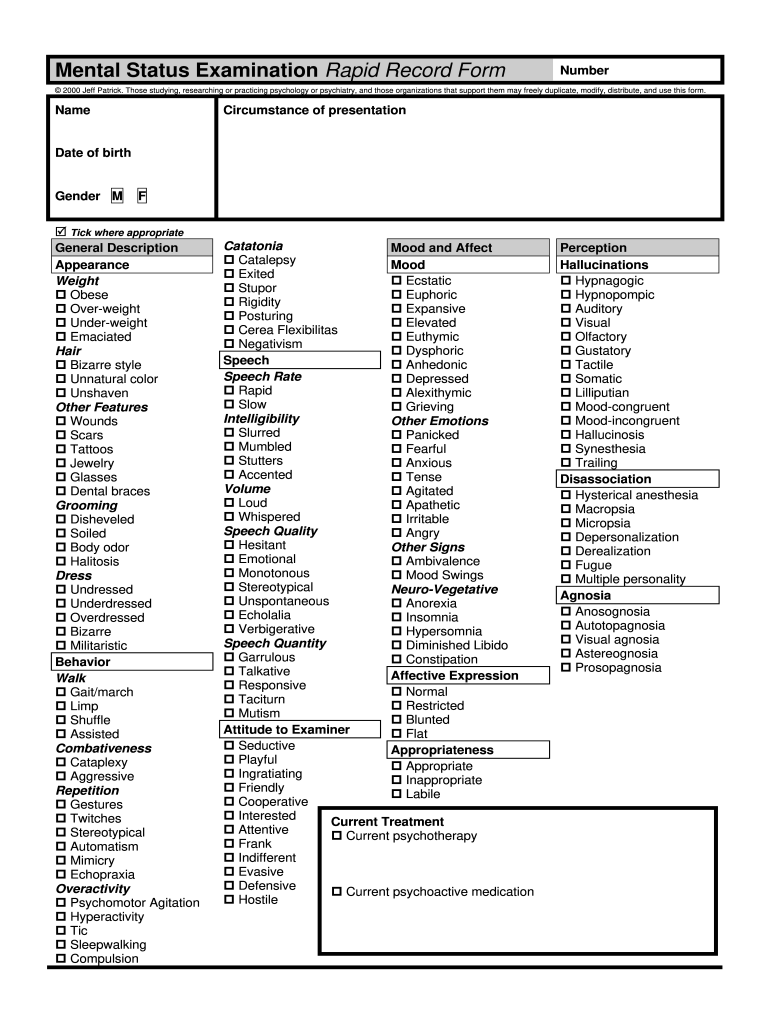







Definition and Meaning of the MSE Checklist
The "mse checklist," or Mental Status Examination checklist, is a structured tool used by mental health professionals to evaluate a patient's cognitive and emotional state. Its primary purpose is to systematically assess various aspects of an individual's mental health during clinical evaluations. The checklist typically includes a range of criteria related to mood, behavior, thought processes, perception, and cognitive function, enabling clinicians to document their observations comprehensively. This standardized format promotes accurate evaluations and helps track changes in a patient's condition over time.
Core Components of the MSE Checklist
- General Appearance: Observations regarding the patient's physical state, including hygiene, clothing, and posture.
- Behavior: Assessment of the patient's interactions and responses, noting any unusual behaviors or movements.
- Mood and Affect: Evaluation of the patient's emotional state, including emotional responses and consistency.
- Thought Processes: Analysis of the organization and clarity of the patient’s thoughts, including any signs of disorganized thinking.
- Perception: Exploration of perceptual disturbances, like hallucinations or illusions, if present.
- Cognitive Functioning: Assessment of attention, memory, and orientation regarding time, place, and identity.
Understanding the definition and components of the mse checklist is crucial for healthcare providers to ensure comprehensive mental health assessments.
How to Use the MSE Checklist Effectively
Using the mse checklist involves several systematic steps to enhance assessment accuracy. Clinicians should familiarize themselves with the checklist's components before initiating an evaluation.
Steps for Utilizing the MSE Checklist
- Preparation: Ensure the environment is conducive to an interview, minimizing noise and distractions to encourage patient openness.
- Observation: Observe the patient’s overall demeanor and behavior as soon as contact is made, documenting initial impressions on the mse checklist.
- Engagement: Communicate with the patient, asking open-ended questions to elicit detailed responses that touch on each checklist component.
- Documentation: Use the checklist to systematically record findings during the assessment while ensuring all relevant aspects are covered.
- Review and Analyze: Post-assessment, review the completed checklist to analyze findings, determining any areas of concern that require further exploration or follow-up.
By following these steps, mental health professionals can effectively utilize the mse checklist to obtain a thorough understanding of their patients' mental states.
How to Obtain the MSE Checklist
Acquiring the mse checklist can vary depending on practice settings and organizational requirements; however, there are several common methods.
Sources for the MSE Checklist
- Healthcare Institutions: Many hospitals and clinics provide standardized mse checklists within their electronic health record (EHR) systems for clinicians.
- Professional Associations: Organizations related to psychology and psychiatry often publish mse checklists for member use, typically found on their websites or distributed during training sessions.
- Academic Journals: Research articles and publications in psychological and psychiatric journals may offer downloadable mse checklists as supplementary materials.
- Publicly Accessible Resources: Various mental health educational platforms provide templates and examples of mse checklists that can be downloaded or printed for clinical use.
Healthcare providers are encouraged to select a reliable and validated mse checklist from recognized sources to ensure credibility and accuracy in assessments.
Key Elements of the MSE Checklist
Each section of the mse checklist serves a distinct purpose and contributes to a holistic understanding of the patient's mental health status.
Detailed Breakdown of Key Elements
- Appearance and Behavior: This section offers insights into a patient’s demeanor, which is critical for observations regarding their mental state. Factors like eye contact, body language, and response to questions are analyzed.
- Mood and Affect: Distinguishing between mood (lasting emotional states) and affect (temporary emotional responses) allows professionals to assess both the depth and variability of emotional states.
- Thought Content: Evaluating what the patient thinks about (e.g., suicidal ideation or delusions) helps identify risks and the need for intervention.
- Cognitive Functioning: Memory assessment includes recalling specific events or procedures, directly impacting a patient’s comprehension and processing during evaluation.
- Perceptual Disturbances: Identifying any hallucinations or misinterpretations of reality offers insights into possible psychological disorders, essential for accurate diagnosis.
These key elements are crucial for conducting comprehensive mental status examinations that inform clinical opinions and treatment plans.
Examples of Using the MSE Checklist in Clinical Practice
Real-world scenarios demonstrate the effectiveness of the mse checklist in clinical settings, highlighting its practical application.
Practical Examples
- Case Study of Depression: A clinician uses the mse checklist during a session with a patient exhibiting signs of depression. Through structured questioning, the clinician evaluates the patient's mood and thoughts, documenting observed symptoms like depressed affect and impaired cognitive function.
- Cognitive Assessment: Utilizing the checklist to assess a patient suspected of experiencing early cognitive decline allows the clinician to focus on specific areas of memory and orientation, providing a standardized means of determining any need for further testing or intervention.
- Emergency Situations: In emergency mental health evaluations, the mse checklist serves as a rapid, organized approach to assess individuals displaying acute psychiatric symptoms, allowing practitioners to identify immediate risks and treatment needs quickly.
These examples reflect the essential role of the mse checklist in guiding clinicians through diverse situations, ensuring consistent and thorough assessments.




