




01. Edit your standard bank power of attorney online
Type text, add images, blackout confidential details, add comments, highlights and more.

Type text, add images, blackout confidential details, add comments, highlights and more.

Draw your signature, type it, upload its image, or use your mobile device as a signature pad.

Send standard bank power of attorney form via email, link, or fax. You can also download it, export it or print it out.
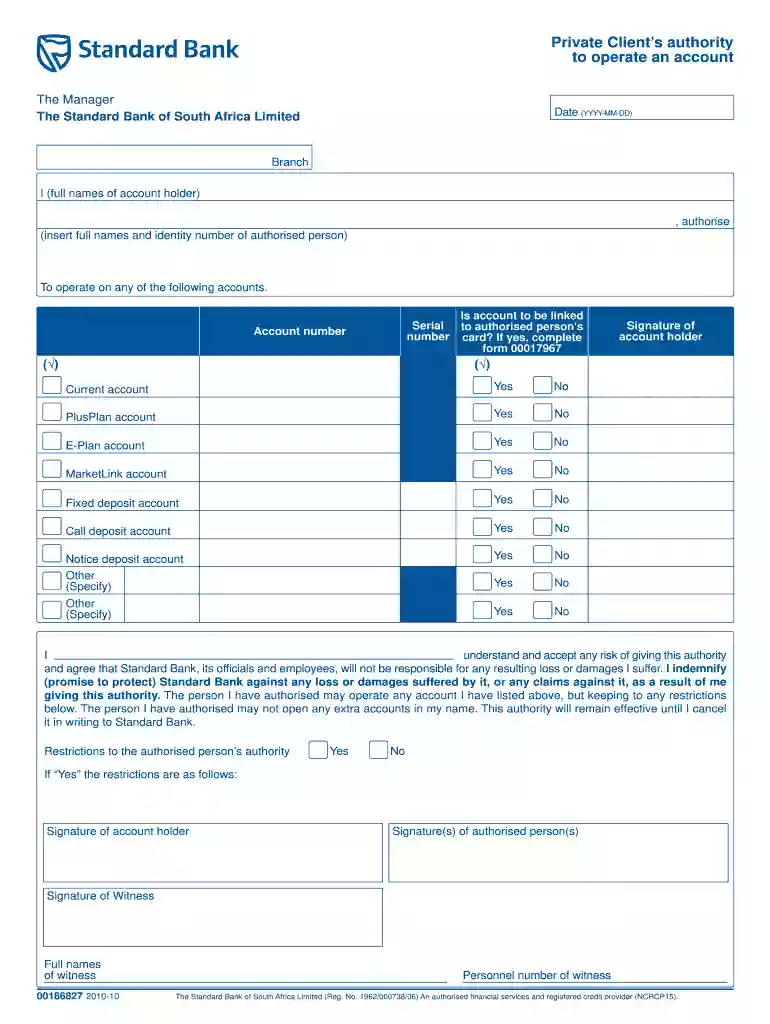
The standard bank power of attorney form is a legal document that allows an individual, referred to as the principal, to appoint another person, known as the agent or attorney-in-fact, to make specified financial decisions on their behalf. This form is specifically tailored for banking transactions and grants the agent authority to perform tasks such as managing bank accounts, authorizing transactions, and handling other financial matters as outlined in the document.
A power of attorney can be limited or broad in its scope, depending on the needs of the principal. For instance, the form may permit the agent to access checking and savings accounts, apply for loans, or manage investments. The principal can also delineate specific powers, thereby restricting the agent's authority to certain transactions or decisions.
Legal effectiveness of this form continues until the principal cancels it in writing or passes away, making it a crucial tool for estate planning and financial management. Understanding the implications, responsibilities, and limitations set forth in the power of attorney is vital for both the principal and the agent to ensure effective and ethical handling of the principal's finances.
Using the standard bank power of attorney form involves several critical steps to ensure it is executed properly and legally binding.
Identify the Need: Determine what financial responsibilities the agent will handle. This may include accessing bank accounts, making deposits, and authorizing withdrawals.
Choose the Right Agent: Select a trustworthy individual who understands your financial situation and will act in your best interest. This person could be a family member, friend, or even a financial advisor.
Complete the Form Accurately: Fill out the form with accurate information about the principal, agent, and specific powers granted. Ensure all required fields are completed to avoid delays or rejection.
Sign the Form: The principal must sign the document in the presence of a notary public or witnesses, as required by state law. This signature legitimizes the power of attorney and verifies the principal's intent.
Distribute Copies: Provide copies of the signed form to the bank and any other financial institutions where the agent will be operating on behalf of the principal. It's also wise to keep copies for personal records.
Review Regularly: Periodically review the power of attorney to ensure it reflects current relationships and financial situations. Modify as necessary using the appropriate legal channels.
Completing the standard bank power of attorney form is a straightforward process, but attention to detail is essential. Follow these steps to ensure accuracy and compliance:
Gather Required Information: Start with collecting necessary details such as the names and addresses of both the principal and the agent. Identify the exact powers you wish to grant.
Select the Appropriate Form Version: Confirm that you are using the most current version of the standard bank power of attorney form, as forms may be updated periodically.
Fill Out the Form: Carefully enter the required information, ensuring that the names match the identification documents. Specify the powers granted to the agent clearly to avoid ambiguity.
Review Legal Requirements: Check state-specific requirements for power of attorney documents, including the need for notarization or witnesses. Different states have varying laws impacting the form's validity.
Sign and Date: The principal must sign and date the form after reviewing it for accuracy. In some cases, the agent may also need to sign as an acknowledgment of their responsibilities.
Notarization and Witness Signatures: If necessary, arrange for notarization or obtain witness signatures. This step enhances the legality of the form.
File or Submit the Form: Depending on your circumstances, deliver the completed form to the bank or relevant financial institutions.
Understanding key terms associated with the standard bank power of attorney form can clarify many aspects of its use and implications:
The legal use of a standard bank power of attorney form is governed by state laws and provides a framework for the principal to delegate financial authority. Several key elements underscore how this form can be employed legally:
Authority Grant: The form grants the agent explicit rights to perform financial transactions, but it must outline these powers clearly to prevent misuse.
Conformance to State Laws: Each state may have specific requirements regarding the format, necessary signatures, and how powers of attorney must be executed. Familiarity with these laws is crucial for validity.
Revocation Procedures: Legal provisions must be followed if the principal chooses to revoke the power of attorney. This often involves submitting a revocation notice to the bank and any involved parties.
Record Retention: Both the principal and the agent should retain copies of the power of attorney form, as financial institutions may require proof of the agent's authority on request.
Utilizing the standard bank power of attorney form effectively ensures that financial matters are managed according to the principal's wishes, safeguarding their interests and providing clarity in financial decision-making.
We've got more versions of the standard bank power of attorney form. Select the right standard bank power of attorney version from the list and start editing it straight away!
| Versions | Form popularity | Fillable & printable |
|---|---|---|
| 2010 | 4.9 Satisfied (293 Votes) |
At DocHub, your data security is our priority. We follow HIPAA, SOC2, GDPR, and other standards, so you can work on your documents with confidence.
You should fill in this form carefully. Then sign it in the presence of at least two witnesses or a notary. And then you should: Give a copy to yourRead more
Dec 16, 2025 A power of attorney is a legal document that allows you to appoint an individual or individuals to represent you before the department.Read more
Feb 28, 2026 Power of Attorney (included on page 109 of this Annual Report on. Form 10-K). X. 107. Page 111. Table of Contents. Exhibit. Number. ExhibitRead more


