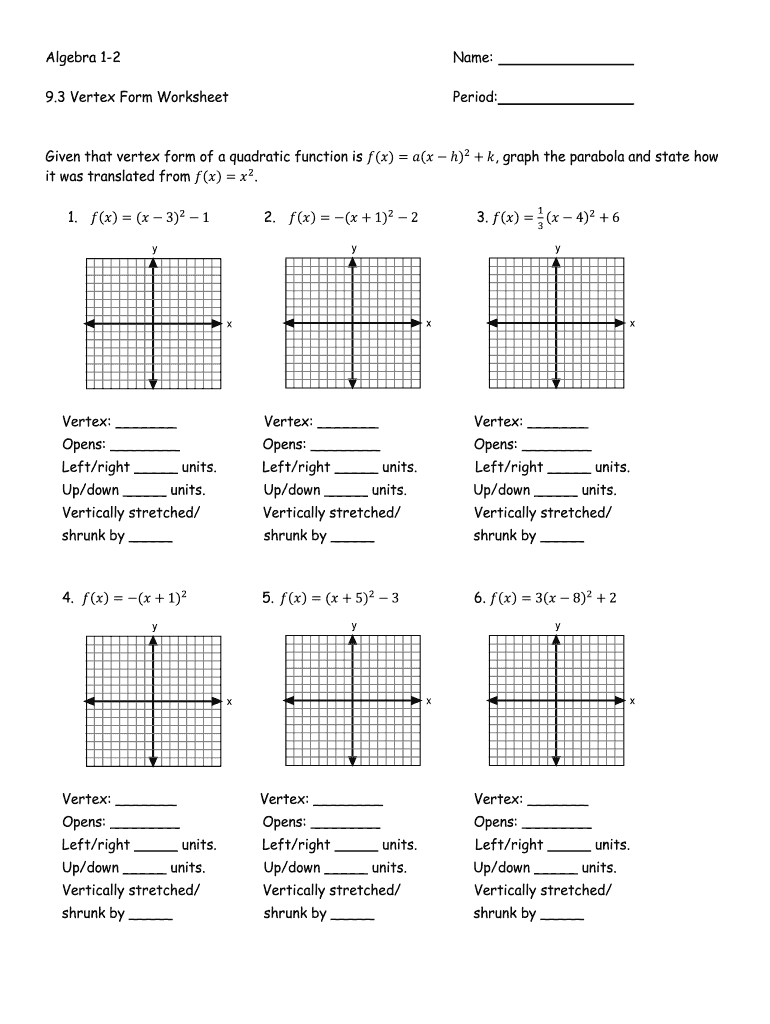






Understanding Worksheet Graphing Quadratics from Standard Form
This section provides a comprehensive overview of worksheets dedicated to graphing quadratic functions in standard form. The emphasis is on the practical applications of these worksheets for students in Algebra courses, exploring their benefits for understanding the fundamental concepts of quadratics.
What are Quadratic Functions in Standard Form?
A quadratic function in standard form is defined by the equation:
[ y = ax^2 + bx + c ]
- Parameters:
- ( a ) indicates the direction of the parabola (upward if positive, downward if negative).
- ( b ) impacts the location of the vertex along the x-axis.
- ( c ) represents the y-intercept, the point at which the parabola intersects the y-axis.
This format is pivotal for teaching students how to identify key features such as the vertex, axis of symmetry, and intercepts.
Benefits of Graphing Quadratics from Standard Form
Graphing quadratics from standard form offers several advantages for students:
- Clear Visualization: Students gain better insight into how quadratic equations behave.
- Identification of Key Features:
- Vertex: The peak or lowest point of the parabola.
- Axis of Symmetry: A vertical line that divides the parabola into two mirror-image halves.
- Intercepts: Points where the parabola cuts the x and y axes.
These worksheets allow students to practice translating between forms and to enhance their graphing skills.
Steps to Graph Quadratic Functions from Standard Form
Step-by-step instructions for graphing a quadratic function from standard form are crucial for student comprehension. Follow these steps:
-
Identify Values:
- Determine ( a ), ( b ), and ( c ) from the quadratic equation.
-
Calculate the Vertex:
- Use the vertex formula ( x = -\frac{b}{2a} ) to find the x-coordinate.
- Substitute the x-coordinate back into the equation to find the y-coordinate.
-
Determine the Direction of Opening:
- Based on the sign of ( a ), decide if the parabola opens upwards or downwards.
-
Find the Y-Intercept:
- Set ( x = 0 ) and solve for ( y ) to locate the y-intercept.
-
Calculate the X-Intercepts (if any):
- Use the quadratic formula ( x = \frac{-b \pm \sqrt{b^2 - 4ac}}{2a} ) to find real roots and their corresponding y-values.
-
Plot Points:
- Create a table of values to help in plotting additional points for accuracy.
-
Draw the Parabola:
- Use the vertex, intercepts, and additional points to sketch the quadratic graph.
Using the Worksheet Graphing Quadratics from Standard Form
Worksheets designed for graphing quadratics can include various problems aimed at reinforcing these skills. Here are key elements typically found in these worksheets:
-
Diverse Exercises:
- Students graph functions with varying coefficients.
- Problems may ask for specific transformations, such as shifting or reflecting the graph.
-
Answer Keys:
- Each worksheet usually comes with a corresponding answer key. This enables students to self-check their work.
-
Focus on Real-World Applications:
- Some worksheets may present real-world scenarios requiring quadratic modeling, enhancing the relevance of the material.
Additional Resources for Quadratic Graphing Practice
In addition to traditional worksheets, students can access various digital resources and online platforms that offer interactive quadratic graphing calculators. These tools allow for instant graphing of standard form equations and provide immediate feedback on the characteristics of the resulting parabolas.
Conclusion of Key Features in Quadratic Graphing Worksheets
Overall, worksheets that facilitate graphing quadratics from standard form are indispensable educational tools. They provide structured practice, enhance understanding of key mathematical concepts, and prepare students for more advanced mathematical topics while fostering a solid foundation in algebraic skills.