Get and manage Summary Judgment Motions online

Accelerate your document managing with the Summary Judgment Motions library with ready-made templates that meet your requirements. Access your form, change it, fill it, and share it with your contributors without breaking a sweat. Begin working more effectively with your forms.

The best way to manage our Summary Judgment Motions:

  1. Open our Summary Judgment Motions and search for the form you need.
  2. Preview your document to ensure it’s what you want, and click Get Form to begin working on it.
  3. Edit, include new text, or point out important information with DocHub tools.
  4. Complete your form and save the adjustments.
  5. Download or share your document with other people.

Discover all of the possibilities for your online document management using our Summary Judgment Motions. Get your totally free DocHub profile right now!


Video Guide on Summary Judgment Motions management

video background

Commonly Asked Questions about Summary Judgment Motions

Under a motion for summary judgment, the movant should assert that a fact cannot be genuinely disputed based on the record. The nonmovant is given notice and a reasonable time to respond, after which the court may grant or deny summary judgment.
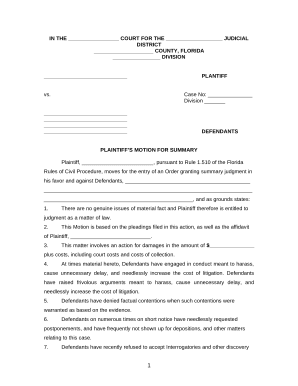
What You Need in Your Motion for Summary Judgement Title and Introduction. Clearly state the documents purpose and include the case caption. Statement of Facts. Provide a clear, detailed statement of the undisputed facts. Standard of Review. Explain the legal standard for granting summary judgment. Argument. Conclusion.
Summary judgment is a procedure that allows a party to obtain a judgment on all or part of a claim or defence by way of a motion (where evidence is presented to a master or a judge in writing) and without having to proceed to a trial (where evidence is presented to a judge (and possibly a jury) by way of oral testimony Rule 20 (Summary Judgment) - CanLII canlii.org commentary doc canlii.org commentary doc
When bringing a summary judgment motion, a party is arguing that there can be no real dispute about material facts, and the moving party is entitled to win the case as a matter of law.
Get a Fair Hearing in Court Show that the motion fails to list the specific facts and law supporting summary judgment. Show that a dispute exists on a material fact. Show that the law does not support judgment on the undisputed facts.
A motion for summary judgment searches the record, meaning that the court reviews all of the evidence in the record, regardless of which side submitted it.
The court shall grant summary judgment if the movant shows that there is no genuine dispute as to any material fact and the movant is entitled to judgment as a matter of law. The court should state on the record the reasons for granting or denying the motion.
In a summary judgment, one party may contend there are no facts that need to be decided, or the parties may agree on what the facts are. Either side (and sometimes both sides) may bring a motion for summary judgment arguing that they are entitled to a judgment in their favor without a trial.