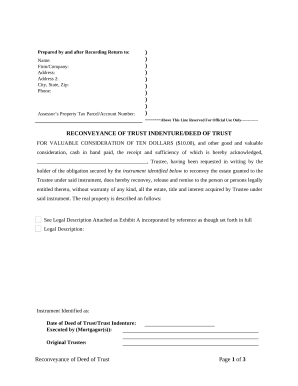
Enhance your template operations with Real Estate Deeds of Trust

Your workflows always benefit when you are able to get all of the forms and documents you require on hand. DocHub gives a vast array of document templates to ease your day-to-day pains. Get a hold of Real Estate Deeds of Trust category and quickly browse for your form.

Begin working with Real Estate Deeds of Trust in a few clicks:

  1. Open Real Estate Deeds of Trust and get the form you need.
  2. Click on Get Form to open it in our editor.
  3. Begin editing your document: add fillable fields, highlight sentences, or blackout sensitive data.
  4. The app saves your changes automatically, and once you are ready, you can download or distribute your form with other contributors.

Enjoy effortless file management with DocHub. Explore our Real Estate Deeds of Trust online library and look for your form right now!


Video Guide on Real Estate Deeds of Trust management

video background

Commonly Asked Questions about Real Estate Deeds of Trust

Mortgages dont loop in the third party; the agreement is just between the lender and the borrower. With a deed of trust, the lender gives the borrower the funds to make the home purchase. In exchange, the borrower provides the lender with a promissory note.
A deed of trust, also called a trust deed, is the functional equivalent of a mortgage. It does not transfer the ownership of real property, as the typical deed does. Like a mortgage, a trust deed makes a piece of real property security (collateral) for a loan.
Like a mortgage, a trust deed makes a piece of real property security (collateral) for a loan. If the loan is not repaid on time, the lender can foreclose on and sell the property and use the proceeds to pay off the loan. A trust deed is not used to transfer property to a living trust (use a Grant Deed for that).
If the loan isnt repaid, the trusteeoften times an escrow companyis responsible for starting the foreclosure process. This is the major and important difference between a mortgage and a deed of trust.
Deeds of trust are the most common instrument used in the financing of real estate purchases in Alaska, Arizona, California, Colorado, the District of Columbia, Idaho, Maryland, Mississippi, Missouri, Montana, Nebraska, Nevada, North Carolina, Oregon, Tennessee, Texas, Utah, Virginia, Washington, and West Virginia,
Disadvantages of a trust deed If you do not cooperate with the trustee, they can try to make you bankrupt. You cannot continue to be the director of a limited company unless your trustee agrees and unless the rules of the limited company allow you to enter into a trust deed.
The two main differences between a mortgage and a deed of trust are: a mortgage involves two parties, while a deed of trust has three, and. mortgages are usually foreclosed judicially, while deeds of trust typically go through a nonjudicial foreclosure process (but not always).
A deed of trust will include the same type of information stated in a mortgage document, such as: The identities of the borrower, lender, and trustee. A full description of the property to be placed in trust. Any restrictions or requirements on the use of the property while it is in trust.