Get and handle Property Rights and Easements online

Accelerate your file operations with the Property Rights and Easements collection with ready-made templates that meet your needs. Get the form template, change it, fill it, and share it with your contributors without breaking a sweat. Start working more efficiently with the forms.

The best way to use our Property Rights and Easements:

  1. Open our Property Rights and Easements and find the form you need.
  2. Preview your document to ensure it’s what you want, and click Get Form to begin working on it.
  3. Modify, include new text, or point out important information with DocHub tools.
  4. Prepare your form and preserve the modifications.
  5. Download or share your document template with other recipients.

Examine all the possibilities for your online document management using our Property Rights and Easements. Get a free free DocHub account today!


Video Guide on Property Rights and Easements management

video background

Commonly Asked Questions about Property Rights and Easements

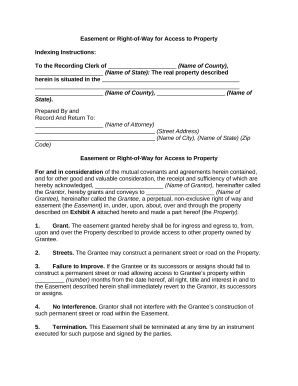
The owner of the land over which the easement runs is not allowed to interfere with the easement, even though the owner owns title to that land.
Do easements expire? It is a common misconception that easements are indefinite but Wis. Stat. 893.33(6) limits the enforceability of easements for a period of 40 years after the document referencing the easement has been recorded.
Adverse possession occurs when the servient estate owner, the landowner burdened with the easement, blocks the easement in a manner that is exclusive, open and notoriously hostile, preventing the dominant estate owner from using the easement for a continuous period of 10 years.
An easement is where a landowner gives another a limited right to use their land most often for reasonable access to things like roads, trails, parks or beaches. It is not an ownership right in the land, it is the mere right to use anothers land for limited purposes.
Easement defined. Previous Next. An easement is a right which the owner or occupier of certain land possesses, as such, for the beneficial enjoyment of that land, to do and continue to do something, or to prevent and continue to prevent something being done, in or upon, or in respect of, certain other land not his own Act Number - India Code: Section Details indiacode.nic.in show-data indiacode.nic.in show-data
Release or Abandonment by the Easement Holder An easement can be extinguished if the easement holder releases the easement. This release can be done on the holders own or as part of a deal with the owner of the servient tenement. Foundations of Law - Termination of Easements - LawShelf lawshelf.com coursewarecontentview ter lawshelf.com coursewarecontentview ter
In most cases, property owners cannot block an easement as it is a legal right granted to another party. However, there may be specific circumstances where restrictions can be placed on the easements use.
Property owners may not interfere with the purpose of an easement. For example, if a beneficiary electric company has wires strung across your yard, you can not take them down or block the workers path. Violators may be held liable for damages to the easement holder.
An easement holder is deemed to have all rights necessarily incident to the enjoyment of the easement and its servitude, and the owner of the servient estate may not obstruct, interfere, or otherwise encroach upon the easement holders use and enjoyment.