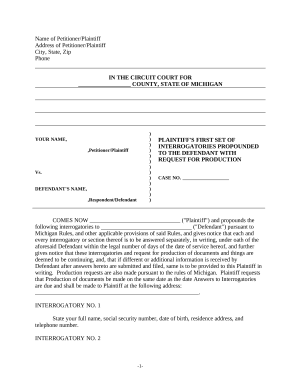
Transform your file management with Plaintiff to Defendant Interrogatories

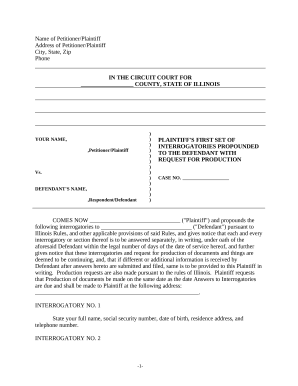
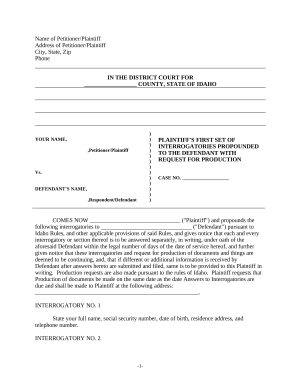
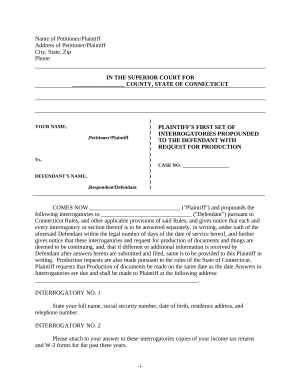
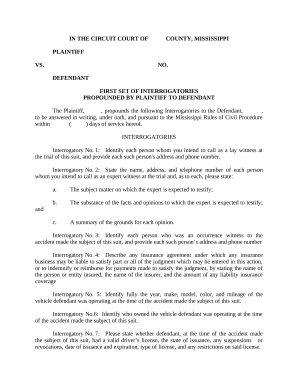
Your workflows always benefit when you can easily find all the forms and documents you require on hand. DocHub supplies a wide array of form templates to relieve your daily pains. Get a hold of Plaintiff to Defendant Interrogatories category and quickly browse for your document.

Begin working with Plaintiff to Defendant Interrogatories in several clicks:

  1. Gain access to Plaintiff to Defendant Interrogatories and find the document you require.
  2. Click on Get Form to open it in our online editor.
  3. Start editing your document: add more fillable fields, highlight sentences, or blackout sensitive information.
  4. The application saves your modifications automatically, and once you are all set, you are able to download or distribute your form with other contributors.

Enjoy fast and easy file administration with DocHub. Check out our Plaintiff to Defendant Interrogatories online library and find your form right now!


Video Guide on Plaintiff to Defendant Interrogatories management

video background

Commonly Asked Questions about Plaintiff to Defendant Interrogatories

Interrogatories are a discovery tool that the parties can use to have specific questions about a case answered before trial. Interrogatories are lists of questions sent to the other party that s/he must respond to in writing. What are interrogatories and how are they used? - WomensLaw.org womenslaw.org laws trial what-are-inte womenslaw.org laws trial what-are-inte
Your answers to the interrogatories should usually be short, clear, and direct and should answer only the question that is being asked. This is not the time to set out your entire case or defense to the other side. Take the time to make sure your answers are correct and truthful. Responding To The Other Sides Requests For Information Civil Law Self-Help Center self-help 245- Civil Law Self-Help Center self-help 245-
After the Interrogatories have been answered, the defendants attorney will request that your deposition be taken.
You have to respond to interrogatories in writing to the best of your ability. If you do not answer an interrogatory question, and then the other side learns that you did in fact know the answer, it could have a negative impact on your case at trial. Before the Trial: How do I respond to interrogatories? | WomensLaw.org WomensLaw.org preparing-court-yourself WomensLaw.org preparing-court-yourself
Interrogatories are a discovery device used by a party, usually a Defendant, to enable the individual to learn the facts that are the basis for, or support, a pleading with which he or she has been served by the opposing party. What are interrogatories and can I see a sample? - FAQS FAQS faq FAQS faq
Interrogatories are a frequently used discovery device, consisting of written questions propounded by one party to anotherwhether an opposing party or co-party. Interrogatories may relate to any matter, not privileged, relevant to the claims and defenses of any party, and proportional to the needs of the case. Interrogatories (Defendant to Plaintiff) (Federal) - Lexis Lexis document openwebdocview Lexis document openwebdocview
(a) The party to whom interrogatories have been propounded shall respond in writing under oath separately to each interrogatory by any of the following: (1) An answer containing the information sought to be discovered. (2) An exercise of the partys option to produce writings.
You have 30 days to respond to the interrogatories. If you were served by mail, you typically have 35 days from the date of mailing to respond. Just below the top caption identifying the case, the form identifies the Answering (or Responding) party. Respond to Special Interrogatories | California Courts | Self Help Guide ca.gov discovery-civil special-i ca.gov discovery-civil special-i
Then, explain the type of discovery (interrogatories or requests for admission) and what has been requested. For example, Interrogatories are formal written questions that the opposing party wants you to answer. As you will see in the enclosure, there are [specify number, e.g., 30] interrogatories.
Rule 33 (b), Federal Rules of Civil Procedure , requires the respondent to answer an interrogatory separately and fully in writing and under oath, unless the respondent objects, in which event the party objecting shall state with specificity the reasons for objection and shall answer to the extent the interrogatory is