Supercharge your efficiency with Nonlegal Personal Letters

Document managing takes up to half of your business hours. With DocHub, it is easy to reclaim your time and improve your team's efficiency. Get Nonlegal Personal Letters category and check out all form templates relevant to your day-to-day workflows.

Easily use Nonlegal Personal Letters:

  1. Open Nonlegal Personal Letters and use Preview to get the appropriate form.
  2. Click Get Form to begin working on it.
  3. Wait for your form to upload in our online editor and start modifying it.
  4. Add new fillable fields, symbols, and images, change pages order, and many more.
  5. Complete your form or set it for other contributors.
  6. Download or deliver the form by link, email attachment, or invite.

Improve your day-to-day file managing with our Nonlegal Personal Letters. Get your free DocHub account right now to discover all forms.

Video Guide on Nonlegal Personal Letters management

video background

Commonly Asked Questions about Nonlegal Personal Letters

A Letter, published or unpublished, is always protected under the Copyright laws.
What Is an Engagement Letter? An engagement letter is a written agreement that describes the business relationship to be entered into by a client and a company. The letter details the scope of the agreement, its terms, and costs. The purpose of an engagement letter is to set expectations on both sides of the agreement.
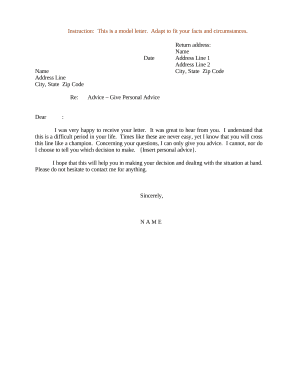
A personal letter is a type of letter (or informal composition) that usually concerns personal matters (rather than professional concerns) and is sent from one individual to another.
Employing unilateral or negative engagement letters. This type of engagement letter does not require a clients signature. Rather, the engagement letter includes a provision that the client agrees to the terms and conditions of the engagement letter by sending its organizer or other tax information to the CPA firm.
A disengagement letter is especially critical when a lawyer decides not to continue past a specific stage in a case. The lawyer should send a disengagement letter to establish that the relationship is no longer continuing, and to refer the client to another lawyer.
The Non-Engagement Letter is used when an attorney or law firm opts not to represent a prospective client following initial consultations. In essence, it preempts the formation of an attorney-client relationship, thereby mitigating potential legal ambiguities or liabilities.
Your non-response to the demand letter from an attorney may be considered evidence of intentional wrongdoing or willful violation of the other partys rights. Moreover, penalty provisions and attorneys fees may substantially increase the amount you owe.
Letters of engagement and retainer agreements (Letter(s)) help outline the terms under which the attorney will represent the client, and offer the client a better understanding of the attorneys path of representation. A retainer agreement is a letter of engagement that has been countersigned by the client.