Get and manage Minnesota Divorce Laws online

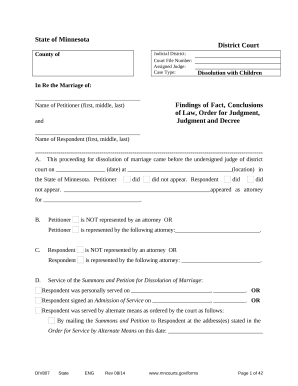
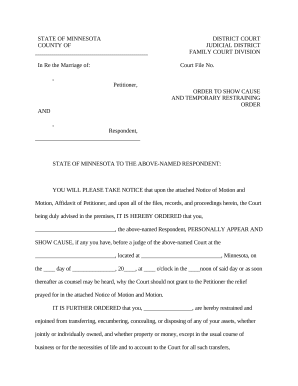
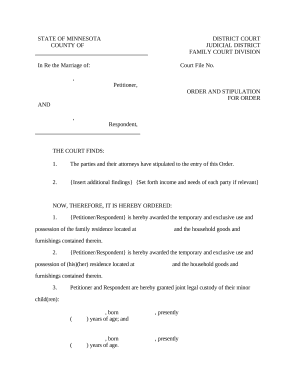
Accelerate your file administration using our Minnesota Divorce Laws category with ready-made document templates that suit your requirements. Get your document, modify it, fill it, and share it with your contributors without breaking a sweat. Start working more effectively together with your forms.

How to use our Minnesota Divorce Laws:

  1. Open our Minnesota Divorce Laws and search for the form you require.
  2. Preview your form to ensure it’s what you want, and click Get Form to start working on it.
  3. Alter, include new text, or point out important information with DocHub features.
  4. Complete your form and save the changes.
  5. Download or share your form with other people.

Discover all of the possibilities for your online document management using our Minnesota Divorce Laws. Get your free free DocHub account right now!


Commonly Asked Questions about Minnesota Divorce Laws

A judge can grant you a divorce if s/he finds that there was an irretrievable breakdown of your marriage, which means your marriage cannot be saved. Unlike in many other states, there are no fault-based grounds for divorce in Minnesota.
However Minnesota, like most states, follow the equitable distribution methodmeaning, the court will divide all marital property between the spouses a way it decides is equitable or fair, but not necessarily in an equal 50/50 split.
Minnesota is an equitable distribution state. This does not necessarily mean a 50-50 settlement of everything. But the law presumes that all assets and debts acquired during the marriage will be divided equitably, including: Your house and other real estate.
Is Minnesota a 50-50 state for divorce? In a 50-50 state for divorce, your assets are divided as fairly and equitably as possible, ing to a judges discretion. That means bank accounts, retirement accounts, retirement interests, and other assets gained during the marriage will be split as fairly as possible.
In the marriage dissolution, the income, assets and debts accumulated during the marriage must be allocated between you and your spouse. The law is that you and your spouse are financial partners during the marriage and are presumed entitled to share in both the assets and income the partnership made.
The judge decides who is responsible for the debts. For example, you may have to pay all or part of debts that are in your spouses name, or the judge could decide the debts should be paid equally by both of you. But remember: the divorce decree only affects the two of you, not the creditor.
In Minnesota, you do not have to be separated before you get divorced. The process to get a legal separation takes as long as a divorce, and may cost as much as or more than a divorce. The courts do not publish forms for legal separation.