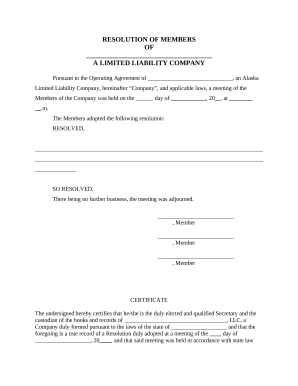
Manage Limited Liability Companies Legal Forms quickly online

Document managing can overpower you when you can’t find all the forms you require. Luckily, with DocHub's considerable form library, you can discover everything you need and swiftly deal with it without switching between programs. Get our Limited Liability Companies Legal Forms and begin working with them.

The best way to manage our Limited Liability Companies Legal Forms using these simple steps:

  1. Browse Limited Liability Companies Legal Forms and select the form you require.
  2. Preview the template and click on Get Form.
  3. Wait for it to upload in the online editor.
  4. Alter your template: add new information and pictures, and fillable fields or blackout some parts if needed.
  5. Fill out your template, save changes, and prepare it for delivering.
  6. When you are ready, download your form or share it with other contributors.

Try out DocHub and browse our Limited Liability Companies Legal Forms category with ease. Get a free profile today!


Video Guide on Limited Liability Companies Legal Forms management

video background

Commonly Asked Questions about Limited Liability Companies Legal Forms

A legal entity is any business organization that is legally permitted to enter into a contract, including a contract for the purchase, sale, or lease of real property. Legal entity interests may be owned individually, owned by another legal entity, or held in trust.
Ltd. is a standard abbreviation for limited, a form of corporate structure available in countries including the U.K., Ireland, and Canada. The term appears as a suffix that follows the company name, indicating that it is a public or private limited company.
As an LLC, you can elect S Corp status instead of the default sole proprietorship or partnership. As a corporation, youll automatically be taxed as a C Corp. A larger LLC might want to elect C Corp status for a lower tax rate or to appeal to future investors or buyers.
An LLC is a hybrid legal entity having certain characteristics of both a corporation and a partnership or sole proprietorship (depending on how many owners there are). An LLC is a type of unincorporated association, distinct from a corporation.
Ltd. refers to limited liability, meaning the companys owners are not personally responsible for the debts of the business. By Christine Mathias, Attorney ● Penn State Dickinson School of Law. Updated 11/17/2020. Learn more about our history and our editorial standards.
LLCs have multiple taxation options, including being taxed as sole proprietorships, partnerships, C corporations, or S corporations. Conversely, LLPs are generally taxed as partnerships, where profits and losses pass through to the partners personal tax returns, and the entity itself is not taxed.
A limited liability company (LLC) is a business structure that offers limited liability protection and pass-through taxation. As with corporations, the LLC legally exists as a separate entity from its owners. Therefore, owners cannot typically be held personally responsible for the LLCs debts and liabilities.