Enhance your template operations with Legal Restraining Orders

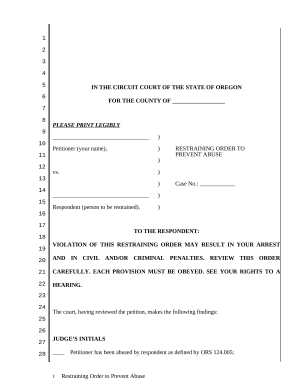
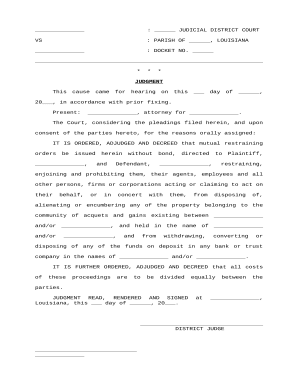
Your workflows always benefit when you can locate all the forms and documents you require on hand. DocHub gives a a huge collection of templates to relieve your everyday pains. Get hold of Legal Restraining Orders category and easily discover your document.

Start working with Legal Restraining Orders in a few clicks:

  1. Gain access to Legal Restraining Orders and get the form you require.
  2. Click on Get Form to open it in our online editor.
  3. Start adjusting your file: add more fillable fields, highlight sentences, or blackout sensitive information and facts.
  4. The application saves your changes automatically, and after you are ready, you are able to download or distribute your file with other contributors.

Enjoy effortless record administration with DocHub. Check out our Legal Restraining Orders online library and discover your form today!


Video Guide on Legal Restraining Orders management

video background

Commonly Asked Questions about Legal Restraining Orders

In a criminal case in New York, for a restraining order, called an Order of Protection, to be issued, the police must make an arrest based on probable cause, the person arrested must be formally charged by the the District Attorneys Office or other prosecutors office, appear in front of a judge, and the judge will
Though its name can vary state-to-state, a Protection Order (also referred to as a Civil Protection Order, Stay Away Order, and a Protection from Abuse Order) requires your abuser to do or refrain from doing certain actions. Protection orders are part of the civil justice process.
Proof of service must be filed with the court before your hearing date to get a protective order if the respondent does not show up. Bring any evidence you have, like photographs, medical records, or torn clothing. Also, bring witnesses who know about the violence, like a neighbor, relative, or police.
Protective orders have a much narrower scope than their restraining order counterparts, and are only issued when there has beenor there is a threat ofdomestic violence. Restraining orders, on the other hand, are much more generic, and can be applied to a wide variety of relationships and situational behavior.
Family Court judges can issue an order of protection if a family offense is committed. Some examples of a family offense are: disorderly conduct, harassment, assault, sexual abuse, menacing, reckless endangerment, strangulation, stalking and criminal mischief.
A temporary order of protection is issued on the day you file for an order of protection before the respondent is served with the papers. It only lasts until the next time that you are in court. The court usually will extend the temporary order at each court date until the case is over.
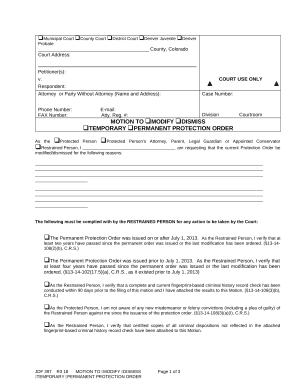
Filing a Motion for Dismissal Submitting a motion for dismissal involves presenting a formal request to the court, detailing the grounds for dismissal. The petition must include the date, the rationale for wanting the order of protection dismissed, and the names of each individual involved.
A protection order is a type of restraining order that you, (the petitioner), can file against another person, (the respondent), who is committing harm. It is a civil court order (that you can request), issued by a judge, meant to protect you from another person committing harm against you.