Get and handle Legal Easements online

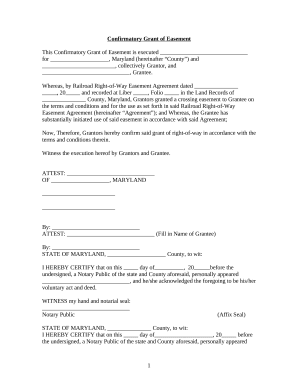
Speed up your document management using our Legal Easements online library with ready-made templates that meet your needs. Get your document template, alter it, fill it, and share it with your contributors without breaking a sweat. Start working more efficiently with the forms.

The best way to use our Legal Easements:

  1. Open our Legal Easements and find the form you want.
  2. Preview your form to ensure it’s what you want, and click on Get Form to start working on it.
  3. Edit, add new text, or point out important information with DocHub features.
  4. Fill out your form and save the modifications.
  5. Download or share your document template with other recipients.

Discover all of the opportunities for your online file administration with the Legal Easements. Get your free free DocHub profile right now!


Video Guide on Legal Easements management

video background

Commonly Asked Questions about Legal Easements

The express easement is the most common. The other three are prescriptive easement, implied easement by existing use, and easement by necessity.
A right-of-way is a type of easement given to legally allow passage over anothers land. The right is restricted to the use described in the Easement document.
Less common are negative easements, which prohibit someone from doing something that would ordinarily be permissible. Negative easements are generally disfavored and only allowed in certain situations.
An easement gives people or organizations the right to access and use another persons property in specific situations for a limited purpose. A right of way is a type of easement that establishes the freedom to use a pathway or road on someone elses property, without conferring ownership.
If an easement appurtenant is granted, it involves two pieces of land, where one serves as the servient tenement that bears the burden, and the other the dominant tenement, which benefits from the grant of the easement and has permission to use the servient land in some manner.
Easements are legal rights granted to a third party to use a portion of a property for a specific purpose. Small businesses in British Columbia should be aware of potential legal risks and challenges related to easements. One potential legal risk is that easements can limit the use and development of a property.
A non-possessory interest in real property that provides the holder with the right to use another partys real property for a specific purpose. The underlying legal title to the real property encumbered by the easement is retained by the original owner for all other purposes.
ALBERTA EASEMENTS RIGHTS OF WAY. There are basically three kinds of non-express easements created by operation of law. The first is prescriptive easements, the second is implied easements and the third is easements by estoppel.