

Get and handle Landlord Tenant Relationship Legal Documents online

Accelerate your file operations with our Landlord Tenant Relationship Legal Documents category with ready-made templates that meet your requirements. Access your form template, alter it, fill it, and share it with your contributors without breaking a sweat. Begin working more effectively with your forms.

How to use our Landlord Tenant Relationship Legal Documents:

  1. Open our Landlord Tenant Relationship Legal Documents and find the form you need.
  2. Preview your document to ensure it’s what you want, and click Get Form to begin working on it.
  3. Edit, include new text, or point out important information with DocHub features.
  4. Complete your form and save the changes.
  5. Download or share your document with other people.

Examine all the opportunities for your online file administration with our Landlord Tenant Relationship Legal Documents. Get your free free DocHub account today!


Video Guide on Landlord Tenant Relationship Legal Documents management

video background

Commonly Asked Questions about Landlord Tenant Relationship Legal Documents

An occupant, on the other hand, resides in the tenants leased space with your permission. These could be family members, a friend, or their docHub other. They dont pay the rent, are not necessarily on the lease, and are not entitled to tenants rights under the law.
As a landlord, it is essential to communicate your expectations and rules clearly to your tenants. This will ensure rent is paid on time, the terms of the lease are followed, and maintenance responsibilities are understood. You cannot hold your tenants accountable if there is no communication.
One of our favorite definitions of a lease is this one: a lease is an agreement that creates the relationship of landlord and tenant.
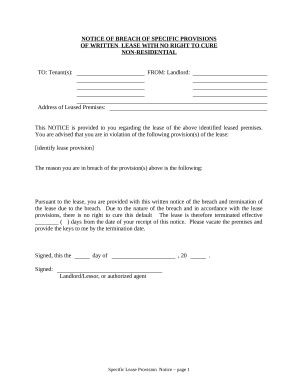
The landlord-and-tenant relationship is a legal agreement between the person who owns a property (the landlord) and the person who rents it (the tenant). This agreement is made through a lease, which is a contract that outlines the terms of the rental.
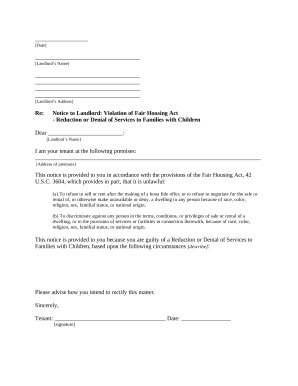
ing to the Fair Housing Act, landlords cannot ask prospective tenants questions that discriminate based on race, color, national origin, religion, sex, age, family status, marital status, or disability.
If there is a conflict between the terms of an agency agreement or lease and the applicable landlord-tenant laws, the legal provisions take precedence. This ensures that the rights of both parties are protected and that the rental relationship operates within the bounds of the law.
Property managers are the main point of contact for tenants. They handle tenant relations, leases, emergencies, complaints, move-ins, move-outs, and evictions.
A renter is someone who rents a property. All of the rights of the renter are spelled out in the rental agreement or lease, but no right of ownership is implied by the term. But a tenant is someone who has some legal right to a property that includes the right of occupancy but may also include ownership rights.
