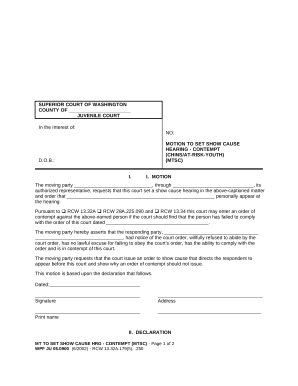
Handle Juvenile Legal Forms effortlessly online

Document management can overwhelm you when you can’t discover all of the documents you need. Fortunately, with DocHub's considerable form collection, you can get all you need and promptly deal with it without changing between applications. Get our Juvenile Legal Forms and begin working with them.

How to use our Juvenile Legal Forms using these simple steps:

  1. Browse Juvenile Legal Forms and choose the form you need.
  2. Review the template and then click Get Form.
  3. Wait for it to open in the online editor.
  4. Modify your document: add new information and pictures, and fillable fields or blackout some parts if necessary.
  5. Complete your document, conserve modifications, and prepare it for sending.
  6. When all set, download your form or share it with your contributors.

Try out DocHub and browse our Juvenile Legal Forms category with ease. Get your free account right now!


Video Guide on Juvenile Legal Forms management

video background

Commonly Asked Questions about Juvenile Legal Forms

A Juvenile Delinquent is a youth between ages 12 and 15 who has committed an offense. 16 and 17 year old youth charged with all misdemeanors or felonies that have been removed from Criminal/Supreme Court are also considered Juvenile Delinquents. All juvenile delinquency cases are heard in Family Court. ACS - Juvenile Justice Process - NYC.gov NYC.gov site acs juvenile-justice-process NYC.gov site acs juvenile-justice-process
A youth who is 13, 14 or 15 years old and has committed a very serious felony, may be tried as a Juvenile Offender in the New York City Supreme Court. If found guilty, the youth is subject to more serious penalties than a Juvenile Delinquent. Juvenile offender charges can be removed to Family Court.
There are four main types of juvenile delinquency individual, group-supported, organized and situational. Individual delinquency refers to one child committing an act on his or her own, with the argument that the delinquency is caused by family problems.
The juvenile justice process involves nine major decision points: (1) arrest, (2) referral to court, (3) diversion, (4) secure detention, (5) judicial waiver to adult criminal court, (6) case petitioning, (7) delinquency finding/adjudication, (8) probation, and (9) residential placement, including confinement in a 10.10. The Structure of the Juvenile Justice System pressbooks.pub ccj230 chapter pressbooks.pub ccj230 chapter
If adjustment is not possible, a petition is filed by a presentment agency, which is the office that in Family Court will act on behalf of the county to prosecute juvenile delinquency cases. Juvenile Delinquency - New York State Unified Court System New York State Unified Court System courts family casetypes New York State Unified Court System courts family casetypes
Juvenile Offenders, who are 13, 14, and 15 years of age, are charged with committing serious or violent felony offenses listed in Penal Law Section 10.00 (18). Juvenile Offenders are not considered Juvenile Delinquents. Juvenile Offender cases are heard in the Youth Part of Supreme Court. Juvenile Delinquency | NYCOURTS.GOV New York State Unified Court System nyc family faqsjuvenile New York State Unified Court System nyc family faqsjuvenile
Juvenile Delinquents A Juvenile Delinquent is a child over 7, but under 18 years of age (effective 10/1/19), who commits an act that would be a crime if it had been committed by an adult. Juvenile offenders, who are 13, 14, and 15 years of age, are not considered Juvenile Delinquents.
A status offense is a noncriminal act that is considered a law violation only because of a youths status as a minor. 1 Typical status offenses include truancy, running away from home, violating curfew, underage use of alcohol, and general ungovernability.