Get and manage Drainage Contracts online

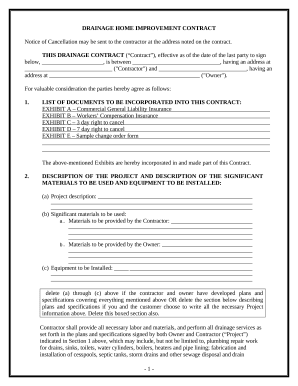
Boost your file management with our Drainage Contracts online library with ready-made document templates that meet your needs. Get your form template, modify it, fill it, and share it with your contributors without breaking a sweat. Start working more effectively with the forms.

The best way to use our Drainage Contracts:

  1. Open our Drainage Contracts and find the form you want.
  2. Preview your form to ensure it’s what you want, and click on Get Form to start working on it.
  3. Modify, add new text, or highlight important information with DocHub tools.
  4. Complete your form and save the changes.
  5. Download or share your form template with other people.

Discover all the possibilities for your online file management with our Drainage Contracts. Get a totally free DocHub profile today!


Video Guide on Drainage Contracts management

video background

Commonly Asked Questions about Drainage Contracts

Most of the time, the sewer line will be sticking out of the ground and easy to spot; however, overgrown landscaping or objects close to the house could hide the cap. Or, you could have a buried sewer cleanout. Try searching on the side of the home that is closest to the main floor bathroom.
How to Design a Drainage System: 5 Essential Tips Observe Where the Excess Water Comes From. Prepare for Your Soil. Survey Your Lay of the Land Determine Your Drain Layout. Get an Expert Involved. Get Your New Drainage System Planned-Out Today!
Draw a Drainage Plan Start by making a sketch of your property showing the house, driveway, patios, street and other features. Then use a line level, builders level or some other leveling method to determine high and low spots.
You Can Access Property Drainage Plans from the Council It is very likely that your local Council will also have the drainage plans for your property. These can be extracted from the archives (note that you will be charged an administration fee for this access).
Your site drainage plan should show all manholes, rainwater pipes, gullies and drainage channels. In addition, the plan should show the drain flow; as in what direction the water flows underground and clearly showing the point at which any water leaves your site.
Drain Agreements means all crossing agreements, easements (including any agreements and easements required by the applicable county drain commissioner from the underlying fee owner of such land in connection with the Project facilities) and other approvals and consents to the extent that any portion of the Project must
The drains which carry household waste are normally the property owners (or the landlords) responsibility up until the boundary of the property where they connect to public sewers. There will often be a company maintained manhole at that point.
Underground pipes, French drains, and tile drains are all part of the subsurface drainage system. They collect and redirect groundwater from potentially hazardous locations. The following are important components of subsurface drainage systems: Main drainage lines.