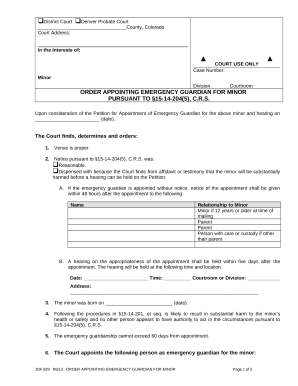
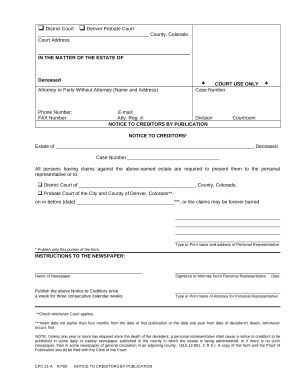
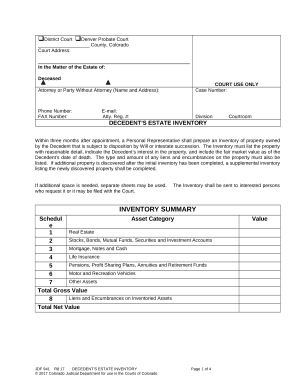
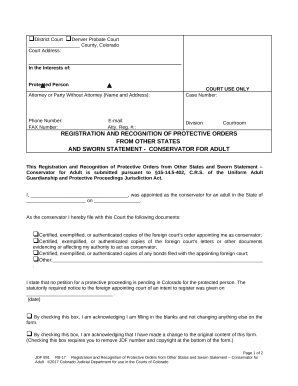
Get and handle Colorado Probate Court Forms online

Boost your form managing with our Colorado Probate Court Forms category with ready-made form templates that meet your requirements. Get your form template, modify it, fill it, and share it with your contributors without breaking a sweat. Start working more effectively with your documents.

The best way to use our Colorado Probate Court Forms:

  1. Open our Colorado Probate Court Forms and find the form you require.
  2. Preview your document to ensure it’s what you want, and click on Get Form to begin working on it.
  3. Edit, include new text, or point out important information with DocHub features.
  4. Prepare your form and preserve the changes.
  5. Download or share your document template with other recipients.

Discover all of the opportunities for your online document administration with our Colorado Probate Court Forms. Get your totally free DocHub profile today!


Commonly Asked Questions about Colorado Probate Court Forms

Under normal circumstances, the total probate process can take six months to several years. The average probate case in Colorado might take approximately 9 to 24 months. Its important to remember that while these timelines are typical, each probate case is unique, and many variables can affect the duration.
Filing fees: One of the initial costs in the probate process is the filing fee, which typically ranges from $200 to $300, depending on the county. This fee covers the cost of submitting the necessary paperwork to the court. Executor fees: Executors are entitled to reasonable compensation for their services.
For formal probate, you must complete and file: JDF 920 - Petition for Formal Probate of Will and Formal Appointment of Personal Representative. JDF 911 - Acceptance of Appointment. JDF 912 - Renunciation and/or Nomination of Personal Representative. JDF 721 - Irrevocable Power of Attorney. JDF 711 - Notice of Hearing.
The probate process in Colorado can be avoided through various strategies such as the use of living trusts, joint ownership arrangements, payable-on-death and transfer-on-death designations, as well as the small estate affidavit.
2024 is $82,000, Y.O.D. 2023 is $80,000; Y.O.D. 2022 is $74,000; Y.O.D. 2021 and 2020 is $70,000; Y.O.D.
Assets subject to probate in Colorado include real estate titled only in the name of the person who died, or other assets they owned if the total combined value is $64,000.00 or more. Someone who dies may have only non-probate assets.
Personal representatives administer wills and estates in Colorado. This role comes with several responsibilities. Understanding what those are and how to fulfill them is crucial to efficient estate administration. Its also essential to avoid any allegations that fiduciary duties may have been bdocHubed.
All wills and intestate estates must be probated. The probate process has been greatly simplified by the Uniform Probate Code, and more than 90% of probates in Colorado are not court supervised.
The probate procedure includes completing a small estate affidavit and filing it with the probate court. Once this is completed and approved by the court, the heirs may collect the decedents assets. This is much quicker and less expensive than both the informal probate and formal probate processes. An Easy Guide to Colorados Probate Process - Ball Morse Lowe ballmorselowe.com blog an-easy-guide-t ballmorselowe.com blog an-easy-guide-t